
Sometimes the PREP Act Does NOT Apply (Part 1)
Did the court system in Maine improperly apply the lawsuit and liability protections provided by the PREP Act in the case of Jeremiah Hogan v. Lincoln Medical Partners?

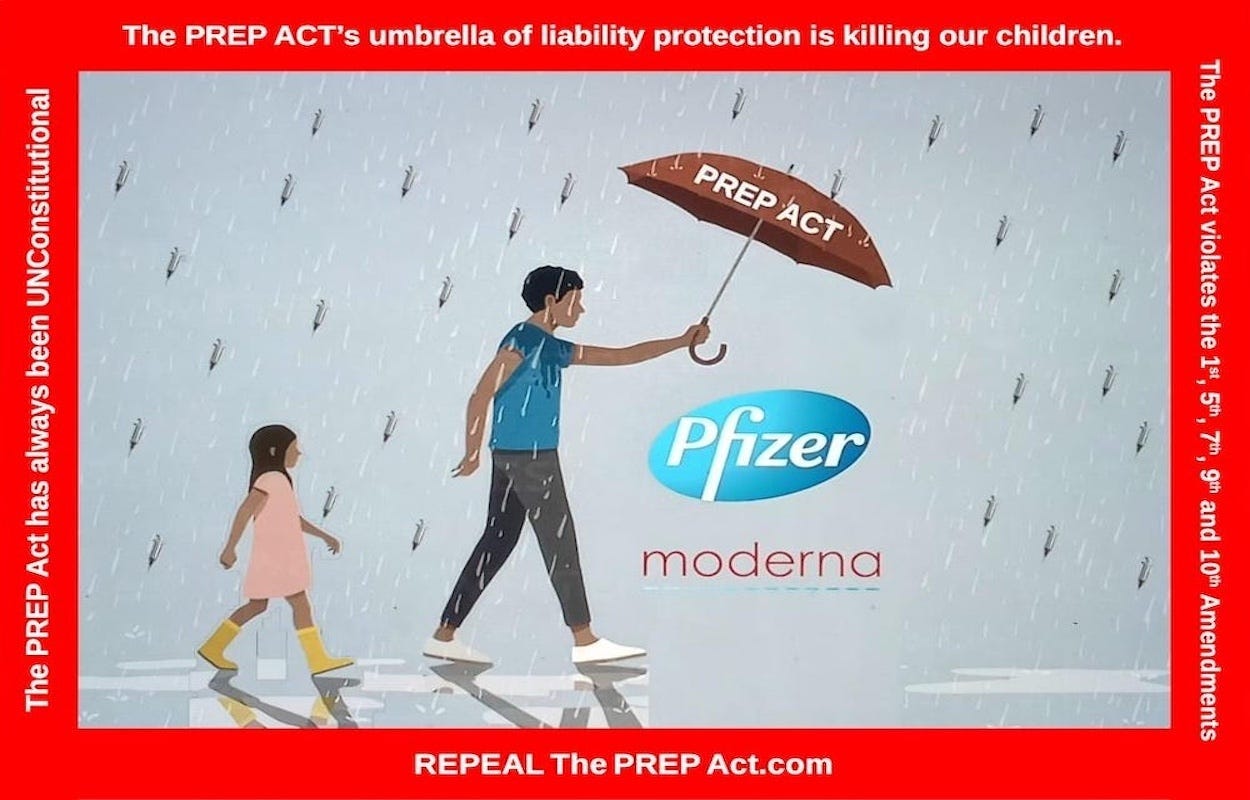
Please watch this interview with Larry Becraft:
https://rumble.com/v6yvax4-an-interview-with-larry-becraft.html

Jeremiah Hogan, et al v. Lincoln Medical Partners, et al
At a school clinic held in November 2021, Lincoln Medical administered the Pfizer-BioNTech mRNA COVID-19 vaccine to Jeremiah Hogan and Siara Jean Harrington’s FIVE-YEAR-OLD CHILD without having obtained parental consent to the vaccination.
Hogan filed a notice of claim pursuant to the Maine Health Security Act, in the Superior Court against the doctor who administered the vaccine (Russ), the corporation for which the doctor worked (Lincoln Medical Partners), and that corporation’s parent company (MaineHealth, Inc.). Framed as a multi-count civil complaint for medical malpractice, Hogan’s notice alleged claims against all defendants on behalf of the child for
professional negligence,
systemic professional negligence,
battery, and
false imprisonment.
The notice alleged three additional tort claims against all defendants on behalf of the parents:
intentional infliction of emotional distress,
negligent infliction of emotional distress, and
tortious interference with parental rights.
Finally, the notice alleged negligent supervision against the corporate defendants on behalf of the child and parents.
https://www.courts.maine.gov/courts/sjc/lawcourt/2025/25me022.pdf
Please note that “harm caused by the injection” is not included in the claims above.
The Hogan v. Lincoln Medical Partners case is NOT about vaccine harm. It is about the violation of bodily autonomy and parental rights that are supposed to be protected by the 14th Amendment.
Even though it is absolutely horrible and must be repealed, the PREP Act unconstitutionally only protects those who cause harm by administering “covered countermeasures.”
The PREP Act does NOT protect against criminal prosecution.
The PREP Act does NOT protect those who infringe upon Constitutionally protected rights or violate state laws governing the general practice of medicine. (See below and also see Part 2 of this article, coming soon.)
The Maine Superior Court dismissed the Hogan v. Lincoln Medical Partners case and the parents appealed the judgment to the Maine Supreme Judicial Court, which also dismissed the case, stating the following:
Because we agree with the trial court that federal law [the PREP Act] confers immunity on Lincoln Medical and preempts state law that would otherwise allow Hogan to sue, we affirm the judgment.
https://www.courts.maine.gov/courts/sjc/lawcourt/2025/25me022.pdf
Due to the specific details of this case, the Maine Supreme Judicial Court may have ruled in error.
On June 2, 2025, the parents submitted a Petition for a Writ of Certiorari (Jeremiah Hogan v. Lincoln Medical Partners) to the United States Supreme Court seeking a review of the decisions handed down by the Maine Supreme Judicial Court.
Respondents (Lincoln Medical Partners) requested that the time for filing a response be extended by four weeks, to and including September 26, 2025.
A conference is scheduled for September 29, 2025.
The U.S. Supreme Court typically receives between 7,000 and 8,000 petitions for review each year, but it only agrees to hear about 80 to 150 of those cases, with fewer than 100 often resulting in full opinions after oral arguments.
By law, the U.S. Supreme Court's term begins on the first Monday in October (October 6, 2025) and goes through the Sunday before the first Monday in October of the following year (October 4, 2026).
Will the Supreme Court hear the case or ignore it?
Will the Supreme Court send the case back to the Maine courts?
Will the Supreme Court entertain a challenge to the constitutionality of the PREP Act?

Excerpts from the Petition for a Writ of Certiorari:
The U.S. Constitution does not grant to Congress any power or authority to regulate health matters within the jurisdiction of the States as such power is a part of the “police power” constitutionally reserved to the States.
I. PREP Act immunity provisions exceed the enumerated powers of Congress.
There are serious constitutional problems with Maine’s reading of the PREP Act, § 247d–6d. First, there are serious constitutional problems with Maine’s reading of the PREP Act, § 247d–6d. First, Congress lacks the constitutional authority to mandate or authorize any vaccine requirement or any immunity pertaining to vaccine administration within the territorial jurisdictions of the States since such a power is one falling within the police powers reserved to the States under the Tenth Amendment.
This section violates principles against Congressional “commandeering” because it arguably requires state courts to dismiss valid state lawsuits which are perfectly proper and valid under state law, denying the people remedies at law for tortious interference with their rights.
III. Confusion and conflict in state courts needs resolution.
In deciding whether or not state law has been completely preempted under federal law, a number of federal district courts have concluded that the PREP Act does not preempt state law medical malpractice and negligence claims when those claims arise from independent legal duties or the “proper standards of general medical [] care, not the administration or use of certain drugs, biological products, or devices, i.e., the countermeasures covered under the PREP Act.” Dupervil v. Alliance Health Operations, 516 F. Supp. 3d 238, 257 (E.D.N.Y. 2021);
It is state courts that must decide if a plaintiff’s claims fall within the PREP Act’s immunity provision. If the answer is no, there is no federal law left to apply and the case proceeds under state law.
Whether a claim asserts causality of injury directly from the use or administration of a countermeasure or from the breach of an independent legal duty apart from the countermeasure itself is not only critical to jurisdiction, but to the determination of the question of immunity under the PREP Act. The Supreme Judicial Court of Maine here, as well as the Supreme Court of Vermont in Politella v. Windham Southeast School District, 2024 VT 43 (2024), did not undertake any analysis of this factor.
The Maine Supreme Court, in Petitioners’ case of forcible vaccination without parental consent, failed to distinguish constitutional claims from other state tort claims, nor to engage in any analysis of the causality of injuries which arise from breaches of independent legal duties (unrelated to countermeasures).
V. Interstate commerce powers do not validate the PREP Act’s preemptive grant of immunity
Congress has no constitutional authority to mandate that the Maine legislature change Maine tort law (both common law and statutory) so that such laws are suspended whenever a particular federal official so declares. Most importantly, the federal government has no constitutional power to direct the state courts in Maine to dismiss valid lawsuits filed there on grounds that medical professionals are immunized from injury caused by breaches of legal duties and standards of care when “countermeasures” under § 247d-6d are involved.
VI. The constitutional right to court access and a jury trial.
Prior to November 12, 2021, the Petitioners twice refused to give consent to the vaccination of their minor son. On November 12, their son was dropped off at the school he attended. Most likely, he simply walked into the school, where he encountered some adult persons, or even teachers, and then was shuffled to Dr. Russ, who then vaccinated him. But since this shot was not given with consent, the Petitioners possessed a valid cause of action for, at least, assault and battery as well as several other causes of action recognized by the laws and courts of Maine. A party to a lawsuit filed in Maine is entitled to a jury trial. Art. I, § 20 of the Maine Constitution.
However, pursuant to § 247d–6d(a)(1), [of the PREP Act] the Maine Supreme Judicial Court held that the Respondents had immunity from the Petitioners’ suit for damages.
This process of leaving injured parties without a real remedy or access to the courts in their own state, and without the right to a jury trial there, is violative of both substantive and procedural due process. “The right to sue and defend in the courts is the alternative of force. ... It is one of the highest and most essential privileges of citizenship ... granted and protected by the federal constitution.”
Chambers v. Baltimore & Ohio R.R. Co., 207 U.S. 142, 148 (1907). “The right of access to the courts is basic to our system of government, and it is well established today that it is one of the fundamental rights protected by the Constitution.”
Ryland v. Shapiro, 708 F.2d 967, 971 (5th Cir. 1983). See also Granfinanciera, S.A. v. Nordberg, 492 U.S. 33, 52 (1989) (Congress cannot “conjure away the Seventh Amendment by mandating that traditional legal claims be ... taken to an administrative tribunal.”).
“When a matter from its nature is the subject of a suit at the common law, Congress may not withdraw it from judicial cognizance.” Sec. & Exch. Comm’n v. Jarkesy, 144 S.Ct. 2117, 2139 (2024).
Clearly, the deprivation of a trial with a jury is a grievous violation of due process, a fundamental right unconstitutionally abridged by § 247d-6d.
VII. The constitutional rights to parental control and bodily integrity.
Minor son Petitioner J.H. has a constitutional right to bodily integrity, and his Petitioner parents have the legal right to protect his rights by means of the lawsuit they filed. If the PREP Act purports to authorize “covered persons” to administer vaccines in violation of state law, even to those who object thereto, then the PREP Act abridges both the constitutional right to bodily integrity and the fundamental liberty interest of the parents in the welfare and health of their child.
This Court has taken the opportunity to recognize these constitutional rights a number of times. “The protections of substantive due process have for the most part been accorded to matters relating to marriage, family, procreation, and the right to bodily integrity.” Albright v. Oliver, 510 U.S. 266, 272 (1994).
The “‘liberty’ specially protected by the Due Process Clause [of the Fourteenth Amendment] includes the right[] ... to bodily integrity.” See Washington v. Glucksberg, 521 U.S. 702, 720 (1997). This Court has “never retreated ... from [its] recognition that any compelled intrusion into the human body implicates significant, constitutionally protected privacy interests.” Missouri vs McNeely, 569 U.S. 141, 148 (2013).
Parents generally share in their child’s rights. Parham v. J.R., 442 U.S. 584, 600 (1979) (“[S]ince [the child’s] interest is inextricably linked with the parents’ interest in and obligation for the welfare and health of the child, the private interest at stake is a combination of the child’s and parents’ concerns.”). And parental rights are a “fundamental liberty interest” under the Fourteenth Amendment. Santosky v. Kramer, 455 U.S. 745, 753 (1982).
The PREP Act creates a machinery for the abridgement of these constitutional rights. The Maine Supreme Judicial Court, and other state supreme courts, with the exception of the Supreme Court of North Carolina, have ignored these federally protected rights in deciding the PREP Act preempts state law protecting the rights of persons against common law battery and tortious interference with parental rights.
VIII. The unconstitutional “commandeering” of the courts of the states.
Here, Petitioners sued Respondents in a state court in Maine and had available to them a trial by jury. No state law in Maine authorized dismissal by its judges of this perfectly valid lawsuit; instead, this suit was dismissed based solely on the authority of § 247d-6d, which “commandeers” the dismissal of state cases like this one. Federal commandeering of the state judicial apparatus is unconstitutional.
The PREP Act does not affect state court cases that do not involve an injury caused by the use of a covered countermeasure by a covered person during a declared emergency. For example, state suits involving nursing homes where patients were injured or harmed by something other than a “covered countermeasure” (such as poor or negligent care) have not been preempted. See
Maglioli v. Alliance HC Holdings LLC, 16 F.4th 393, 400 n.2 (3rd Cir. 2021);
Mitchell v. Advanced HCS, L.L.C., 28 F.4th 580 (5th Cir. 2022);
Saldana v. Glenhaven Healthcare LLC, 27 F.4th 679 (9th Cir. 2022);
Martin v. Petersen Health Operations, LLC, 37 F.4th 1210 (7th Cir. 2022);
Hudak v. Elmcroft of Sagamore Hills, 58 F.4th 845, 853 (6th Cir. 2023) (The PREP Act “does not completely preempt claims that do not allege willful misconduct related to the administration or use of covered COVID-19 countermeasures.”); and
Solomon v. St. Joseph Hospital, 62 F.4th 54 (2nd Cir. 2023) (claims for malpractice, negligence, and gross negligence do not fall within the scope of the PREP Act’s exclusive federal cause of action).
Contrary to the limits on immunity recognized in these federal court decisions, the PREP Act has been broadly applied by many state courts to dismiss a large number of otherwise meritorious cases filed in those courts.
- - - - -
REASONS FOR GRANTING THE WRIT
In this case, the son of the parent Petitioners was administered, without their consent, a Pfizer vaccine at school on November 12, 2021. At a minimum, such action constitutes a common-law battery, a cause of action recognized in every State in this country. Under Maine’s common law of torts, a defendant is liable for “assault and battery” if the defendant, without permission or privilege, unlawfully touches the person of another “with the intention of bringing about a harmful or offensive contact.” Wilson v. State, 268 A.2d 484, 486-87 (Me. 1970). In such a suit filed in a state court in Maine, the plaintiff is entitled to a jury trial, pursuant to Section 20 of Article I, Declaration of Rights, of the Maine Constitution.
The PREP Act, if read and applied as the Maine Judicial Supreme Court did in Petitioners’ case, unconstitutionally deprives parties injured by the administration of countermeasures approved by the Secretary from filing any lawsuit for the recovery of damages in a state court where they live.
- - - - - -
There are many threats to liberty and due process within the PREP Act. There are constitutional missteps with the apparent attempt by Congress to impose laws regarding health (especially vaccines) not otherwise connected to its interstate commerce power. There are very real problems with preempting state lawsuits filed in state courts for violations of “bodily integrity,” and directing state judges to dismiss those lawsuits pending in their courts that somehow relate to injuries suffered after some federal official declares that an emergency exists. Certainly, such federal statutory machinery violates Petitioners’ and all similar plaintiffs’ due process rights, both substantive and procedural. And most assuredly, this federal scheme undoubtedly violates a state plaintiff’s bodily integrity.
For the reasons noted above, this court should grant certiorari herein, reverse the decision of the Maine Supreme Judicial Court and remand this case back to the courts in Maine for further proceedings.
https://www.supremecourt.gov/DocketPDF/24/24-1242/362150/20250602191002364_Hogan%20petition.pdf

DOCUMENTS:
Maine Supreme Judicial Court Decision:
https://www.courts.maine.gov/courts/sjc/lawcourt/2025/25me022.pdf
Supreme Court Docket:
https://www.supremecourt.gov/search.aspx?filename=/docket/docketfiles/html/public/24-1242.html
Petition:
https://www.supremecourt.gov/DocketPDF/24/24-1242/362150/20250602191002364_Hogan%20petition.pdf
Appendix:
https://www.supremecourt.gov/DocketPDF/24/24-1242/362150/20250602191001864_Hogan%20appendix.pdf
Petition:
Waiver of right to file a response:
Limits to the police power:
The authority of both the federal and state governments are supposed to be limited. The authority known as “police power” is an authority held by the 50 states, NOT by the federal government. Attorney Larry Becraft maintains a list of court decisions that have shown the limits of that authority:
https://home.hiwaay.net/~becraft/PolicePower.html

James Roguski
310-619-3055
JamesRoguski.substack.com/archive

Praying this is fought successfully all the way through the Supreme Court!!! 🙏🏻
The majority of 56% of the people now see the mRNA as causing death...and it won't be long until people realize Big Pharma is an industry into the selling of products to make money...and their products don't work! They break down the internal organs, as they are lab-created substances...designed to make money for the provider. the only thing which belongs in the bloodstream...nutrients from unprocessed healthy food...They create health and energy. Too simple and won't put big bucks into anyone's pocket.