
Happy 16th Anniversary!


For even more information, click here, here, here, here, here and here.
A note to my readers:
I spent the majority of this July, August, September and the first week of October writing a proposal for Congressional legislation to PROHIBIT what most people refer to as “solar geoengineering.”
More accurately referred to as “solar radiation modification,” it basically refers to the following methods that are designed to block the sun in what, in my opinion, is a misguided attempt to counteract “global warming.”
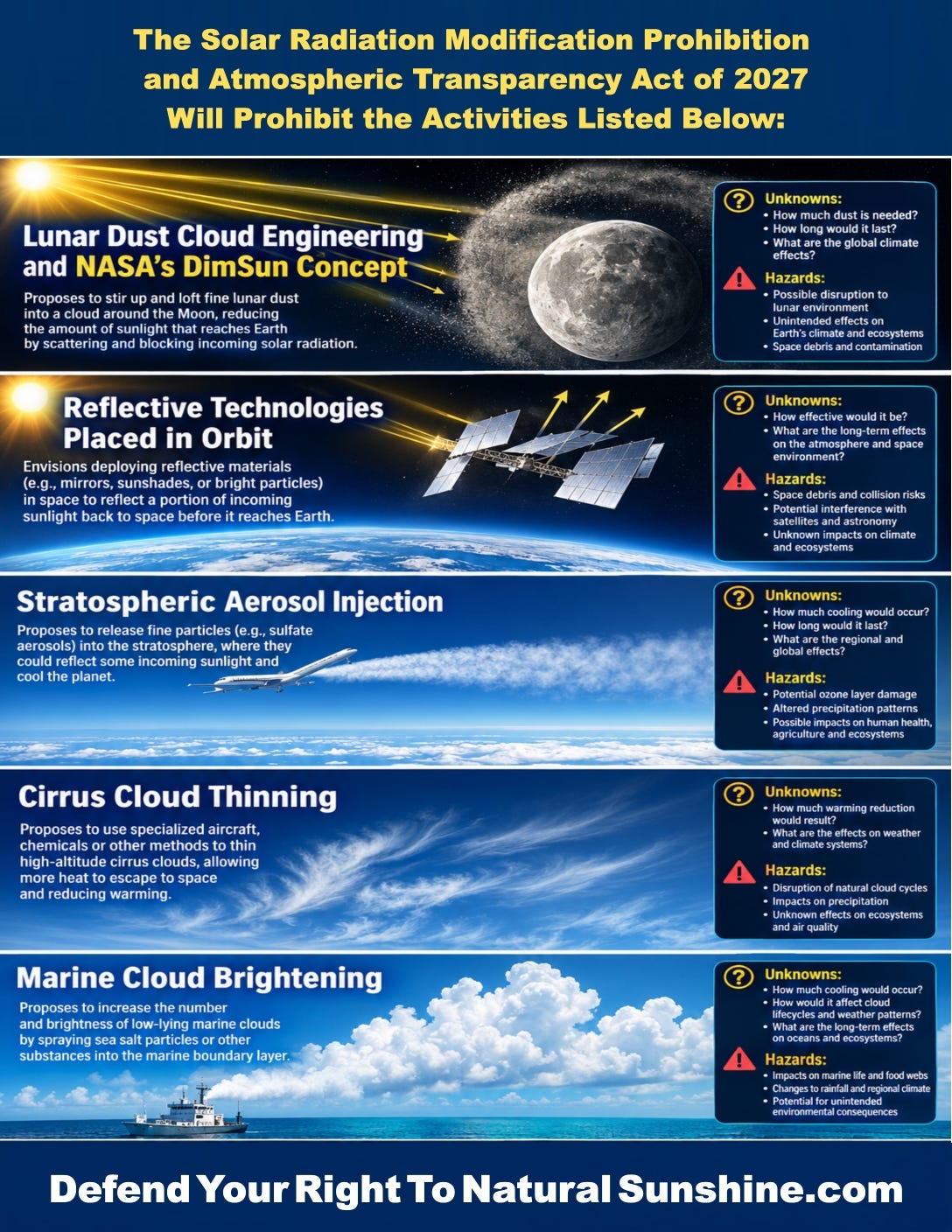
I encourage you to read the proposed Congressional legislation that is available below. At least listen to and read the section-by-section summary that is featured in this article.
If you agree that it should be a crime for governments or corporations attempt to block the sun in response to “global warming,” and if you support this proposed legislation, then please help spread the word!
Please consider this to be a personal invitation from me to you to join the worldwide movement to defend your right to natural sunshine.
JOIN THE MOVEMENT:
CLICK HERE IF YOU LIVE IN THE U.S.
CLICK HERE IF YOU LIVE OUTSIDE THE U.S.
James Roguski
310-619-3055

I have prepared a plain English summary of each section of the proposed legislation and I have also recorded those summaries in audio format so that you can both listen to and read the summaries of each section.
You can download the entire Section-by-Section Summary in PDF format and listen to the full audio that is immediately below:

Listen to the complete audio:
You can click on the “clock” on the far right of the audio and adjust the speed of the recording. I suggest listening at 1.25 or 1.5 times normal speed.
OR, EVEN BETTER…
Scroll down and listen and read along with the highlighted text below one section at a time.


RECOMMENDED COURSE OF ACTION
(Read one section at a time):
I highly recommend that you scroll down in this article in order to listen to, and read each section individually, along with the actual text of the proposed legislation.
I realize that this proposed Congressional legislation is big and complicated. Don’t try to read it all at once. Nibble away at it. Listen to one audio and read one section at a time. Consider the implications. Let it sink in. Give yourself some time to digest it. Then return the next day to listen and read some more.
The summaries of each section of the proposed legislation are in highlighted text in the article below, along with an audio recording of each of the summaries, followed by the full text of each section of the proposed legislation.
If you are patient and persistent, you will certainly be able to read and comprehend this entire proposed legislation. Please take the time to read the entire proposal.


Contact me directly at 310-619-3055 or James.Roguski@gmail.com if you have any questions or if you are interested in volunteering to help in any way.
The Solar Radiation Modification Prohibition and Atmospheric Transparency Act of 2027 is designed with 15 primary purposes:
Listen to the audio:
To prohibit the deployment of all forms of solar radiation modification.
To also prohibit research that could be used to develop or operationalize solar radiation modification.
To also prohibit the full range of conduct that would enable solar radiation modification, including the organizing, planning, financing, conspiring and support and facilitation of solar radiation modification.
To establish the widest range of jurisdiction possible within the guidelines of the Constitution and international agreements.
To provide for criminal penalties, civil, State, Tribal, private and class action remedies.
To establish full personal accountability for governmental officials, employees and contractors.
To amend the Weather Modification Reporting Act of 1972 to remove the exceptions that have allowed the federal government, federal agents, federal contractors, the military and classified programs to potentially act in secrecy.
To end all Federal financing, grants and support for solar radiation modification operational research and testing.
To establish an atmospheric monitoring and reporting network to detect possible violations of the Act.
To protect and expand research that can monitor, detect and assess the risks associated with solar radiation modification.
To require full disclosure of all historical and current solar radiation modification activities from all Federal agencies with public access to all records and radical transparency.
To establish an interagency Task Force to coordinate detection, investigation, response and enforcement of the Act.
To encourage, protect and reward whistleblowers who reveal hidden information leading to enforcement actions.
To authorize a graduated federal response up to and including limited military action as a last resort to enforce the prohibition on solar radiation modification.
To lead a worldwide effort toward a binding international agreement to prohibit solar radiation modification.

The Solar Radiation Modification Prohibition and Atmospheric Transparency Act of 2027:

Working draft for introduction in the 1st Session of the 120th Congress
120TH CONGRESS
1ST SESSION
H. R. ______
IN THE HOUSE OF REPRESENTATIVES
[Date]
Mr./Ms. __________ introduced the following bill;
which was referred to the Committee on __________
A BILL
To prohibit solar radiation modification and the organizing, planning, financing, supporting, and operationalizing conduct that enables it; to establish criminal, civil, private, and class-action remedies, including full personal accountability for governmental actors at every level; to close the Federal reporting exception under the Weather Modification Reporting Act of 1972; to terminate Federal support for prohibited research; to protect monitoring research; to establish a national atmospheric monitoring and detection network; to require radical transparency and public disclosure of Federal weather modification and solar radiation modification research and activity; to protect and reward whistleblowers; to authorize a graduated response, including limited military action if necessary; to advance international governance; to expand the duties and authorities of the Secretary of Commerce; and for other purposes.
Be it enacted by the Senate and House of Representatives of the United States of America in Congress assembled,

TITLE I—GENERAL PROVISIONS
SEC. 1. SHORT TITLE; TABLE OF CONTENTS.
Listen to the audio:
Section 1 gives the proposed legislation its formal short title, the “Solar Radiation Modification Prohibition and Atmospheric Transparency Act of 2027,” and sets out the table of contents. It organizes the bill into 12 titles covering the prohibition of solar radiation modification, criminal and civil enforcement, Federal accountability, atmospheric monitoring, disclosure, whistleblower protections, presidential response, international governance, and general provisions.
(a) Short Title.—This Act may be cited as the “Solar Radiation Modification Prohibition and Atmospheric Transparency Act of 2027”.
(b) Table of Contents.—The table of contents for this Act is as follows:
TITLE I—GENERAL PROVISIONS
SEC. 1. SHORT TITLE; TABLE OF CONTENTS.
SEC. 2. FINDINGS.
SEC. 3. PURPOSES.
SEC. 4. DEFINITIONS.
SEC. 5. RULES OF CONSTRUCTION.
TITLE II—PROHIBITION
SEC. 6. PROHIBITION ON SOLAR RADIATION MODIFICATION AND RELATED CONDUCT.
SEC. 7. JURISDICTION.
SEC. 8. EXCLUSIONS AND PROTECTED ACTIVITY.
SEC. 9. NO AUTHORIZATION; NO DEFENSE; ANTI-EVASION.
TITLE III—CRIMINAL OFFENSES
SEC. 10. SOLAR RADIATION MODIFICATION OFFENSES.
SEC. 11. CONFORMING AND SUPPORTING CRIMINAL-LAW AMENDMENTS.
TITLE IV—CIVIL ENFORCEMENT AND PRIVATE REMEDIES
SEC. 12. FEDERAL CIVIL ENFORCEMENT.
SEC. 13. ADMINISTRATIVE ORDERS AND EMERGENCY AUTHORITY.
SEC. 14. PRIVATE, STATE, TRIBAL, AND CLASS ACTIONS.
SEC. 15. LIABILITY OF GOVERNMENTAL ACTORS; WAIVER OF IMMUNITY.
TITLE V—FEDERAL GOVERNMENT AND FEDERAL CONTRACTORS
SEC. 16. CLOSING THE FEDERAL REPORTING EXCEPTION.
SEC. 17. TERMINATION OF FEDERAL SUPPORT FOR SRM AND PROHIBITED OPERATIONAL RESEARCH.
SEC. 18. ACCOUNTABILITY OF FEDERAL PERSONNEL.
TITLE VI—ATMOSPHERIC MONITORING AND DETECTION
SEC. 19. NATIONAL ATMOSPHERIC INTEGRITY MONITORING NETWORK.
SEC. 20. DETECTION, ATTRIBUTION, AND INVESTIGATION.
SEC. 21. PROTECTION OF AND SUPPORT FOR MONITORING RESEARCH.
TITLE VII—DISCLOSURE AND TRANSPARENCY
SEC. 22. MANDATORY DISCLOSURE OF FEDERAL WEATHER MODIFICATION AND SRM ACTIVITY.
SEC. 23. ATMOSPHERIC RECORDS REVIEW BOARD.
SEC. 24. PUBLIC ACCESS TO RECORDS AND ATMOSPHERIC DATA.
TITLE VIII—SECRETARY OF COMMERCE
SEC. 25. OFFICE OF ATMOSPHERIC INTEGRITY AND ENFORCEMENT; SCIENCE ADVISORY BOARD.
SEC. 26. AMENDMENTS TO THE WEATHER MODIFICATION REPORTING ACT OF 1972.
SEC. 27. REPORTING OF COVERED RELEASES AND TRANSACTIONS; EXPORT CONTROLS.
SEC. 28. INTERAGENCY TASK FORCE AND ENFORCEMENT AUTHORITIES.
TITLE IX—WHISTLEBLOWERS
SEC. 29. WHISTLEBLOWER AWARDS.
SEC. 30. WHISTLEBLOWER AND EMPLOYEE PROTECTIONS.
SEC. 31. ATMOSPHERIC INTEGRITY ENFORCEMENT FUND.
TITLE X—PRESIDENTIAL RESPONSE
SEC. 32. PRESIDENTIAL DETERMINATION AND RESPONSE.
SEC. 33. AUTHORIZATION FOR LIMITED USE OF MILITARY FORCE; SAFEGUARDS.
TITLE XI—INTERNATIONAL GOVERNANCE AND SANCTIONS
SEC. 34. INTERNATIONAL GOVERNANCE OF SRM.
SEC. 35. SANCTIONS AND DIPLOMATIC MEASURES.
TITLE XII—GENERAL PROVISIONS
SEC. 36. RELATIONSHIP TO STATE, LOCAL, AND TRIBAL LAW.
SEC. 37. AUTHORIZATION OF APPROPRIATIONS.
SEC. 38. EFFECTIVE DATE; APPLICABILITY; SEVERABILITY.
SEC. 2. FINDINGS.
Listen to the audio:
Section 2 sets out Congress’s proposed factual and policy basis for the legislation. It asserts that access to natural sunlight is a fundamental interest, distinguishes solar radiation modification from conventional weather modification, and describes concerns about transboundary atmospheric effects, ozone depletion, precipitation changes, ecosystem and agricultural impacts, uncertainty, and the potential for rapid warming if sustained solar radiation modification deployment is interrupted. It also argues that existing Federal reporting requirements, State laws, and international arrangements do not adequately address the risks identified by the bill.
The findings further support a comprehensive framework of prohibition, broad Federal jurisdiction, personal accountability for governmental actors, monitoring, disclosure of historical activities, whistleblower incentives, and international cooperation. This section also references the constitutional authorities on which Congressional action relies.
Congress finds the following:
(1) Every living being possesses an inherent, inalienable right to enjoy unhindered access to unadulterated sunlight, without discrimination based on geography, economic status, race, or nationality. Sunlight is essential to physical and psychological well-being, environmental health, and terrestrial life and is a shared planetary inheritance. No person or nation has a right to deprive others of access to this life-sustaining resource.
(2) Solar radiation modification is distinct from conventional weather modification and requires a clear Federal framework. Its methods include stratospheric aerosol injection, marine cloud brightening, cirrus cloud thinning, space-based reflective technologies, and dust clouds formed from lunar or other extraterrestrial material, undertaken to alter the radiation governing the Earth’s climate or radiative balance.
(3) The atmosphere and the Earth’s radiative systems are interconnected and do not conform to State or national boundaries. Materials introduced into the atmosphere may cross jurisdictional boundaries, persist for months or years, and be impracticable to retrieve. Solar radiation modification may therefore produce effects beyond the location of deployment, affecting public health, the ozone layer, agriculture, forests, transportation, energy production, property, natural resources, ecosystems, and interstate or foreign commerce.
(4) Scientific assessments, including the Scientific Assessment of Ozone Depletion: 2026 prepared under the Montreal Protocol, have identified risks from stratospheric aerosol injection, including ozone loss or delayed ozone recovery. The National Oceanic and Atmospheric Administration, the National Aeronautics and Space Administration, and other scientific institutions contribute to observing and assessing these risks. The United States has a substantial interest in protecting the ozone layer and maintaining the scientific capacity to detect and explain changes affecting its recovery.
(5) Solar radiation modification presents risks to precipitation patterns, agriculture, and ecosystems. Sustained deployment may create dependence on its continuation, and interruption may cause rapid, severe warming. Substantial scientific uncertainty remains concerning the consequences of deployment, continued operation, and termination.
(6) A single governmental or private actor, domestic or foreign, may initiate solar radiation modification that exposes persons and communities to risks they cannot individually consent to, avoid, or withdraw from. The United States has substantial interests in protecting its population, territory, airspace, natural resources, agriculture, infrastructure, economy, national defense, and foreign relations from unauthorized conduct that materially alters atmospheric or radiative conditions.
(7) Prevention before deployment is preferable to remediation after injury. Effective deterrence requires a credible prospect of detection, investigation, attribution, interruption, and predictable and proportionate legal consequences. A comprehensive Federal response should therefore combine monitoring and preventive authority with criminal and civil enforcement, private remedies, appropriate penalties and forfeiture, and measures addressing responsible individuals and organizations.
(8) The Weather Modification Reporting Act of 1972 (15 U.S.C. 330 et seq.) establishes a reporting and record keeping framework rather than a comprehensive prohibition or authorization system for solar radiation modification. It excludes persons acting solely as Federal employees, agents, or independent contractors from its reporting requirement. Although the Act prohibits covered activity undertaken without required reporting, reporting compliance does not itself authorize deployment or establish its safety or legality under other law. Existing Federal statutes may apply to particular conduct or instrumentalities but do not collectively establish the integrated, activity-specific system provided by this Act. Reporting, records preservation, monitoring, disclosure, preventive orders, substantive prohibitions, enforcement, private remedies, and emergency response perform separate and complementary functions.
(9) State law alone cannot adequately address activity whose effects cross State and national boundaries. Tennessee in 2024, and Florida and Louisiana in 2025, adopted prohibitions or restrictions that this Act complements and does not preempt. Mexico announced restrictions on January 13, 2023, further demonstrating governmental concern regarding solar radiation modification.
(10) Existing international law does not provide a comprehensive criminal jurisdictional framework addressing all forms of catastrophic, unilateral solar radiation modification, particularly activity conducted outside the United States. The Conference of the Parties to the Convention on Biological Diversity has addressed climate-related geoengineering through Decisions X/33 (2010), XI/20 (2012), XIII/14 (2016), and XVI/22 (2024). The absence of a comprehensive international regime does not eliminate the interests of the United States in preventing, investigating, and responding to conduct within its lawful jurisdiction.
(11) Solar radiation modification operations may use aircraft, vessels, spacecraft, vehicles, launch infrastructure, communications, financial services, materials, equipment, contracts, grants, procurement, and other channels, instrumentalities, or activities of interstate or foreign commerce. Planning, financing, manufacturing, transportation, and deployment may occur in different jurisdictions, including beyond national territory. Effective prevention therefore requires clearly defined Federal jurisdictional bases, established in each case and consistent with the Constitution and international law.
(12) Secrecy, fragmented records, inconsistent reporting, classification, and restricted access concerning Federal weather modification and solar radiation modification impair scientific scrutiny, public trust, congressional oversight, and democratic accountability. A complete, accurate, and independently reviewable historical and continuing record should encompass activities conducted, funded, authorized, or proposed by Federal entities, including military and intelligence components, and through contractors, grantees, universities, laboratories, foreign entities, or other intermediaries. Disclosure, archiving, and timely public access should preserve legitimate national-security protections while preventing secrecy from concealing conduct prohibited by this Act.
(13) Independent, continuous atmospheric monitoring is essential to detect deployments, support attribution, protect the ozone layer, and distinguish lawful scientific activity from prohibited conduct. No individual community, private organization, or State can reliably provide the necessary capabilities alone. The Federal Government should support interoperable, independently reviewable, and appropriately protected monitoring and data systems serving scientific, administrative, civil, criminal, congressional, and international functions.
(14) A prohibition limited to the person physically conducting deployment would permit evasion through organizational, financial, and logistical intermediaries. Effective prevention requires the prohibition of specified organizing, planning, financing, procurement, preparation, and material support, and liability for persons who direct, authorize, procure, finance, or materially support prohibited activity, subject to the elements and limitations established by Federal law. Deployment and organized preparation to deploy present serious national-security and transboundary concerns warranting appropriate treatment of attempt, conspiracy, and material support.
(15) Governmental status does not reduce the dangers of solar radiation modification. Federal, State, local, Tribal, and foreign governmental actors, and individuals acting for them, should be accountable for prohibited conduct to the extent provided by this Act and permitted by the Constitution and applicable international law.
(16) In February 2026, the Government Accountability Office, in report GAO–26–108013, found that the National Oceanic and Atmospheric Administration was not fully meeting its responsibilities to maintain and share weather-modification reports; estimated that more than half of reports filed likely contained errors; and found that agency forms and processes were not well suited to emerging solar geoengineering activities. These findings demonstrate the need for enforceable reporting standards, records verification, interoperable public data, and sustained congressional oversight.
(17) Persons with knowledge of prohibited planning, financing, procurement, preparation, or deployment may be uniquely positioned to prevent or terminate such activity. Effective deterrence should therefore include meaningful protections and appropriate incentives for persons who promptly disclose relevant information, preserve evidence, and cooperate with lawful investigations, together with appropriate consequences for participation in prohibited conduct.
(18) Independent scientific inquiry is essential to public safety, accountability, and enforcement. Research that observes, monitors, detects, attributes, models, or assesses solar radiation modification and its effects, risks, prevention, termination, or remediation is distinct from research directed toward developing, testing, optimizing, or otherwise establishing a practical capability to conduct prohibited deployment. An effective prohibition must preserve protected research while preventing prohibited operational research, as those terms are defined in this Act.
(19) Congress enacts this Act under article I, section 8, clauses 1, 3, 10, 11 through 16, and 18 of the Constitution; article IV, section 3, clause 2; and other applicable constitutional authority. Congress intends this Act to protect substantial Federal interests through the broadest jurisdiction consistent with the Constitution and international law.
SEC. 3. PURPOSES.
Listen to the audio:
Section 3 identifies 15 purposes for the legislation. These include prohibiting solar radiation modification and operational research that could enable it; prohibiting planning, financing, supporting, and facilitating conduct; establishing broad jurisdiction; creating criminal, civil, private, State, Tribal, and class-action remedies; and holding individuals acting for governments personally accountable.
The remaining purposes are to close the Federal reporting exception under the Weather Modification Reporting Act of 1972, end Federal support for solar radiation modification, establish a monitoring network, protect research that detects and assesses solar radiation modification, require public disclosure of historical and current activities, expand the authorities of the Secretary of Commerce and an interagency task force, reward and protect whistleblowers, authorize a graduated Federal response that may include limited military action, and advance international governance.
I encourage you to also read the Executive Summary of the 15 Purposes of the Solar Radiation Modification Prohibition and Atmospheric Transparency Act of 2027.
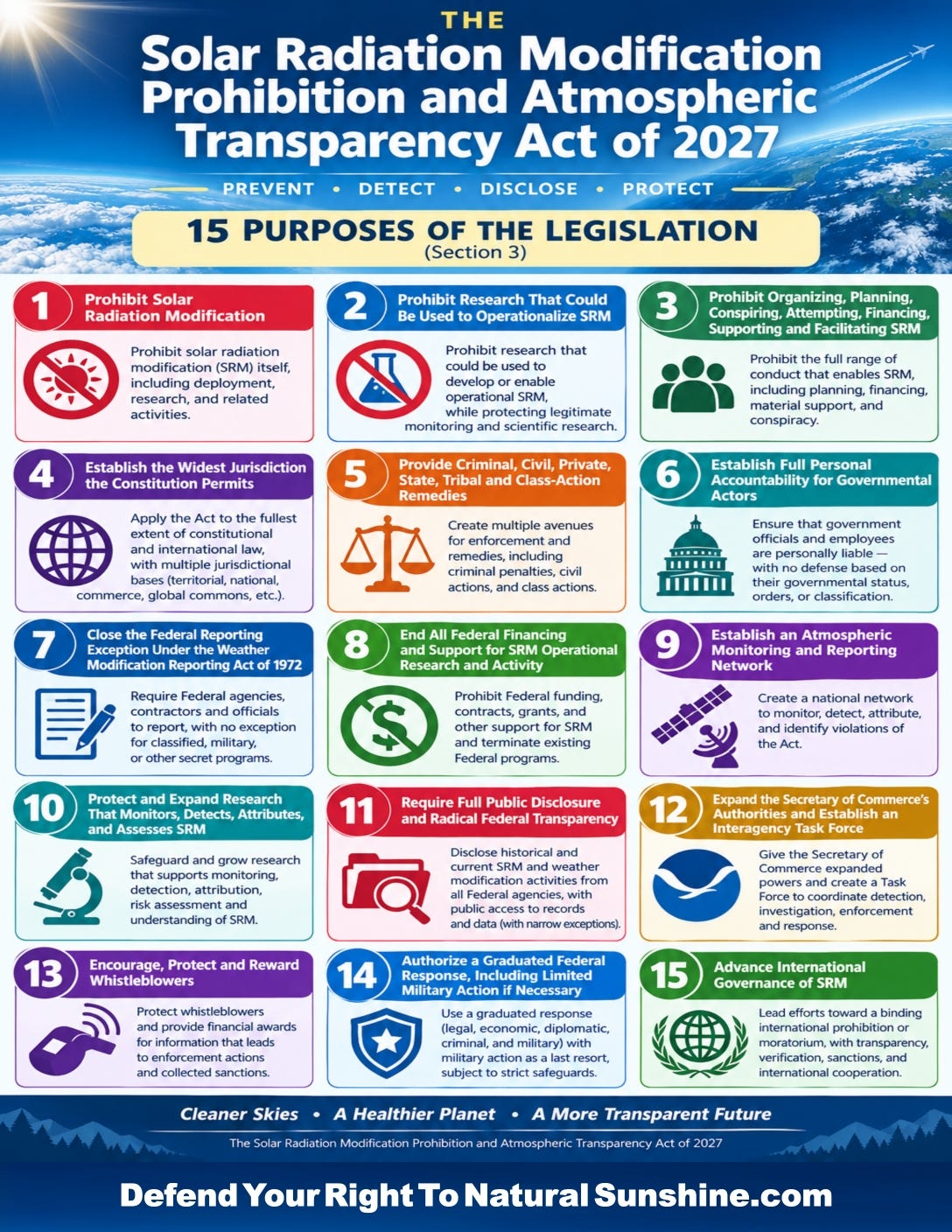
The purposes of this Act are—
(1) to prohibit solar radiation modification;
(2) to prohibit research that could be used to operationalize solar radiation modification;
(3) to prohibit organizing, planning, conspiring, attempting, financing, supporting, and facilitating solar radiation modification, and the related activities that any such operation would require;
(4) to establish the widest jurisdiction the Constitution permits;
(5) to provide for criminal, civil, private, State, Tribal and class-action remedies;
(6) to include full personal accountability for individuals acting as governmental employees, agents, or contractors at any level of government;
(7) to close the Federal reporting exception under the Weather Modification Reporting Act of 1972;
(8) and to end all Federal financing of and support for SRM operational research and activity;
(9) to establish an atmospheric monitoring and reporting network capable of identifying violations;
(10) to protect and expand research that helps monitor, detect, attribute, and assess solar radiation modification;
(11) to require full public disclosure of unreported weather modification activity and solar radiation modification research and testing, and radical transparency from every Federal department and agency, including the military;
(12) to expand the authorities of the Secretary of Commerce and a Task Force of government agencies empowered to stop SRM operational research, planning and other S RM activity.
(13) to encourage, protect, and reward whistleblowers;
(14) to authorize a graduated Federal response, including limited military action if necessary; and
(15) to advance international governance of solar radiation modification.
SEC. 4. DEFINITIONS.
Listen to the audio:
Section 4 defines the terms used throughout the bill, including “solar radiation modification,” “SRM activity,” “SRM deployment,” “SRM system,” “covered material,” “covered enabling item,” “prohibited operational research,” and “protected research.” Its definition of solar radiation modification is broad and technology-neutral, covering interventions intended to alter incoming solar radiation or outgoing terrestrial radiation, regardless of the method, location, altitude, scale, duration, or label used to describe the activity.
The definitions encompass stratospheric aerosol injection, marine cloud brightening, cirrus cloud modification, space-based reflective technologies, and lunar or extraterrestrial dust-cloud engineering. The section also defines catastrophic harm, Federal agencies and contractors, governmental actors, material support, operational planning, and other terms needed to establish jurisdiction and liability. These definitions are especially consequential because they determine the reach of the bill’s prohibitions, enforcement powers, and protected-research exceptions.
In this Act:
(1) Administrator.—The term “Administrator” means the Under Secretary of Commerce for Oceans and Atmosphere and Administrator of the National Oceanic and Atmospheric Administration.
(2) Appropriate Congressional Committees.—The term “appropriate congressional committees” means the Committees on Energy and Commerce, Science, Space, and Technology, the Judiciary, Armed Services, Foreign Affairs, and Oversight and Government Reform of the House of Representatives, and the Committees on Commerce, Science, and Transportation, the Judiciary, Armed Services, Foreign Relations, and Homeland Security and Governmental Affairs of the Senate, and, with respect to classified matters, the congressional intelligence committees.
(3) Armed Forces.—The term “Armed Forces” has the meaning given in section 101 of title 10, United States Code.
(4) Atmosphere.—The term “atmosphere” means the gaseous envelope of the Earth, including the troposphere, stratosphere, mesosphere, thermosphere, and exosphere, and the clouds, aerosols, and particles within it.
(5) Catastrophic Harm.—The term “catastrophic harm” means any of the following, resulting from SRM activity:
(A) The death of, or serious bodily injury to, multiple persons.
(B) Crop failure, famine, or displacement of populations.
(C) Damage to ecosystems or natural resources.
(D) Damage to, or delayed recovery of, the stratospheric ozone layer.
(E) Disruption of a regional or global climate, hydrological, oceanic, or ecological systems.
(6) Covered Enabling Item.—The term “covered enabling item” means—
(A) an SRM system;
(B) any item specially designed, modified, or configured for use in SRM deployment; and
(C) any covered material in a quantity, form, purity, or combination that the Secretary has designated by rule as reasonably indicative of SRM deployment.
(7) Covered Material.—The term “covered material” means a substance or material that the Secretary has designated by rule as capable of use in SRM deployment, including, but not limited to, aluminum oxide, barium titanate, black carbon (soot), calcium carbonate, carbon nanoparticles, diamond dust, dolomite, hydrogen sulfide, ice-nucleating agents, magnesium sulfate, magnesite, sea-salt aerosol formulations, self levitating nano-disks, silicon carbide, silicon dioxide, amorphous silica or other silicates, sodium bicarbonate, sodium chloride, sulfuric acid, sulfur dioxide, titanium dioxide, zinc carbonate, zinc oxide, zirconium dioxide and their precursors.
(8) Federal Agency.—The term “Federal agency” means any department, agency, office, establishment, instrumentality, or corporation of the Federal Government, including the Executive Office of the President, each military department, each element of the intelligence community, and each independent regulatory agency.
(9) Federal Contractor.—The term “Federal contractor” means any person, at any tier, that is a party to or performs work under a contract, subcontract, grant, subgrant, cooperative agreement, other transaction, license, lease, prize, or similar arrangement with or funded in whole or in part by a Federal agency, including any university, laboratory, federally funded research and development center, consortium, employee, or agent of such a person.
(10) Federal Support.—The term “Federal support” means any appropriation, allotment, funds, grant, cooperative agreement, contract, loan, loan guarantee, subsidy, prize, fellowship, in-kind assistance, technical or scientific assistance, personnel, facility, laboratory, test range, aircraft, spacecraft, vessel, computing resource, data, software, or other Federal property or resource, whether provided directly or through an intermediary.
(11) Foreign Government.—The term “foreign government” includes a “foreign state” as defined in section 1603(a) of title 28, United States Code, and any agency, instrumentality, or official of a foreign state.
(12) Global Commons.—The term “global commons” means areas beyond the national jurisdiction of any State, including the high seas, Antarctica and the international airspace and the atmosphere above them, and outer space.
(13) Governmental Entity.—The term “governmental entity” means the Federal Government, a State, a political subdivision of a State, an Indian Tribe, a foreign government, and any agency, instrumentality, authority, corporation, or enterprise of any of them.
(14) Government Official.—The term “government official” means any individual who is an officer, employee, elected or appointed official, member of the Armed Forces or of a foreign armed force or agent of a governmental entity, whether or not acting in an official capacity.
(15) Indian Tribe.—The term “Indian Tribe” has the meaning given in section 4 of the Indian Self-Determination and Education Assistance Act (25 U.S.C. 5304).
(16) Individual.—The term “individual” means a natural person, whether acting in a personal, official, representative, or contractual capacity.
(17) Material Support or Resources.—The term “material support or resources” has the meaning given in section 2339A(b)(1) of title 18, United States Code, and also includes launch, flight, and payload-integration services, aircraft, balloons, vessels, spacecraft, covered enabling items, and any operational plan.
(18) Network.—The term “Network” means the National Atmospheric Integrity Monitoring Network established under section 19.
(19) Operational Planning.—The term “operational planning” means formulating, designing, drafting, adopting, approving, or refining a concrete plan to carry out SRM deployment that is specific enough that, if executed, it would result in SRM deployment (such as a plan identifying, in combination, a method, materials or platforms, a location or region, and timing, quantity, or funding). The term does not include modeling, scenario analysis, risk assessment, or study undertaken to evaluate SRM or to inform governance decisions.
(20) Organization.—The term “organization” means any entity other than an individual, including a corporation, company, partnership, association, joint venture, trust, foundation, nonprofit organization, educational or research institution, consortium, special-purpose entity, and any governmental entity.
(21) Person.—The term “person” means an individual or an organization, and includes any Federal agency, Federal contractor, and other governmental entity, to the full extent consistent with the Constitution and with any immunity that is not waived by this Act.
(22) Prohibited Operational Research.—
(A) In General.—The term “prohibited operational research” means any research, development, test, evaluation, engineering, or demonstration activity, by any person, that—
(i) is or includes SRM deployment;
(ii) designs, develops, fabricates, integrates, tests, validates, demonstrates, or improves an SRM system, or a material, particle, or formulation for use in an SRM system, with the purpose or knowledge that the activity will directly and materially establish, validate, or improve a practical capability to conduct SRM deployment;
(iii) produces or refines an operational deployment specification, including a concept of operations, deployment strategy, injection or release schedule, rate, altitude, or location plan, control or feedback algorithm for deployment, logistics plan, or engineering design, with the purpose or knowledge that the specification is intended to enable SRM deployment; or
(iv) is otherwise undertaken with the purpose or knowledge that it will directly and materially establish, validate, or improve a practical capability to conduct SRM deployment.
(B) Relationship to Protected Research.—Research described in section 8(b) is protected research, subject to the classification rules in subparagraph (C). An activity that is or includes SRM deployment is not protected research, regardless of whether the deployment is undertaken to obtain scientific information, assess risks, or support another activity described in section 8(b).
(C) Classification of Research Activities.—For purposes of this paragraph and section 8(b)—
(i) Classification shall be based on the activity’s actual purpose, design, conduct, intended use, and reasonably expected practical outputs, as established by objective evidence and the applicable purpose or knowledge requirement.
(ii) An activity does not constitute prohibited operational research solely because its findings, data, methods, or instruments could subsequently be used by another person to support SRM deployment, or because it advances general scientific understanding relevant to SRM.
(iii) An activity does not constitute protected research solely because it is described as monitoring, assessment, laboratory research, theoretical research, safety research, or another protected category, if its actual purpose and practical function satisfy subparagraph (A)(ii), (iii), or (iv).
(iv) Where an undertaking contains separately identifiable activities, each activity shall be classified according to its own purpose, conduct, intended use, and practical outputs. A protected activity does not become prohibited solely because it is conducted within the same institution, program, or undertaking as a prohibited activity. A prohibited activity does not become protected because it is combined with a protected activity.
(v) Where an activity serves both a purpose described in section 8(b) and a purpose described in subparagraph (A)(ii), (iii), or (iv), the activity is prohibited if the operational purpose or knowledge required by the applicable provision is established. The operational purpose need not be the activity’s sole or predominant purpose.
(vi) Where the available evidence does not establish the elements of prohibited operational research under the applicable standard of proof, uncertainty concerning classification does not, by itself, establish a violation. This clause does not prevent a lawful investigation, a request for information, or an application for prospective relief upon satisfaction of the requirements otherwise applicable under this Act.
(23) Protected Research.—The term “protected research” means research and related activity described in section 8(b).
(24) Radiative Balance.—The term “radiative balance” means the balance between incoming solar radiation and outgoing terrestrial radiation, including the amount, distribution, and spectrum of radiation absorbed, reflected, scattered, transmitted, or emitted by the atmosphere, clouds, or the surface of the Earth.
(25) Secretary.—The term “Secretary” means the Secretary of Commerce.
(26) Serious Bodily Injury.—The term “serious bodily injury” has the meaning given in section 1365(h)(3) of title 18, United States Code.
(27) Solar Radiation Modification; SRM.—
(A) In General.—The terms “solar radiation modification” and “SRM” mean any intervention in the atmosphere, in near-Earth space, in outer space, or on the surface of the Earth that reflects, scatters, absorbs, blocks, filters, redirects, or otherwise alters incoming solar radiation or outgoing terrestrial radiation in order to alter the temperature, climate, weather, or radiative balance of the Earth or of any region of the Earth, regardless of the scale, duration, location, altitude, or technology of the intervention; regardless of whether it is characterized as research, experiment, test, trial, demonstration, pilot, commercial venture, weather modification, climate intervention, geoengineering, or by any other name; and regardless of whether it produces any measurable effect.
(B) Technology-Neutral.—Whether an intervention is SRM does not depend on the substance, material, device, platform, altitude, or technology employed, including any method now known or hereafter devised.
(C) Exclusions.—The exclusions in section 8(a) apply to this paragraph.
(28) SRM Activity.—The term “SRM activity” means SRM deployment and any conduct described in section 6(b).
(29) SRM Deployment.—The term “SRM deployment” means the release, injection, dispersal, emplacement, launch, positioning, activation, or operation of any substance, material, device, structure, or system as part of SRM, including any test, experiment, or trial of any scale, whether or not it is completed or produces any effect.
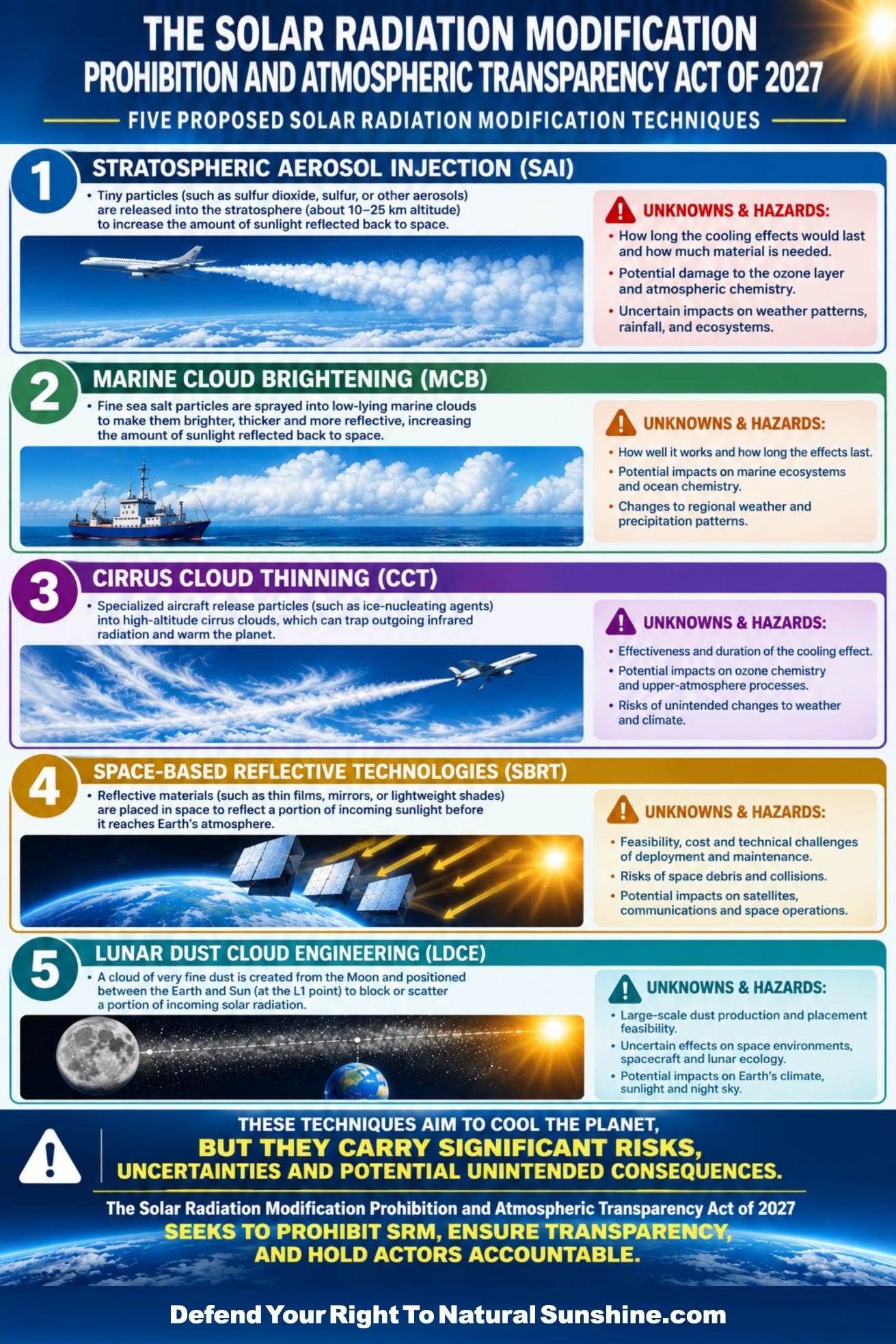
(30) SRM Method.—The term “SRM method” includes, without limitation—
(A) stratospheric aerosol injection, including the introduction of reflective or radiatively active particles, gases, or precursors into the stratosphere or upper atmosphere;
(B) marine cloud brightening, including the introduction of sea-salt or other particles into marine clouds or the marine boundary layer;
(C) cirrus cloud thinning or modification, including seeding of upper-tropospheric clouds to alter their radiative properties;
(D) space-based reflective technologies, including mirrors, reflectors, sunshades, shields, solar panels associated with mega-constellations of orbiting satellites, and orbital particle rings or clouds placed in Earth orbit or at any Sun-Earth Lagrange point;
(E) lunar or extraterrestrial engineering, including the extraction, processing, launch, or deployment of lunar or other extraterrestrial material to form dust clouds or other structures that alter solar radiation reaching the Earth;
(F) any other method, technique, or technology, now known or hereafter devised, that satisfies paragraph (28), including any method the Secretary designates under section 8(f).
(31) SRM System.—The term “SRM system” means any substance, material, device, apparatus, aircraft, balloon, rocket, vessel, spacecraft, platform, payload, dispersal or delivery system, control system, or software designed, adapted, or used for SRM deployment.
(32) United States.—The term “United States” includes the several States, the District of Columbia, the territories and possessions of the United States, the territorial sea and airspace of the United States, and every place within the special maritime and territorial jurisdiction or the special aircraft jurisdiction of the United States.
(33) United States Person.—The term “United States person” means a citizen or national of the United States, an alien lawfully admitted for permanent residence, and an organization organized under the laws of the United States or any State or having its principal place of business in the United States, and any organization controlled by any of them.
(34) Unreported Weather Modification Activity.—The term “unreported weather modification activity” means weather modification activity, wherever and whenever conducted, that was required to be reported under the Weather Modification Reporting Act of 1972 (15 U.S.C. 330 et seq.) but was not, and any weather modification activity conducted by or for a Federal agency or Federal contractor that was not reported to the Secretary, whether or not reporting was then required.
(35) Weather Modification; Weather Modification Activity.—The terms “weather modification” and “weather modification activity” have the meaning given “weather modification” in section 1 of the Weather Modification Reporting Act of 1972 (15 U.S.C. 330).
SEC. 5. RULES OF CONSTRUCTION.
Listen to the audio:
Section 5 establishes interpretive rules for the Act. Reporting, registration, disclosure, or archival compliance cannot be treated as authorization to conduct otherwise prohibited solar radiation modification activity, and the remedies provided by the bill are cumulative rather than exclusive of other available legal remedies.
It directs that the prohibitions be construed to accomplish the bill’s purposes and that exclusions and protections be applied according to their terms. It also requires constitutional interpretation, expressly protects First Amendment belief, opinion, and expression, and preserves other Federal authority to investigate, prevent, or punish the conduct covered by the bill.
(a) Reporting Is Not Authorization.—Reporting, registration, disclosure, or archival requirements under any law do not authorize, license, approve, or permit any activity prohibited by this Act, and compliance with them is not a defense.
(b) Cumulative Remedies.—The remedies in this Act are cumulative and in addition to any other remedy under Federal or State law.
(c) Broad Construction of Prohibitions; Narrow Construction of Exclusions.—The prohibitions in this Act shall be construed to accomplish their purposes, and the exclusions and protections in section 8 shall be construed according to their terms.
(d) Constitutional Construction.—This Act shall be construed consistent with the Constitution. No provision shall be construed to punish belief, opinion, or expression that is protected by the First Amendment.
(e) No Implied Repeal.—Nothing in this Act repeals or limits any other Federal authority to investigate, prevent, or punish conduct prohibited by this Act.
TITLE II—PROHIBITION
SEC. 6. PROHIBITION ON SOLAR RADIATION MODIFICATION AND RELATED CONDUCT.
Listen to the audio:
Section 6 is the bill’s central substantive prohibition. It prohibits any person from engaging in, causing, or directing solar radiation modification deployment. Even when no deployment occurs, it also prohibits a wide range of associated conduct, including organizing, authorizing, operational planning, financing, manufacturing, acquiring, possessing, transporting, supplying, attempting, conspiring, soliciting, and materially supporting solar radiation modification activity or prohibited operational research.
The section additionally prohibits concealment, destruction or falsification of evidence, obstruction of investigations or monitoring, shielding participants or property to prevent detection, and specified retaliation. It applies to Federal agencies, Federal contractors, governmental entities, and government officials, including in classified, covert, military, intelligence, or emergency programs. Violations are subject to the bill’s criminal and civil enforcement provisions.
(a) SRM Deployment.—No person may engage in, cause, or direct SRM deployment.
(b) Related Conduct.—Whether or not deployment occurs, no person may—
(1) organize, direct, lead, supervise, recruit for, or authorize SRM activity;
(2) engage in operational planning;
(3) finance SRM activity, including by providing, arranging, soliciting, managing, lending, guaranteeing, underwriting, insuring, or indemnifying money, credit, or other financial resources;
(4) develop, manufacture, procure, acquire, possess, store, transport, import, export, supply, or provide any SRM system or covered enabling item;
(5) attempt, conspire, or solicit or induce another to engage in conduct prohibited by this Act;
(6) provide material support or resources;
(7) conduct, sponsor, or fund prohibited operational research;
(8) conceal, disguise, or misrepresent the existence, nature, ownership, financing, or location of SRM activity, or destroy, alter, falsify, or withhold records or evidence relating to it, or obstruct, impede, or interfere with any investigation, inspection, monitoring instrument, or proceeding concerning it;
(9) protect, shield, or harbor a person or property engaged in SRM activity so as to prevent detection or lawful interruption of it; or
(10) take, or threaten, any retaliatory action prohibited by section 30.
(c) Federal Government and Governmental Actors.—Subsections (a) and (b) apply to every Federal agency, Federal contractor, and other governmental entity and to every government official, without exception for classified, covert, intelligence, military, emergency, or other secret programs.
(d) Civil and Criminal Enforcement.—A violation of this section is subject to enforcement under titles III and IV.
SEC. 7. JURISDICTION.
Listen to the audio:
Section 7 attempts to establish the broadest Federal jurisdiction over solar radiation modification activity that the Constitution and international law permit. Jurisdiction may be based on conduct occurring in the United States, participation by a U.S. person, use of U.S.-registered or U.S.-launched platforms, effects on U.S. interests, use of interstate or foreign commerce, Federal funding or involvement, activity affecting the global commons, an offender’s later presence in the United States, or other specified connections.
The section treats these jurisdictional grounds as independent, so that invalidation of one does not automatically invalidate the others. It also establishes standards of proof for jurisdictional facts in criminal and civil proceedings. The provision is designed to reach certain conduct outside U.S. territory, but its actual extraterritorial application would remain subject to constitutional and international-law constraints.
(a) Intent.—Congress intends this Act, and chapter 16 of title 18, United States Code, to apply to the fullest extent permitted by the Constitution and international law, and to overcome any presumption against extraterritorial application.
(b) Bases.—Federal jurisdiction exists over SRM activity, and over any offense or violation under this Act or chapter 16 of title 18, United States Code, if any of the following applies:
(1) Territory.—The conduct, or any part of it, occurs in the United States, on Federal property or in a Federal facility, or in any place subject to the jurisdiction of the United States.
(2) Nationality.—The offender, or any participant in the offense, is a United States person.
(3) Registered or Licensed Instrumentalities.—The conduct is carried out by, on, or through an aircraft, balloon, vessel, spacecraft, space object, or other platform that is registered, documented, flagged, licensed, or authorized by the United States, or launched from the United States or from a facility or vessel subject to United States jurisdiction, or for which the United States is a launching State.
(4) Commerce.—The conduct uses, or affects, any means, facility, channel, or instrumentality of interstate or foreign commerce, including the mails, wire, radio, satellite, or internet communications, transportation, or the financial system, including any transaction conducted through a United States financial institution or in United States currency; or any item used in the conduct has moved in interstate or foreign commerce.
(5) Effects.—The conduct has, is intended to have, or would reasonably be foreseen to have an effect in the United States, or on any United States person, natural resource, property, agriculture, commerce, or national security interest, or on the atmosphere over or adjacent to the United States, or on United States interests abroad.
(6) Federal Nexus.—The conduct is by, for, on behalf of, or funded, contracted, licensed, permitted, or otherwise supported by a Federal agency or Federal contractor, or involves national defense, intelligence, or a Federal defense facility, contract, or procurement.
(7) Global Commons.—The conduct occurs in, over, or is directed at the global commons, in which case jurisdiction exists over any person, wherever a national, who is found in, brought to, or otherwise subject to the jurisdiction of the United States.
(8) Presence.—The offender is present in the United States, or is brought to or found in the United States, after the offense, wherever the offense was committed.
(9) Stateless Instrumentalities.—The conduct is carried out on or through a stateless vessel, aircraft, or platform.
(10) Treaty and Law of Nations.—Jurisdiction is necessary and proper to carry out an obligation of the United States under a treaty or other international agreement, including ENMOD, or a duty under customary international law to prevent significant transboundary harm, or to define and punish offenses against the law of nations.
(11) Foreign-Government Conduct Affecting the United States.—The conduct is by or on behalf of a foreign government and has or is intended to have an effect described in paragraph (5).
(c) Independent Bases.—Each basis in subsection (b) is independent. If any basis or its application is held invalid, every other basis and application remains in force.
(d) Proof of Jurisdictional Facts.—In a criminal case the Government shall prove the jurisdictional facts beyond a reasonable doubt, and need not prove that the defendant knew of any jurisdictional fact. In a civil case, jurisdictional facts shall be proved by a preponderance of the evidence.
SEC. 8. EXCLUSIONS AND PROTECTED ACTIVITY.
Listen to the audio:
Section 8 defines activities that are not treated as solar radiation modification, provided they are not undertaken for the prohibited purpose or with the specified knowledge of a principal solar radiation modification effect. Examples include ordinary building, roofing, road, land-management, forestry, and agricultural practices undertaken for conventional purposes, as well as weather modification for precipitation enhancement, hail suppression, or fog dispersal when not undertaken for an solar radiation modification purpose.
It also protects monitoring and observation, detection and attribution, risk assessment, modeling and simulation, laboratory and theoretical atmospheric research, study of natural analogues, legal and policy research, and research on solar radiation modification effects, prevention, termination, and remediation. Speech, publication, journalism, education, advocacy, and expression of opinion are protected, subject to limits concerning speech integral to criminal conduct. The section also addresses general-purpose goods and services, the burden associated with claiming an exclusion, and a process for designating additional solar radiation modification methods by rule.
(a) Excluded Activities.—The following are not SRM, SRM activity, or SRM deployment, unless undertaken for the purpose, or with the knowledge of a principal effect, described in section 4(27)(A):
(1) The design, construction, coating, and operation of buildings, roofs, roads, pavements, vehicles, and other infrastructure, and land, forest, urban forestry, and agricultural practices, including shade structures, for energy efficiency, local heat mitigation, safety, cultivation, or other purposes not described in section 4(27)(A).
(2) Weather modification for precipitation enhancement, hail suppression, or fog dispersal that is not undertaken for a purpose described in section 4(27)(A). Such activity remains subject to reporting under the Weather Modification Reporting Act of 1972.
(b) Protected Research.—The following are protected research, and are not prohibited operational research:
(1) Atmospheric, oceanic, and cryospheric monitoring, observation, measurement, sampling, and remote sensing, by ground, ship, aircraft, balloon, satellite, or other means, including the development, calibration, and operation of instruments and platforms for those purposes.
(2) Detection, characterization, attribution, and forensic analysis of SRM or suspected SRM.
(3) Assessment of the risks, impacts, and consequences of SRM, including for ozone, climate, hydrology, agriculture, ecosystems, health, the economy, and security, and modeling and simulation of hypothetical SRM scenarios undertaken for those purposes.
(4) Laboratory and Theoretical Research.—
(A) Protected Scope.—Laboratory and theoretical research in atmospheric chemistry, aerosol and cloud science, radiative transfer, and related fields undertaken to—
(i) observe, measure, characterize, or explain physical, chemical, biological, or radiative processes;
(ii) assess the potential effects, risks, limitations, or consequences of hypothetical SRM interventions;
(iii) develop, calibrate, validate, or improve instruments and analytical methods for monitoring, detection, attribution, risk assessment, or environmental measurement; or
(iv) support prevention, termination, remediation, governance, or independent scientific evaluation of SRM.
(B) Operational Activities Outside the Protection.—The protection under this paragraph does not extend to any activity that—
(i) is or includes SRM deployment;
(ii) designs, develops, fabricates, integrates, tests, validates, demonstrates, or improves an SRM system, or a material, particle, or formulation for use in such a system, with the purpose or knowledge that the activity will directly and materially establish, validate, or improve a practical capability to conduct SRM deployment;
(iii) produces or refines a specification, engineering design, operational procedure, deployment-control algorithm, or logistics plan with the purpose or knowledge that it is intended to enable SRM deployment; or
(iv) is otherwise undertaken with the purpose or knowledge that it will directly and materially establish, validate, or improve a practical capability to conduct SRM deployment.
(C) Application.—The classification rules in section 4(22)(C) apply to research under this paragraph. A laboratory location, theoretical method, absence of an outdoor release, or stated assessment purpose does not alone determine whether an activity is protected.
(5) Study of natural analogs, including volcanic eruptions, wildfires, ship tracks, dust events, and contrails.
(6) Legal, policy, economic, ethical, social-science, governance, verification, and treaty research concerning SRM.
(7) Research concerning the effects, prevention, detection, termination, and remediation of SRM.
(8) Education, teaching, publication, peer review, and public communication concerning any of the foregoing.
(c) Protected Expression.—Speech, publication, teaching, journalism, petitioning, advocacy, and expression of belief or opinion concerning SRM, including advocacy that SRM be adopted as public policy, are not prohibited by this Act. This subsection does not protect speech that is integral to criminal conduct, including solicitation, conspiracy, and the provision of material support or of an operational plan to a person the speaker knows or intends will use it to carry out SRM deployment.
(d) Providers of General-Purpose Items and Services.—
(1) Definition.—In this subsection, the term “general-purpose item or service” means an item or service ordinarily used for lawful purposes that is neither an SRM system nor a covered enabling item within the meaning of section 4(6).
(2) Protection for Ordinary-Course Provision.—A person does not violate this Act or chapter 16 of title 18, United States Code, and is not subject to liability under this Act, solely by providing a general-purpose item or service in the ordinary course of lawful commerce, unless the person—
(A) provides the item or service with the purpose of materially facilitating conduct prohibited by this Act; or
(B) knows that the recipient intends to use the item or service to carry out conduct prohibited by this Act and knows that its provision will materially facilitate that conduct.
(3) Insufficient Grounds for Liability.—The possibility that an item or service could be used for prohibited conduct, the provider’s general awareness that such conduct occurs, or the recipient’s participation in lawful research or advocacy concerning SRM does not, without more, establish the purpose or knowledge required under paragraph (2).
(4) Relationship to Other Requirements.—
(A) The loss of protection under this subsection does not independently establish a violation or liability. The party seeking to establish a violation or impose liability shall prove the elements otherwise required by the applicable provision of law.
(B) Nothing in this subsection excuses compliance with an independently applicable reporting, registration, record keeping, export-control, sanctions, subpoena, warrant, or court-order requirement.
(C) This subsection does not create a general duty to investigate a customer or recipient. Any duty to obtain, verify, retain, or report information must arise under another applicable provision of law.
(e) Burden.—A person asserting an exclusion under subsection (a) or (d) bears the burden of production. In a criminal case the Government retains the burden of persuasion beyond a reasonable doubt on every element of the offense, including that no exclusion applies.
(f) Designation of Additional Methods.—The Secretary may by rule, after notice and comment and consultation with the Science Advisory Board established under section 25, designate additional methods as SRM methods under section 4(30)(F). The Secretary shall notify the appropriate congressional committees of each designation not less than 60 days before it takes effect. The Secretary may not, by rule or otherwise, narrow any SRM method listed in section 4(30) or any prohibition in this Act.
SEC. 9. NO AUTHORIZATION; NO DEFENSE; ANTI-EVASION.
Listen to the audio:
Section 9 provides that no permit, license, contract, grant, appropriation, classification, report, registration, or governmental approval can authorize prohibited solar radiation modification activity or serve as a defense to liability. It also rejects defenses based on official duties, superior orders, claimed scientific or humanitarian benefits, national-security rationales, an asserted climate emergency, or ignorance of the law.
The anti-evasion provision seeks to prevent a person from avoiding responsibility by arranging solar radiation modification through intermediaries, subsidiaries, contractors, joint ventures, foreign persons, or foreign-registered platforms. A person who arranges, directs, finances, or supports prohibited activity through such means may be held responsible as though the person had engaged in the conduct directly.
(a) No Authorization.—No permit, license, certification, contract, grant, appropriation, classification, report, registration, or approval by any Federal, State, local, Tribal, or foreign governmental entity authorizes, or is a defense to, SRM activity prohibited by this Act. No government official has authority to authorize SRM activity prohibited by this Act.
(b) No Defense.—None of the following is a defense to a violation of this Act or of chapter 16 of title 18, United States Code:
(1) That the conduct was performed in the course of official duties or under color of law.
(2) That the conduct was ordered, directed, or approved by a superior or by a governmental entity.
(3) That the conduct served scientific, humanitarian, environmental, commercial, national-security, or other purposes.
(4) That the conduct was intended to reduce, or would reduce, global warming or any other harm, or was necessitated by a claimed climate or other emergency.
(5) That the defendant was ignorant of the law.
(c) Anti-Evasion.—Any person that arranges, conducts, directs, authorizes, finances, or supports SRM activity through an intermediary, nominee, agent, subsidiary, affiliate, contractor, joint venture, special-purpose entity, foreign person, or foreign-flagged or foreign-registered platform, or otherwise causes it to occur, is responsible for it as if the person had engaged in it directly. The use of a separate legal entity or a foreign instrumentality does not defeat any basis of jurisdiction under section 7.
TITLE III—CRIMINAL OFFENSES
SEC. 10. SOLAR RADIATION MODIFICATION OFFENSES.
Listen to the audio:
Section 10 creates a new Chapter 16, titled “Climate Non-Intervention,” in Part I of Title 18 of the United States Code. It establishes Federal criminal offenses for solar radiation modification deployment, attempts, conspiracy, solicitation, organizing, operational planning, financing, procurement, material support, prohibited operational research, concealment, obstruction, interference with monitoring systems, false submissions, and retaliation against people who report violations or refuse to participate.
The proposed chapter defines a substantial step toward an offense, addresses jurisdiction and venue, and provides for liability involving organizations and governmental actors. It also establishes criminal penalties, restitution, forfeiture, and related consequences. Protected research and the exclusions specified elsewhere in the bill are expressly relevant to determining whether conduct constitutes an offense.
(a) In General.—Part I of title 18, United States Code, is amended by inserting after chapter 15 the following:
“CHAPTER 16—CLIMATE NON-INTERVENTION
“Sec.
“300. Definitions.
“301. Solar radiation modification deployment.
“302. Attempt, conspiracy, and solicitation.
“303. Organizing, planning, financing, and other preparatory and support offenses.
“304. Prohibited operational research.
“305. Concealment, obstruction, tampering, and retaliation.
“306. Jurisdiction and venue.
“307. Liability of organizations and governmental actors; no defenses.
“308. Penalties, restitution, and forfeiture.
“309. Relationship to other law.
Ҥ300. Definitions
“(a) Incorporated Definitions.—In this chapter, the terms ‘SRM’, ‘SRM activity’, ‘SRM deployment’, ‘SRM method’, ‘SRM system’, ‘covered enabling item’, ‘covered material’, ‘operational planning’, ‘prohibited operational research’, ‘protected research’, ‘material support or resources’, ‘person’, ‘individual’, ‘organization’, ‘government official’, ‘governmental entity’, ‘Federal agency’, ‘Federal contractor’, ‘United States’, ‘United States person’, ‘catastrophic harm’, ‘global commons’, and ‘serious bodily injury’ have the meanings given those terms in section 4 of the Solar Radiation Modification Prohibition and Atmospheric Transparency Act of 2027.
“(b) Substantial Step.—In this chapter, the term ‘substantial step’ means an act that, in view of what the person intended, strongly corroborates the person’s intent to carry out SRM deployment, including acquiring, positioning, loading, fueling, configuring, or testing an SRM system, aircraft, balloon, vessel, or spacecraft for SRM deployment; reconnoitering or preparing a release site or flight path; entering a contract or transferring funds for SRM deployment; recruiting or training operators; or filing a flight plan, launch application, or similar request for SRM deployment.
“(c) Exclusions.—Conduct excluded from SRM by section 8 of that Act is not an offense under this chapter.
Ҥ301. Solar radiation modification deployment
“(a) Offense.—Whoever engages in, causes, or directs SRM deployment shall be punished as provided in section 308.
“(b) Continuing Offense.—Each deployment event is a separate offense. SRM deployment that continues after the effective date of this chapter is punishable as to the conduct occurring on and after that date.
Ҥ302. Attempt, conspiracy, and solicitation
“(a) Attempt.—Whoever takes a substantial step toward commission of an offense under section 301, 303, or 304, shall be punished as provided in section 308 for the offense attempted.
“(b) Conspiracy.—Whoever conspires with one or more other persons to commit an offense under this chapter shall be punished as provided in section 308 for the object offense. A conspiracy exists upon agreement to commit the offense; no overt act is required.
“(c) Solicitation.—Whoever commands, induces, entreats, or otherwise endeavors to persuade another person to engage in conduct constituting an offense under this chapter shall be punished as provided in section 308 for the offense solicited.
“(d) No Defense.—It is not a defense to an offense under this section that the object offense could not have been completed, including because a payload was inert or a plan could not have succeeded, or that a person with whom the defendant conspired or whom the defendant solicited was an undercover agent. Withdrawal is not a defense to conspiracy after the agreement is made.
Ҥ303. Organizing, planning, financing, and other preparatory and support offenses
“(a) Offenses.—Whoever, in connection with SRM deployment (whether or not deployment occurs)—
“(1) organizes, directs, leads, supervises, or finances SRM activity;
“(2) engages in operational planning;
“(3) develops, manufactures, procures, acquires, possesses, stores, transports, imports, exports, supplies, or provides—
“(A) any SRM system or covered enabling item used in preparation for or in carrying out SRM deployment; or
“(B) any SRM system designed or adapted for SRM deployment;
“(4) provides material support or resources to be used in preparation for or in carrying out an offense under this chapter, or in concealing such an offense or escaping after it; or
“(5) harbors or conceals a person who has committed, or is about to commit, an offense under this chapter, in order to prevent the person’s discovery or arrest;
shall be punished as provided in section 308.
“(b) Provision of Material Support Through Speech.—Nothing in this section prohibits expression protected by the First Amendment. It is an offense under this section to provide an operational plan, or expert assistance directed at carrying out SRM deployment, to a person who intends to use it to carry out SRM deployment.
Ҥ304. Prohibited operational research
“Whoever conducts, sponsors, funds, directs, or participates in prohibited operational research shall be punished as provided in section 308. Prohibited operational research that consists of SRM deployment is punishable under section 301.
Ҥ305. Concealment, obstruction, tampering, and retaliation
“(a) Concealment and Obstruction.—Whoever—
“(1) conceals, disguises, falsifies, destroys, alters, or withholds any record, document, sample, data, equipment, or other evidence with intent to impair its availability or integrity in an investigation, inspection, or proceeding concerning an offense or violation under this chapter or the Solar Radiation Modification Prohibition and Atmospheric Transparency Act of 2027;
“(2) obstructs, impedes, or interferes with any such investigation, inspection, or proceeding;
“(3) destroys, disables, damages, jams, spoofs, or otherwise interferes with any monitoring instrument, sensor, satellite, communications link, or data of the National Atmospheric Integrity Monitoring Network or of any instrument used to detect SRM, or falsifies monitoring data;
“(4) makes a materially false statement, or submits a materially false certification, in any report, disclosure, application, or other submission required or authorized by that Act; or
“(5) removes, conceals, or transfers an SRM system or covered enabling item to prevent its seizure or forfeiture;
shall be punished as provided in section 308.
“(b) Retaliation.—Whoever takes, or threatens to take, any action harmful to a person, including interference with lawful employment or livelihood, in retaliation for the person’s providing truthful information to a law enforcement officer, the Secretary of Commerce, an Inspector General, or the Congress relating to an offense or violation described in subsection (a), or for the person’s refusal to participate in such an offense or violation, shall be punished as provided in section 308.
Ҥ306. Jurisdiction and venue
“(a) Jurisdiction.—There is Federal jurisdiction over an offense under this chapter on any basis set forth in section 7 of the Solar Radiation Modification Prohibition and Atmospheric Transparency Act of 2027. This chapter applies extraterritorially to the fullest extent permitted by the Constitution and international law.
“(b) Jurisdictional Facts.—Each jurisdictional fact is an element that the Government must prove beyond a reasonable doubt. The Government need not prove that the defendant knew of any jurisdictional fact.
“(c) Venue.—An offense under this chapter may be prosecuted in any district in which the offense was begun, continued, or completed, or in which any act in furtherance of it occurred. An offense committed outside any district may be prosecuted in the district in which the offender is arrested or first brought, or, if the offender is not arrested or brought to a district, in the district of the offender’s last known residence or, if none is known, in the District of Columbia.
Ҥ307. Liability of organizations and governmental actors; no defenses
“(a) Organizations.—An organization is criminally liable for an offense under this chapter committed by an officer, employee, contractor, or agent acting within the scope of employment or agency and at least in part to benefit the organization. The knowledge of such persons, individually or collectively, is imputed to the organization. A parent organization is liable if it directed, authorized, financed the offense or benefited from it. A successor organization is liable for the offenses of its predecessor. The existence of a compliance program is not a defense.
“(b) Individuals.—An individual is liable for the individual’s own conduct, including as a principal under section 2. An officer, director, or manager is also liable if the person directed or authorized the offense or, having authority to prevent it, permitted the offense to occur.
“(c) Governmental Actors.—Every government official is personally subject to prosecution under this chapter for the official’s own conduct, at every level of Federal, State, local, Tribal, and foreign government. It is not a defense that the defendant was a government official; acted within official duties or under color of law; acted under orders; acted under a classification, national-security designation, or secrecy designation; or acted under any authorization, permit, contract, or approval of a governmental entity. No government official has authority to authorize an offense under this chapter, and no public-authority, entrapment-by-estoppel, or similar defense may be based on any such authorization.
“(d) Classified Information.—The Classified Information Procedures Act (18 U.S.C. App.) applies in prosecutions under this chapter. Classification of information is not a bar to prosecution.
Ҥ308. Penalties, restitution, and forfeiture
“(a) Deployment and Related Inchoate Offenses.—Whoever violates section 301, or violates section 302 as to an offense under section 301, shall be fined under subsection (e), imprisoned not more than 30 years, or both; except that if death results, or if catastrophic harm results, the defendant shall be imprisoned for any term of years or for life, and fined under subsection (e).
“(b) Organizing, Planning, Financing, and Support.—Whoever violates section 303 shall be fined under subsection (e), imprisoned not more than 20 years, or both; except that whoever violates section 303(a)(1) shall be imprisoned not more than 30 years. Whoever violates section 302 as to an offense under section 303 or 304 shall be punished as provided for the object offense.
“(c) Prohibited Operational Research.—Whoever violates section 304 shall be fined under subsection (e), imprisoned not more than 10 years, or both.
“(d) Concealment, Obstruction, and Retaliation.—Whoever violates section 305(a) shall be fined under subsection (e), imprisoned not more than 20 years, or both. Whoever violates section 305(b) shall be fined under subsection (e), imprisoned not more than 10 years, or both.
“(e) Fines.—Notwithstanding section 3571(b) and (c), the maximum fine for an offense under this chapter is—
“(1) for an individual, $100,000,000,000 per count;
“(2) for an organization, $500,000,000,000 per count; or
“(3) in either case, if greater, twice the gross gain or gross loss under section 3571(d), or three times the value of the SRM activity, including all funds committed to it.
“(f) Restitution.—Section 3663A applies to every offense under this chapter. In addition to restitution to victims, the court shall order restitution to the United States, to States, and to Indian Tribes for the costs of monitoring, investigation, response, mitigation, and remediation.
“(g) Forfeiture.—
“(1) Property Subject to Forfeiture.—The court, in imposing sentence on a person convicted of an offense under this chapter, shall order forfeiture to the United States of—
“(A) any property constituting, derived from, or traceable to proceeds obtained directly or indirectly from the offense;
“(B) any property, real or personal, used or intended to be used to commit or to facilitate the offense, including any SRM system, covered enabling item, aircraft, balloon, vessel, spacecraft, launch or dispersal system, equipment, or facility; and
“(C) any property involved in a transaction or attempted transaction constituting the offense, and any property traceable to such property.
“(2) Procedures.—Subsections (b) through (p) of section 413 of the Controlled Substances Act (21 U.S.C. 853) apply to forfeiture under this subsection. Property subject to forfeiture under this subsection is also subject to civil forfeiture under section 981 of this title.
“(3) Property Outside the United States.—Forfeiture extends to property located outside the United States to the extent the United States has jurisdiction over it or over the owner.
“(h) Organizational Sanctions.—In addition to any other penalty, the court may order an organization convicted of an offense under this chapter to adopt a compliance program under an independent monitor; make public disclosures; be ineligible for Federal support and contracts for up to 10 years (and shall order ineligibility upon a conviction under section 301); divest interests; and, if the organization is principally engaged in SRM activity, be dissolved or reorganized.
“(i) Individual Ineligibility.—An individual convicted of an offense under this chapter is ineligible for Federal support and for employment or contracts with a Federal agency for 10 years.
Ҥ309. Relationship to other law
“(a) Cumulative.—This chapter is in addition to, and does not limit, any other law, including sections 2, 3, 4, 371, 373, 1001, 1512, 1519, 1956, 1957, and 1962 of this title.
“(b) No Preemption.—Nothing in this chapter preempts or limits any State, Tribal, or local law that prohibits or regulates conduct described in this chapter.”.
(b) Clerical Amendment.—The table of chapters for part I of title 18, United States Code, is amended by inserting after the item relating to chapter 15 the following:
“16. Climate Non-intervention .................. 300”.

SEC. 11. CONFORMING AND SUPPORTING CRIMINAL-LAW AMENDMENTS.
Listen to the audio:
Section 11 amends other Federal criminal and enforcement statutes to accommodate the new solar radiation modification offenses. It addresses forfeiture of property and proceeds connected to offenses, money-laundering law, racketeering, interception of communications, pretrial detention, statutes of limitation, and sentencing guidelines.
It directs the U.S. Sentencing Commission to establish or amend guidelines for these offenses and identifies aggravating circumstances, including leadership or organization, abuse of public or private trust, sophisticated concealment, foreign-government involvement, substantial financial gain, catastrophic harm, and continuation after notice. The purpose is to integrate the proposed offenses into the wider Federal criminal-law system rather than leave them as isolated prohibitions.
(a) Forfeiture.—Section 981(a)(1) of title 18, United States Code, is amended by adding at the end a subparagraph providing that any property, real or personal, that constitutes, is derived from, or is traceable to proceeds of, or was used or intended to be used to commit or facilitate, an offense under chapter 16 of that title, or is involved in a transaction constituting such an offense, is subject to forfeiture to the United States.
(b) Money Laundering.—Section 1956(c)(7)(D) of title 18, United States Code, is amended by inserting “chapter 16 (relating to Climate Non-intervention),” after the reference to the last chapter listed.
(c) Racketeering.—Section 1961(1) of title 18, United States Code, is amended by inserting “chapter 16 (relating to Climate Non-intervention),” in numerical order.
(d) Interception Predicate.—Section 2516(1) of title 18, United States Code, is amended by adding at the end a paragraph reading “any offense under chapter 16 (relating to Climate Non-intervention);”, with conforming changes to the punctuation of the preceding paragraph.
(e) Pretrial Detention.—Section 3142(e)(3) of title 18, United States Code, is amended by adding at the end a subparagraph reading “an offense under chapter 16 of this title.”.
(f) Statute of Limitations.—Section 3286 of title 18, United States Code, is amended by adding at the end the following: “(d) An offense under chapter 16 may be prosecuted not later than 15 years after the offense is committed, except that an offense that results in catastrophic harm may be prosecuted at any time.”.
(g) Sentencing Guidelines.—Pursuant to its authority under section 994 of title 28, United States Code, the United States Sentencing Commission shall, not later than 180 days after the date of enactment of this Act, promulgate or amend guidelines and policy statements to provide sentences for offenses under chapter 16 of title 18, United States Code, that reflect the gravity of those offenses and that are consistent with those for offenses involving weapons of mass destruction. The Commission shall provide enhancements for leadership and organization; abuse of a position of public or private trust, including by a government official; use of sophisticated means or concealment; foreign-government involvement; substantial financial gain; death or catastrophic harm; and continuation after notice.
TITLE IV—CIVIL ENFORCEMENT AND PRIVATE REMEDIES
SEC. 12. FEDERAL CIVIL ENFORCEMENT.
Listen to the audio:
Section 12 authorizes the Attorney General to bring civil actions against persons who have violated, are violating, or threaten to violate the Act. Available relief may include injunctions, orders to cease conduct or preserve evidence, monitoring and remediation orders, civil penalties, recovery of investigative and enforcement costs, disgorgement, restitution, and declaratory relief.
The section proposes very large maximum civil penalties—up to $10 billion per violation for an individual and $50 billion for an organization, or higher amounts under the specified gain- or activity-value formula. It treats deployment events, acts of organizing or financing, and days of continuing violations as separate violations. It also addresses presumptions supporting injunctive relief, asset preservation, jury trials for civil penalties on request, limitation periods, seizure and forfeiture, and suspension or debarment from Federal contracts and support following a final determination of liability.
(a) Civil Violations.—A person violates this Act if the person engages in conduct prohibited by section 6.
(b) Civil Actions.—The Attorney General, on referral or request of the Secretary or on the Attorney General’s own initiative, may bring a civil action in a United States district court against any person that has violated, is violating, or threatens to violate section 6 for—
(1) injunctive relief, including temporary, preliminary, and permanent injunctions, cessation and preservation orders, and monitoring and remediation orders;
(2) civil penalties under subsection (c);
(3) recovery of costs of monitoring, investigation, attribution, response, mitigation, remediation, and enforcement;
(4) disgorgement of gains and restitution; and
(5) declaratory and other appropriate relief.
(c) Civil Penalties.—
(1) Amount.—A person that violates section 6 is liable for a civil penalty of not more than—
(A) $10,000,000,000 per violation, for an individual; and
(B) $50,000,000,000 per violation, for an organization,
or, in either case if greater, three times the gain or three times the value of the SRM activity, including all funds committed to it.
(2) Separate Violations.—Each deployment event, each act of organizing, planning, or financing, and each day of a continuing violation is a separate violation.
(3) Factors.—In setting a penalty the court shall consider the seriousness of the violation, the culpability of the violator, the violator’s role, any gain, the scale, scope, and risk of the activity, actual harm, cooperation and voluntary disclosure, and history of violations.
(4) Inflation Adjustment.—The maximum penalties in this subsection are subject to adjustment under the Federal Civil Penalties Inflation Adjustment Act of 1990 (28 U.S.C. 2461 note).
(d) Injunctive Relief.—
(1) Threatened Violations.—The United States may seek relief against conduct that is planned, in preparation, imminent, ongoing, or completed, and need not await deployment or actual consequence.
(2) Presumptions.—On a showing of a violation or a reasonable likelihood of a violation, the court shall presume irreparable harm and that the balance of equities and the public interest favor relief.
(3) Bond.—No bond is required of the United States.
(4) Asset Preservation.—The court may freeze assets, appoint receivers, and take other action to preserve assets sufficient to satisfy penalties, restitution, and costs.
(e) Trial by Jury.—A person against whom a civil penalty is sought in a civil action under this section is entitled to a jury trial on request.
(f) Standard of Proof.—The United States shall prove a civil violation by a preponderance of the evidence.
(g) Limitation.—An action under this section may be brought not later than 10 years after the violation is discovered and not later than 15 years after it occurs.
(h) Seizure and Civil Forfeiture.—Any SRM system, covered enabling item, and other property used or intended to be used to commit or facilitate a violation of section 6, and any proceeds of the violation, are subject to seizure on probable cause and to civil forfeiture under chapter 46 of title 18, United States Code.
(i) Federal Contracts and Support.—On a final determination of liability under this section, each Federal agency shall suspend and debar the person under subpart 9.4 of the Federal Acquisition Regulation (or an equivalent) and terminate the person’s eligibility for Federal support for not less than 10 years.
(j) Federal Agencies.—A Federal agency is subject to injunctive and declaratory relief under this section but no civil penalty may be assessed against it. Government officials, contractors, and other individuals are subject to civil penalties as provided in this section and section 15.

SEC. 13. ADMINISTRATIVE ORDERS AND EMERGENCY AUTHORITY.
Listen to the audio:
Section 13 empowers the Secretary of Commerce to issue written stop orders when there are reasonable grounds to believe solar radiation modification activity is occurring, planned, or imminent. Such orders may require cessation, preservation of records and equipment, and other steps to prevent or mitigate the activity. For an imminent or ongoing deployment presenting an imminent and substantial threat, the Secretary may issue an immediately effective emergency order without prior notice or a hearing, subject to prompt judicial review and a limited duration unless a court confirms it.
The section also authorizes compliance orders and administrative penalties of up to $250,000 per violation for specified reporting, registration, recordkeeping, transaction-reporting, and order violations. It provides an option to have an administrative penalty determined in Federal court with a jury trial, authorizes judicial enforcement of orders, and expressly states that the Commerce Department’s authority under this section does not itself authorize the use of force.
(a) Stop Orders.—If the Secretary has reasonable grounds to believe that SRM activity is occurring, is planned, or is imminent, the Secretary may issue a written order to any person requiring the person to cease and refrain from the activity, to preserve records, equipment, materials, and evidence, and to take other action to prevent or mitigate it.
(b) Emergency Orders.—If the Secretary finds that SRM deployment is imminent or ongoing and presents an imminent and substantial threat to public health, safety, the environment, the atmosphere, or national security, the Secretary shall issue an order under subsection (a) without prior notice or hearing, effective immediately. The Secretary shall apply to a United States district court for confirmation within 5 days. The order expires 14 days after issuance unless the court confirms it.
(c) Compliance Orders.—The Secretary shall issue orders requiring compliance with this Act and with regulations and requirements of the Secretary under the Weather Modification Reporting Act of 1972.
(d) Administrative Penalties.—The Secretary shall assess an administrative penalty of not more than $250,000 per violation for violations of reporting, registration, record-keeping, or transaction-reporting requirements under this Act or the Weather Modification Reporting Act of 1972, and for violations of orders under this section, after notice and an opportunity for a hearing. A respondent may, within 30 days after notice, elect to have the penalty determined in a civil action in a United States district court with a trial by jury, in which case the Secretary may not assess the penalty administratively.
(e) Judicial Enforcement.—The Attorney General may bring a civil action to enforce any order issued under this section. Failure to obey an order is punishable as contempt.
(f) No Authorization of Force.—This section does not authorize the use of force by the Department of Commerce.
SEC. 14. PRIVATE, STATE, TRIBAL, AND CLASS ACTIONS.
Listen to the audio:
Section 14 creates a private civil cause of action for any person, State, political subdivision, or Indian Tribe against a person who violates, is violating, or threatens to violate the central prohibition in Section 6. It provides for injunctions and declaratory relief, compensatory damages, restitution, disgorgement, and punitive damages in cases involving reckless conduct. States, local governments, and Tribes may also sue on behalf of their residents under the specified conditions.
The section classifies solar radiation modification deployment as an abnormally dangerous activity and proposes strict liability for damages caused by deployment, joint and several liability for specified participants and suppliers, and a rebuttable presumption of causation when the plaintiff establishes deployment, exposure, and an injury reasonably associated with its effects. It also establishes procedures for class actions, notice, attorneys’ fees, limitation periods, venue, access to monitoring data, and the relationship between private suits and government enforcement.
(a) Cause of Action.—Any person, including a State, a political subdivision of a State, and an Indian Tribe, may bring a civil action in a United States district court against any person that has violated, is violating, or threatens to violate section 6.
(b) Standing.—Congress intends that a plaintiff have standing to the full extent permitted by article III of the Constitution. In an action for prospective relief, documented planning or preparation, including organized financing, acquisition of an SRM system or covered enabling item, or positioning of platforms, is a threatened injury sufficient to warrant relief if the plaintiff otherwise satisfies article III. A State, political subdivision, or Indian Tribe may sue on its own behalf and, through its Attorney General or equivalent official, on behalf of its residents as parens patriae.
(c) Relief.—A court may award—
(1) temporary, preliminary, and permanent injunctive relief, including orders prohibiting commencement or continuation of SRM activity, without regard to whether deployment has occurred, and without a bond if the court finds a bond unnecessary;
(2) declaratory relief;
(3) compensatory damages for personal injury, death, property damage, economic loss, loss of use, and natural-resource damage, and the costs of medical monitoring, mitigation, and remediation;
(4) restitution and disgorgement; and
(5) punitive damages if the defendant’s conduct was reckless.
(d) Strict Liability.—Congress declares SRM deployment to be an abnormally dangerous activity. A person that engages in, causes, directs, or finances SRM deployment is strictly liable for damages caused by it, regardless of the care exercised.
(e) Joint and Several Liability.—Persons that organized, directed, financed, or engaged in SRM deployment, and persons that supplied it, are jointly and severally liable for damages.
(f) Causation.—A plaintiff is entitled to a rebuttable presumption that SRM deployment caused the plaintiff’s injury if the plaintiff shows that (1) SRM deployment occurred, which may be shown by a determination of the Secretary, Network data, or other competent evidence; (2) the plaintiff was within an area reasonably determined to have been exposed; and (3) the injury is of a kind reasonably associated with the effects of the deployment. The defendant may rebut the presumption by a preponderance of the evidence. Where more than one deployment or actor may have caused an injury, liability may be apportioned or imposed jointly and severally as the court finds appropriate.
(g) Effect of Criminal Judgment.—A final judgment of conviction under chapter 16 of title 18, United States Code, is conclusive in a civil action under this section between the same parties as to every fact necessarily established. A determination by the Secretary under section 20 is admissible as evidence and is entitled to appropriate weight.
(h) Class Actions.—One or more persons who satisfy article III may sue on behalf of a class under rule 23 of the Federal Rules of Civil Procedure. Congress finds that actions under this Act commonly present common questions of law and fact and that multistate, nationwide, and issue classes may be appropriate. A predispute arbitration agreement or class waiver is unenforceable as to a claim under this Act. Actions under this section may be consolidated under section 1407 of title 28, United States Code.
(i) Notice.—Except in an action for damages, and except where the plaintiff shows that delay would materially increase the risk of the violation, a plaintiff seeking prospective relief shall give 60 days’ written notice of the alleged violation to the defendant, the Secretary, and the Attorney General before commencing the action.
(j) Relation to Government Enforcement.—A private action is not barred or stayed by any Federal or State investigation or proceeding, but the court may coordinate with a criminal prosecution to avoid prejudice to it.
(k) Fees.—The court shall award a prevailing plaintiff reasonable attorney’s fees, expert-witness fees, and litigation costs. A prevailing defendant may recover fees only on a finding that the action was frivolous, in bad faith, or brought for an improper purpose.
(l) Limitation.—An action under this section may be brought not later than 10 years after the plaintiff discovers, or reasonably should have discovered, the injury and its connection to SRM activity. The period is tolled during any concealment and during the minority or incapacity of the plaintiff.
(m) Venue and Service.—An action may be brought in any district in which any defendant resides or may be found, in which any part of the conduct occurred, or in which the plaintiff was injured or threatened. Process may be served nationwide, and worldwide on a defendant that is a United States person or that is subject to jurisdiction under section 7.
(n) Access to Data.—On request of a party, the Secretary shall provide Network data and certified records relevant to the action, and technical assistance reasonably necessary to interpret them, subject to protection of information in an ongoing criminal investigation or of classified information under section 24.
SEC. 15. LIABILITY OF GOVERNMENTAL ACTORS; WAIVER OF IMMUNITY.
Listen to the audio:
Section 15 seeks to make government officials personally liable for their own solar radiation modification activity, including when acting in an official capacity or under color of law, subject to specified constitutional immunities. It seeks to prevent Federal employees from being dismissed from such cases merely because the United States might otherwise be substituted under the Federal Tort Claims Act framework.
It also proposes waivers of Federal sovereign immunity for specified injunctive, declaratory, and damages actions; rejects the government-contractor defense and derivative sovereign immunity as defenses; and prohibits Federal indemnification of individuals for penalties or judgments arising from violations they committed. The section addresses State sovereign immunity, political subdivisions, and consent to suit tied to certain Federal assistance, and proposes an exception to foreign-state immunity for specified U.S.-based injuries and losses allegedly caused by solar radiation modification deployment or related prohibited conduct.
(a) Personal Liability.—Every government official, at every level of Federal, State, local, Tribal, and foreign government, is personally liable under sections 12 and 14 for the official’s own SRM activity, without regard to whether the official acted in an official capacity or under color of law.
(b) No Immunity.—Qualified immunity, official immunity, the discretionary-function doctrine, and any other judge-made or statutory immunity or exclusivity of remedy do not bar an action under this Act against an individual for SRM activity, except an immunity the Constitution requires, such as legislative, judicial, and prosecutorial absolute immunity for functions within its scope.
(c) Federal Employees.—An action under this Act against a Federal employee is an action “brought for a violation of a statute of the United States under which such action against an individual is otherwise authorized” within the meaning of section 2679(b)(2)(B) of title 28, United States Code. The employee shall not be dismissed from the action, and the United States shall not be substituted, by reason of section 2679 of that title.
(d) Waiver of Federal Sovereign Immunity.—The United States waives sovereign immunity as to—
(1) actions for injunctive and declaratory relief under this Act; and
(2) actions for money damages under section 14 for injury caused by SRM activity of a Federal agency or Federal contractor, and section 2680(a) and (j) of title 28, United States Code, do not apply. A judgment against the United States under this subsection shall be paid from the Judgment Fund, and the agency responsible shall reimburse the Fund from its appropriations.
(e) No Contractor Defense.—Neither the government-contractor defense nor derivative sovereign immunity is a defense in an action under this Act.
(f) No Indemnification.—No Federal funds may be used to pay, reimburse, or indemnify any individual for a fine, penalty, judgment, settlement, or legal fees arising from a violation of this Act or chapter 16 of title 18, United States Code, that the individual committed. The Judgment Fund is not available for any such purpose.
(g) States and Political Subdivisions.—
(1) Individual Capacity and Prospective Relief.—Nothing in this Act treats an action against an individual State or local official in a personal capacity as an action against the State, and an action for prospective relief against a State official is authorized to the extent permitted under Ex parte Young, 209 U.S. 123 (1908).
(2) Abrogation.—To the extent the Constitution permits, Congress abrogates State sovereign immunity for actions under this Act.
(3) Consent as a Condition of Federal Assistance.—Any State, political subdivision, or instrumentality thereof that receives Federal financial assistance for atmospheric, climate, weather, aviation, or space activities, or from the Department of Commerce, the National Science Foundation, the National Aeronautics and Space Administration, the Department of Energy, or the Environmental Protection Agency, thereby consents to suit in Federal court under this Act for SRM activity of its agencies and officials.
(4) Political Subdivisions.—A political subdivision of a State is not immune from suit under this Act.
(h) Foreign States.—Chapter 97 of title 28, United States Code, is amended by inserting after section 1605B the following:
Ҥ1605C. Exception to the jurisdictional immunity of a foreign state for solar radiation modification
“(a) In General.—A foreign state shall not be immune from the jurisdiction of the courts of the United States or of a State in any case in which money damages or equitable relief is sought for personal injury, death, or damage to or loss of property or natural resources occurring in the United States and caused by solar radiation modification deployment, or by conduct described in section 6(b) of the Solar Radiation Modification Prohibition and Atmospheric Transparency Act of 2027, by the foreign state or by an official, employee, or agent of the foreign state while acting within the scope of office, employment, or agency, wherever the conduct occurred.
“(b) Definitions.—Terms defined in section 4 of that Act have the meanings given there.”.
(i) Clerical Amendment.—The table of sections for chapter 97 of title 28, United States Code, is amended by inserting after the item relating to section 1605B the following: “1605C. Exception to the jurisdictional immunity of a foreign state for solar radiation modification.”.
TITLE V—FEDERAL GOVERNMENT AND FEDERAL CONTRACTORS
SEC. 16. CLOSING THE FEDERAL REPORTING EXCEPTION.
Listen to the audio:
Section 16 amends the Weather Modification Reporting Act of 1972 to broaden the definition of a reportable person to include Federal, State, local, Tribal, and foreign governmental entities and their agencies, officers, employees, agents, and contractors, as well as other participating organizations and individuals. It would require reports before weather modification activity or attempts and remove the existing exception for persons acting solely as Federal employees, agents, or independent contractors.
The amendments would require classified activity to be reported through secure channels and addressed in a classified annex for the appropriate congressional committees. Reporting would not authorize an activity otherwise prohibited by law. The section also directs regulatory revisions and establishes criminal and civil penalties for violations of the reporting requirements.
(a) Definition of Person.—Section 1(2) of the Weather Modification Reporting Act of 1972 (15 U.S.C. 330(2)) is amended by striking “any State or local government or any agency thereof, or any other organization, whether commercial or nonprofit, who is performing weather modification activities, except where acting solely as an employee, agent, or independent contractor of the Federal Government” and inserting “any Federal, State, local, Tribal, or foreign government or any agency, instrumentality, officer, employee, agent, or contractor thereof, or any other organization, whether commercial or nonprofit, that performs, sponsors, funds, directs, or participates in weather modification activities, in each case whether acting in a public or private capacity, and any individual officer, employee, agent, or contractor of any of them”.
(b) Reporting Requirement.—Section 2 of that Act (15 U.S.C. 330a) is amended to read as follows:
“(a) Report Requirement.—No person may engage, or attempt to engage, in any weather modification activity in the United States, or, in the case of a Federal agency, Federal contractor, or United States person, anywhere in the world, unless the person submits to the Secretary such reports with respect to the activity, in such form and containing such information, as the Secretary may by rule prescribe. The Secretary shall require that such reports be submitted before any such activity or attempt.
“(b) No Exception for Federal Activity.—A Federal agency, Federal contractor, or government official is not exempt from subsection (a) because the activity is conducted by, for, or on behalf of the Federal Government, or because it is classified, covert, military, intelligence-related, or otherwise secret.
“(c) Classified Activity.—Reports concerning classified activity shall be submitted to the Secretary or the Secretary’s cleared designee through secure channels prescribed by the Secretary in consultation with the Director of National Intelligence and the Secretary of Defense. The Secretary shall maintain a classified annex and shall submit it to the appropriate congressional committees. Classification of a report does not exempt the activity from declassification review under title VII of the Solar Radiation Modification Prohibition and Atmospheric Transparency Act of 2027.
“(d) Reporting Is Not Authorization.—Submission, acceptance, or review of a report, or the Secretary’s failure to object to it, does not authorize, permit, or approve any activity or constitute a defense to any liability under Federal law.”.
(c) Regulations.—Not later than 180 days after the date of enactment of this Act, the Secretary shall revise part 908 of title 15, Code of Federal Regulations, and associated forms and procedures, to conform to this section, including by extending reporting to Federal agencies and Federal contractors and by removing any provision suggesting that an activity prohibited by this Act is merely reportable. Failure to complete the revisions does not delay the effect of any provision of this Act.
(d) Penalties.—The section of that Act codified at 15 U.S.C. 330d is amended to read as follows:
“(a) Criminal.—Any person that violates section 330a of this title, or any rule issued under it, shall be fined under title 18, United States Code, imprisoned not more than 3 years, or both. An organization shall be fined not more than $5,000,000.
“(b) Civil.—Any person that violates section 330a of this title, or any rule issued under it, is liable for a civil penalty of not more than $100,000 per violation, and each day of a continuing violation is a separate violation, assessed as provided in section 13 of the Solar Radiation Modification Prohibition and Atmospheric Transparency Act of 2027.”.
SEC. 17. TERMINATION OF FEDERAL SUPPORT FOR SRM AND PROHIBITED OPERATIONAL RESEARCH.
Listen to the audio:
Section 17 prohibits Federal agencies, officials, and contractors from conducting, sponsoring, funding, authorizing, procuring, or otherwise supporting solar radiation modification activity or prohibited operational research, including through intermediaries. Within 30 days of enactment, agency heads would have to identify and terminate covered programs, contracts, grants, and other undertakings, using available termination and deobligation authorities. The section also addresses recovery of Federal funds and property, rescission of unobligated balances, restrictions on payments for unperformed work, and prevention of reprogramming or substitution to continue prohibited work.
The section requires contract and grant clauses, certifications, Inspector General review, and periodic reporting to Congress and the Comptroller General. It expressly preserves Federal support for protected research, especially monitoring, detection, attribution, and assessment, and allows necessary wind-down actions to protect people, the environment, and evidence without continuing the prohibited activity.
(a) Prohibition.—Effective on the date of enactment of this Act, notwithstanding any other provision of law, no Federal agency, government official, or Federal contractor may conduct, sponsor, fund, authorize, approve, procure, or provide Federal support for—
(1) SRM activity; or
(2) prohibited operational research,
whether directly or indirectly through a State, Tribal government, foreign government, international organization, nonprofit organization, educational or research institution, corporation, contractor, subcontractor, affiliate, joint venture, or other intermediary.
(b) Identification and Termination.—Not later than 30 days after the date of enactment of this Act, the head of each Federal agency shall—
(1) identify each program, project, contract, grant, cooperative agreement, agreement, and other undertaking under the agency’s jurisdiction that constitutes, supports, or materially facilitates SRM activity or prohibited operational research; and
(2) terminate each one, exercising all termination, suspension, non-renewal, and deobligation rights available under law and under the terms of the instrument.
(c) Recovery.—To the maximum extent permitted by law and by the terms of the instrument, each agency shall recover Federal funds and property from any recipient that used them for SRM activity or prohibited operational research after the date of enactment.
(d) Rescission.—
(1) In General.—Unobligated balances of funds made available before the date of enactment for prohibited operational research or SRM activity are rescinded.
(2) Mixed Accounts.—For any account that funds both prohibited operational research and other activity, the head of the agency, with the agency’s Inspector General and the Director of the Office of Management and Budget, shall, not later than 60 days after the date of enactment, identify the unobligated amount attributable to prohibited operational research, which is rescinded. Amounts for protected research and other lawful activity are not rescinded.
(3) Return.—Rescinded amounts shall be returned to the Treasury and are not available for obligation without a later Act of Congress.
(e) Obligated But Unpaid Amounts.—No payment may be made after the date of enactment under an existing obligation for prohibited operational research that has not been performed, or for any option, renewal, extension, supplement, or additional work not legally required on that date. Each agency shall terminate the unperformed portion of each such instrument to the maximum extent permitted by law.
(f) No Reprogramming or Substitution.—No Federal agency may continue prohibited operational research by reprogramming, transferring, or charging it to another appropriation, account, working-capital fund, or revolving fund, or to funds received from another Federal agency.
(g) Contract and Grant Terms.—Not later than 180 days after the date of enactment, the Federal Acquisition Regulatory Council and the Director of the Office of Management and Budget shall amend the Federal Acquisition Regulation and part 200 of title 2, Code of Federal Regulations, to require that each contract, grant, and cooperative agreement contain a clause prohibiting SRM activity and prohibited operational research, requiring certification of compliance, and providing for termination and recovery for breach.
(h) Protected Research Preserved and Encouraged.—Nothing in this section prohibits Federal support for protected research. No Federal agency may terminate or refuse to fund protected research solely because it concerns SRM. Agencies shall give priority to protected research that supports monitoring, detection, attribution, and assessment.
(i) Wind-Down Actions.—Subsection (a) does not prohibit actions necessary to terminate an activity safely; to protect health, safety, and the environment; or to preserve records, data, samples, property, and evidence. No such action may continue SRM activity or prohibited operational research.
(j) Later Acts.—Congress intends that no Act enacted after this Act be construed to authorize Federal support for SRM activity or prohibited operational research unless it expressly identifies this section and states that it supersedes it.
(k) Certification and Review.—
(1) Agency Certification.—Not later than 90 days after the date of enactment, and annually for 10 years thereafter, the head of each Federal agency shall certify to the appropriate congressional committees and the Comptroller General of the United States, subject to section 1001 of title 18, United States Code, that the agency has complied with this section, identifying each instrument terminated, each amount rescinded or recovered, and each unresolved issue.
(2) Inspector General.—Each Inspector General shall review the agency’s compliance and report to Congress.
(3) Comptroller General.—The Comptroller General shall report to Congress not later than 18 months after the date of enactment on agency implementation, including the treatment of mixed accounts, existing obligations, and recovered funds.
SEC. 18. ACCOUNTABILITY OF FEDERAL PERSONNEL.
Listen to the audio:
Section 18 imposes a duty on Federal employees, Armed Forces members, and Federal contractors to refuse participation in solar radiation modification activity or prohibited operational research and report such conduct to designated authorities. It requires agency heads to prevent violations, report suspected violations promptly, and take disciplinary action, including removal when an employee is finally determined to have violated the Act.
Inspectors General must investigate reports, and agencies with reasonable grounds to believe an offense has occurred must refer it to the Attorney General and Secretary of Commerce within the specified period. Defense and intelligence leadership must certify annually to Congress whether covered activities occurred within their jurisdiction or describe each instance. The Comptroller General is directed to audit compliance every two years for ten years, while congressional committees are to hold oversight hearings at least annually.
(a) Duty to Refuse and Report.—Any Federal employee, member of the Armed Forces, or Federal contractor who is directed to engage in, or who learns of, SRM activity or prohibited operational research by a Federal agency or Federal contractor shall refuse to participate and shall report it to the Inspector General of the agency, the Secretary, or the Attorney General. An order to engage in such conduct is unlawful and is not a defense.
(b) Agency Heads.—The head of each Federal agency shall prevent SRM activity and prohibited operational research within the agency’s jurisdiction, shall report any suspected violation to the Inspector General and the Attorney General within 15 days, and shall take disciplinary action, including removal, against any employee finally determined to have violated this Act.
(c) Inspectors General.—Each Inspector General shall investigate reports under this section and shall include a summary in each semiannual report under the Inspector General Act of 1978.
(d) Mandatory Referral.—A Federal agency that has reasonable grounds to believe a violation of this Act or chapter 16 of title 18, United States Code, has occurred shall refer it to the Attorney General and the Secretary within 15 days.
(e) Annual Certification by Heads of Defense and Intelligence Components.—The Secretary of Defense, the Secretaries of the military departments, and the head of each element of the intelligence community shall certify annually to the appropriate congressional committees, in classified form as necessary, that no SRM activity or prohibited operational research has been conducted, sponsored, or funded within their jurisdiction during the preceding year, or shall describe each instance.
(f) Audits and Hearings.—The Comptroller General shall audit compliance with this title every 2 years for 10 years, and the appropriate congressional committees shall hold oversight hearings at least annually.
TITLE VI—ATMOSPHERIC MONITORING AND DETECTION
SEC. 19. NATIONAL ATMOSPHERIC INTEGRITY MONITORING NETWORK.
Listen to the audio:
Section 19 establishes the National Atmospheric Integrity Monitoring Network within the National Oceanic and Atmospheric Administration (NOAA). The Network is intended to monitor the atmosphere and near-Earth space continuously, detect possible solar radiation modification deployment, establish baseline conditions, support attribution, protect the ozone layer, and provide public data. Its proposed components include ground-based remote sensing, balloon and aircraft sampling, satellite observations, marine and coastal measurements, monitoring of reflective structures and particle clouds in space, aerosol and ozone measurements, and laboratory analysis of chemical and physical signatures.
The section sets deadlines for initial operating capability within 24 months and full operating capability within 60 months of enactment. It requires cooperation from multiple Federal agencies, the maintenance of reference datasets, public access to Network data, scientific-integrity safeguards, continuity of key atmospheric observation programs, cybersecurity protections, international data integration, and annual reports on the condition of the stratosphere and upper atmosphere.
(a) Establishment.—The Secretary, acting through the Administrator, shall establish and operate within the National Oceanic and Atmospheric Administration the National Atmospheric Integrity Monitoring Network.
(b) Purposes.—The Network shall continuously monitor the atmosphere and near-Earth space to detect SRM deployment, document baseline conditions, support attribution, protect the ozone layer, and provide public data.
(c) Components.—The Network shall integrate, as appropriate—
(1) ground-based lidar, spectrometer, photometer, radar, and other remote-sensing stations;
(2) balloon, aircraft, and unmanned-aircraft sampling of the upper troposphere and stratosphere;
(3) satellite and space-based observations of aerosols, ozone, clouds, temperature, water vapor, and the Earth’s radiation budget, including commercial and international data;
(4) marine and coastal observations to detect marine cloud brightening;
(5) surveillance, in coordination with the Department of Defense (including the Space Force) and the Office of Space Commerce, of objects in near-Earth space and at Sun-Earth Lagrange points that may be reflective structures or particle clouds;
(6) stratospheric composition, ozone, and ozone-depleting-substance monitoring;
(7) chemical, isotopic, and physical fingerprinting and a library of aerosol and material signatures, together with chain-of-custody sampling and laboratory analysis;
(8) data assimilation, modeling, and machine-learning tools for anomaly detection; and
(9) contributions by universities, laboratories, non-profit organizations, and certified independent and citizen-science monitors.
(d) Milestones.—The Network shall attain initial operating capability, including continuous monitoring of the stratosphere over the United States and adjacent oceans, not later than 24 months after the date of enactment of this Act, and full operating capability not later than 60 months after that date, in cooperation with other countries to extend coverage globally.
(e) Partner Agencies.—The National Aeronautics and Space Administration, the National Science Foundation, the Department of Energy and its national laboratories, the Environmental Protection Agency, the Department of Defense, the Federal Aviation Administration, and other Federal agencies shall, to the extent permitted by law, support the Network with data, instruments, platforms, and expertise.
(f) Baseline.—The Secretary shall establish and maintain baseline observations and reference datasets sufficient to distinguish SRM effects from natural variability, volcanic activity, changes in ozone-depleting substances, and other anthropogenic influences.
(g) Data Access.—Network data shall be made public as provided in section 24.
(h) Independence and Integrity.—The Network shall operate under applicable Federal scientific-integrity policies, with peer review and the advice of the Science Advisory Board established under section 25. Scientific determinations of the Network shall be kept separate from prosecutorial decisions.
(i) Continuity.—No Federal agency may terminate or materially degrade an ongoing ozone, stratospheric-aerosol, or radiation-budget observation program without replacement of equivalent capability, unless the Secretary certifies to the appropriate congressional committees that the capability is redundant.
(j) Procurement.—The Secretary may use contracts, grants, cooperative agreements, and other transactions, and may purchase commercial and foreign data and services, to carry out this section.
(k) Security.—The Secretary shall protect the Network against physical and cyber interference in coordination with the Director of the Cybersecurity and Infrastructure Security Agency.
(l) International Integration.—The Secretary shall integrate the Network, to the extent practicable, with similar international programs and shall pursue data-sharing agreements consistent with section 34.
(m) Annual Report.—The Secretary shall publish an annual report on the state of the stratosphere and upper atmosphere, including observed anomalies, monitoring gaps, ozone conditions, and recommendations.
SEC. 20. DETECTION, ATTRIBUTION, AND INVESTIGATION.
Listen to the audio:
Section 20 establishes procedures for evaluating monitoring anomalies that might indicate solar radiation modification activity. It directs the Secretary of Commerce to establish anomaly-identification standards and sets deadlines for preliminary assessments and determinations about whether there are reasonable grounds to believe solar radiation modification activity has occurred, is occurring, or is planned.
When that threshold is met, the Secretary must investigate using the authorities provided by the amended Weather Modification Reporting Act and refer evidence of possible offenses to the Attorney General. The section calls for multiple independent lines of evidence where practicable, preservation of samples and records under chain-of-custody procedures, coordination with relevant Federal agencies, and independent verification of significant determinations. It also requires public notice of determinations within specified time limits, while allowing limited delays to protect an active investigation or prevent evasion. A determination is expressly characterized as administrative rather than, by itself, proof of legal liability or guilt.
(a) Anomaly Standards.—Not later than 12 months after the date of enactment of this Act, the Secretary shall by rule establish standards for identifying anomalies in Network data that may indicate SRM activity.
(b) Timelines.—The Secretary shall—
(1) assess any flagged anomaly within 24 hours and make a preliminary assessment within 72 hours; and
(2) determine within 14 days whether there are reasonable grounds to believe that SRM activity has occurred, is occurring, or is planned.
(c) Investigation.—If the Secretary determines that there are reasonable grounds, the Secretary shall promptly investigate using the authorities in section 330g of the Weather Modification Reporting Act of 1972 (as added by section 26) and shall refer evidence of any offense to the Attorney General.
(d) Evidence.—Determinations shall rest on multiple independent lines of evidence where practicable. Scientific certainty is not a prerequisite to monitoring, investigation, or referral. A determination by the Secretary is an administrative determination and does not establish liability or guilt.
(e) Public Notice.—The Secretary shall publish each determination of SRM deployment within 7 days, except that the Secretary may delay publication for not more than 30 days, renewable once by a court on an ex parte application, where necessary to protect an active investigation or to prevent evasion.
(f) Preservation.—The Secretary shall preserve data, samples, and records under chain-of-custody procedures.
(g) Coordination.—The Secretary shall coordinate with the Administrator of the Federal Aviation Administration, the Secretary of Defense, the Director of National Intelligence, the Director of the Federal Bureau of Investigation, and the Secretary of State, and shall notify the Secretary of State of any determination that may involve a foreign government.
(h) Independent Verification.—The Secretary shall arrange independent verification of significant determinations by qualified laboratories or scientific institutions.
SEC. 21. PROTECTION OF AND SUPPORT FOR MONITORING RESEARCH.
Listen to the audio:
Section 21 protects lawful atmospheric sampling, monitoring-data analysis, and the development and operation of instruments intended to detect, characterize, or attribute solar radiation modification. It specifies that such activity is not to be treated as prohibited material support, concealment, obstruction, or another offense merely because it concerns solar radiation modification.
It directs several Federal agencies to support research on detection, attribution, ozone and ecosystem effects, aerosol and material fingerprinting, and monitoring technology through an Atmospheric Integrity Research Program. Federal agencies may not restrict or terminate support for monitoring research solely because of its subject matter, subject to lawful protections for classified information. The section also prohibits retaliation against scientists, researchers, and students engaged in protected monitoring research.
(a) Safe Harbor.—The lawful collection, possession, analysis, and publication of atmospheric samples and monitoring data, and the development and operation of instruments to detect, characterize, or attribute SRM, are protected research. They are not material support, concealment, obstruction, or any other conduct prohibited by this Act or chapter 16 of title 18, United States Code.
(b) Support.—The Secretary, the Director of the National Science Foundation, the Administrator of the National Aeronautics and Space Administration, the Administrator of the Environmental Protection Agency, and the Secretary of Energy shall support research on detection, attribution, ozone and ecosystem effects, aerosol and material fingerprinting, and monitoring technology, and shall establish an Atmospheric Integrity Research Program for that purpose.
(c) Non-Interference.—No Federal agency may restrict, condition, or terminate funding for monitoring research, or the publication of its results, on the ground of its subject. This subsection does not limit the protection of classified information under law.
(d) Scientists.—No person may retaliate against any scientist, researcher, or student for conducting or publishing monitoring research, and section 30 applies.
TITLE VII—DISCLOSURE AND TRANSPARENCY
SEC. 22. MANDATORY DISCLOSURE OF FEDERAL WEATHER MODIFICATION AND SRM ACTIVITY.
Listen to the audio:
Section 22 requires every Federal agency—including the Department of Defense, military departments, and intelligence community elements—to search for, preserve, inventory, and disclose records concerning unreported weather modification and solar radiation modification activities dating back to January 1, 1945. The scope includes research, testing, experiments, atmospheric releases, programs intended to alter weather, climate, or radiation, and associated funding, contracts, authorizations, assessments, results, communications, and international collaborations.
The section requires comprehensive searches of ordinary and specialized records repositories, including classified systems, predecessor agencies, archives, Presidential libraries, financial and procurement systems, and records held by contractors or research institutions on behalf of the Federal Government. Agencies must submit inventories within 180 days and the records themselves within 12 months. Contractors must disclose relevant records they hold, while qualifying non-Federal persons may voluntarily disclose certain past activities within one year and receive limited relief from civil penalties for past reporting failures. Agency heads must certify the completeness of their searches, and Inspectors General and the Comptroller General must review compliance. The section does not permit agencies to withhold covered records from the review board or Congress merely because they are classified; public-release decisions are handled under Section 23.
(a) Scope.—Each Federal agency, including the Department of Defense, each military department, and each element of the intelligence community, shall search for, identify, preserve, and disclose in accordance with this title all records concerning—
(1) unreported weather modification activity;
(2) SRM research, testing, experimentation, releases, and activity, past and present, since January 1, 1945;
(3) any other program, project, or operation, past or present, intended to alter the atmosphere, weather, climate, or radiation, including any that may implicate ENMOD;
(4) the funding, contracts, grants, authorizations, legal opinions, environmental and safety assessments, results, and communications concerning any of the foregoing; and
(5) cooperation with foreign governments, international organizations, universities, and private entities concerning any of the foregoing.
(b) Comprehensive Search.—A search under this section shall extend beyond an agency’s ordinary records systems to predecessor agencies, Federal Records Centers, the National Archives and Records Administration, Presidential libraries, classified and compartmented repositories, electronic systems, procurement and financial systems, and records held by contractors, grantees, federally funded research and development centers, and universities on behalf of the Federal Government. Each agency shall document its search, including repositories, custodians, date ranges, methods, records unavailable or destroyed, and known gaps.
(c) Preservation.—Effective on the date of enactment of this Act, each Federal agency and Federal contractor shall preserve every record described in subsection (a), and may not destroy, alter, or remove any such record.
(d) Timelines.—Not later than 180 days after the date of enactment of this Act, each agency shall submit to the Atmospheric Records Review Board established under section 23 and to the appropriate congressional committees an inventory of the records and activities identified, with an unclassified public version. Not later than 12 months after that date, each agency shall submit the records themselves to the Board for review under section 23.
(e) Contents.—For each activity identified, the agency shall report, to the extent the records permit, the nature, purpose, dates, and locations of the activity; the materials, quantities, equipment, and platforms used; funding and contract sources; the responsible agencies, organizations, and officials; the legal authority claimed; environmental and safety assessments; results; whether there was any release into the atmosphere; and whether the activity is continuing.
(f) Contractors.—Each Federal contractor shall disclose to the contracting agency, within 180 days after the date of enactment of this Act, all records and activities described in subsection (a) known to it. A contractor that fails to do so is subject to suspension and debarment.
(g) Voluntary Disclosure by Non-Federal Persons.—A person that conducted unreported weather modification activity or SRM-related activity in the United States or by a United States person during the 25 years before the date of enactment may report it to the Secretary within one year after that date. A person that does so is not liable for a civil penalty for the failure to report the past activity. This subsection does not apply to conduct occurring on or after the date of enactment, and does not limit any other law.
(h) Certification and Review.—The head of each agency shall certify the completeness of the agency’s search and submission, subject to section 1001 of title 18, United States Code. Each Inspector General and the Comptroller General shall review compliance and report to Congress.
(i) No Exemption.—No Federal agency may withhold any record described in subsection (a) from the Board or from Congress on any ground, including classification or executive privilege. Withholding from public release is governed only by section 23(e).
SEC. 23. ATMOSPHERIC RECORDS REVIEW BOARD.
Listen to the audio:
Section 23 establishes an independent executive-branch Atmospheric Records Review Board to examine records covered by Section 22 and decide which must be made public. The proposed five-member Board would include professional expertise in history, atmospheric science, and law, and members would be subject to restrictions intended to reduce conflicts of interest involving Federal employment or solar radiation modification enterprises. The Board could direct agencies to produce records, obtain unredacted access to classified materials, subpoena records and testimony from non-Federal persons, order public release, report to Congress, and refer suspected violations for investigation.
Public release could be postponed only under narrowly specified conditions, supported by clear and convincing evidence of serious harm involving matters such as confidential human sources, specific intelligence or military methods, ongoing law enforcement investigations, or threats to personal safety. The section requires redaction or other less restrictive measures where feasible, periodic review of postponements, and judicial review of compliance. The Board would generally terminate after four years, with a limited extension if its work remained incomplete; its functions would then transfer to the Archivist of the United States.
(a) Establishment.—There is established as an independent establishment of the executive branch the Atmospheric Records Review Board (in this section, the “Board”).
(b) Membership.—The Board shall consist of 5 members appointed by the President, by and with the advice and consent of the Senate, from among persons of distinguished professional standing, including at least one historian, one atmospheric scientist, and one attorney. The President shall solicit nominations from the National Academies of Sciences, Engineering, and Medicine, the American Historical Association, and the American Bar Association, and shall consult the leadership of the Senate and the House of Representatives. No member may be a current officer or employee of a Federal agency, have participated in any SRM program, or hold a financial interest in an SRM enterprise.
(c) Functions.—The Board shall—
(1) identify and review records described in section 22(a);
(2) direct any Federal agency to identify, review, and transmit such records to it;
(3) determine whether a record is within section 22(a) and must be publicly disclosed;
(4) order the release of any record not postponed under subsection (e);
(5) subpoena the production of records and testimony from any non-Federal person, enforceable in a United States district court, and request the Attorney General to enforce the subpoena;
(6) require any agency to give the Board unredacted access to records, including classified records;
(7) publish its determinations, and issue reports to Congress not less often than annually; and
(8) refer suspected violations of this Act or chapter 16 of title 18, United States Code, to the Attorney General and the appropriate Inspector General.
(d) Access.—Board members and staff shall be granted the necessary security clearances promptly. Each Federal agency shall cooperate fully with the Board.
(e) Postponement of Public Release.—
(1) Standard.—A record may be postponed from public release only if the head of the originating agency certifies to the Board in writing, and the Board or the President determines, by clear and convincing evidence, that release would reveal the identity of a confidential human source, a specific intelligence or military method the disclosure of which would gravely and identifiably harm current national defense or intelligence activities, a specific ongoing law enforcement investigation, or a specific threat to the safety of a person, and that the harm is of such gravity that it outweighs the public interest in disclosure.
(2) Narrow Tailoring.—The Board shall require redaction, summary, or substitution in place of postponement wherever it would protect the interest asserted.
(3) Duration.—A postponement shall be reviewed by the Board every 3 years and may not exceed 10 years unless the President re-certifies it under paragraph (5).
(4) Prohibited Grounds.—A record may not be postponed to conceal a violation of law or an error, to avoid embarrassment, or because the activity was unlawful or unwise.
(5) Presidential Certification.—If the Board determines that a record must be released and the head of the originating agency disagrees, the President may, within 30 days, postpone the release by transmitting to the Board and the appropriate congressional committees a written certification stating the specific harm and the reasons it outweighs the public interest, in unclassified form to the greatest extent possible.
(6) Judicial Review.—Any person may bring an action in the United States District Court for the District of Columbia to compel compliance with this section. The court shall determine de novo, including by in camera review, whether a postponement meets the standard in paragraph (1).
(f) Termination.—The Board shall terminate 4 years after its members are first appointed, unless the Board finds, and reports to Congress, that its work is incomplete, in which case it shall terminate not later than 6 years after that date. On termination its functions transfer to the Archivist of the United States.
(g) Independence.—The Board’s budget request and testimony shall not require clearance by the Office of Management and Budget or any other executive-branch entity. The Board may appoint staff without regard to the competitive service.
SEC. 24. PUBLIC ACCESS TO RECORDS AND ATMOSPHERIC DATA.
Listen to the audio:
Section 24 directs the Archivist of the United States to establish an online and in-person Atmospheric Activities Records Collection for records released under Section 23. It requires records to be made available in searchable, machine-readable formats within 30 days of release. Separately, it requires public access to raw and processed Network data, associated metadata, calibration information, quality flags, and processing methods through an online portal, generally within 24 hours after quality control.
The section limits withholding to specified legally protected information, including narrowly defined classified capabilities, active investigations, personal information, and trade secrets. It requires withholding to be documented, narrowly tailored, and periodically reviewed. It also addresses release of enforcement evidence when no longer needed, expedited handling of relevant Freedom of Information Act requests, and congressional access. Publication of a record or monitoring datum is expressly not, by itself, proof that anyone has violated the law.
(a) Public Collection.—The Archivist of the United States shall establish the Atmospheric Activities Records Collection, to which every record released under section 23 shall be transferred and made available online and in person, in searchable and machine-readable form, within 30 days after release.
(b) Network Data.—The Secretary shall make raw and processed Network data, with quality flags, metadata, calibration and processing information, and methods, publicly available through an online portal in open, machine-readable formats within 24 hours after quality control. The portal shall support searching by date, location, instrument, platform, and data type, shall use persistent identifiers, and shall identify corrections and superseded versions.
(c) Narrow Withholding.—Information may be withheld from public access only to the extent it is specifically protected by law and only for the following reasons: (1) classified sensor capabilities or methods, in which case the Secretary shall publish degraded, aggregated, or derived data that preserves scientific usefulness; (2) an active criminal investigation, in which case section 20(e) governs; (3) personal information the disclosure of which would violate law; and (4) trade secrets, narrowly construed. Each withholding shall be documented, narrowly tailored, reviewed at least annually, and publicly described in general terms.
(d) Enforcement Evidence.—Evidence held by the Secretary or by the Attorney General in connection with an active investigation or prosecution shall be released when it is no longer needed to protect that investigation or prosecution, and in any event within 90 days after a charging decision or the closing of the matter, except to the extent a court orders otherwise.
(e) Freedom of Information Act.—A request under section 552 of title 5, United States Code, concerning any record described in section 23(a) shall be processed on an expedited basis. Exemptions (b)(1) and (b)(3) of that section apply to such records only to the extent consistent with section 23(e). Exemption (b)(4) does not apply to records of an SRM-related contract or grant except for trade secrets.
(f) No Presumption of Liability.—Publication of a record, datum, or determination does not establish that any person violated any law.
(g) Congressional Access.—Nothing in this section limits access by Congress, or by any committee or Member, to any record or datum.

TITLE VIII—SECRETARY OF COMMERCE
SEC. 25. OFFICE OF ATMOSPHERIC INTEGRITY AND ENFORCEMENT; SCIENCE ADVISORY BOARD.
Listen to the audio:
Section 25 establishes an Office of Atmospheric Integrity and Enforcement within NOAA, headed by a Director with separate deputies for science and enforcement. The Office would administer the monitoring network, carry out the Secretary’s responsibilities under the bill and the Weather Modification Reporting Act, investigate potential violations, administer reporting and transaction-reporting requirements, support the interagency task force, and maintain public records.
It also requires a 15-member Science Advisory Board with expertise spanning atmospheric chemistry, radiative transfer, ozone, cloud physics, remote sensing, forensics, ecology, agriculture, public health, law, and ethics. Members may not hold financial interests in solar radiation modification enterprises. The Board would advise on monitoring-network design, designation of solar radiation modification methods, and standards for detection and attribution, with its advice published publicly. The section allows expedited staffing where necessary to meet the Act’s deadlines.
(a) Office.—There is established in the National Oceanic and Atmospheric Administration the Office of Atmospheric Integrity and Enforcement (in this section, the “Office”), headed by a Director appointed by the Secretary. The Director shall report to the Secretary through the Administrator, and shall have a Deputy Director for Science and a Deputy Director for Enforcement.
(b) Duties.—The Office shall administer the Network; carry out the duties and authorities of the Secretary under this Act and the Weather Modification Reporting Act of 1972 relating to SRM; conduct investigations; administer reporting and transaction-reporting requirements; support the Task Force under section 28; and maintain public records.
(c) Science Advisory Board.—The Secretary shall establish a Science Advisory Board of 15 members with expertise in atmospheric chemistry, radiative transfer, ozone, cloud physics, remote sensing, forensics, ecology, agriculture, public health, law, and ethics. No member may hold a financial interest in an SRM enterprise. The Board shall advise on Network design, designation of SRM methods, and detection and attribution standards, and shall publish its advice. The Federal Advisory Committee Act (5 U.S.C. App.) applies.
(d) Staffing.—The Secretary may appoint and compensate personnel, including scientists and special agents, without regard to the competitive service where necessary to meet the deadlines in this Act.
SEC. 26. AMENDMENTS TO THE WEATHER MODIFICATION REPORTING ACT OF 1972.
Listen to the audio:
Section 26 adds duties and investigative powers for the Secretary of Commerce under the Weather Modification Reporting Act. The new duties include administering the National Atmospheric Integrity Monitoring Network, detecting and investigating weather modification and solar radiation modification activity, administering reporting and registry requirements, enforcing the relevant laws, monitoring ozone-layer effects, coordinating international technical matters, maintaining public records, and reporting annually to Congress.
The section also authorizes the Secretary to investigate suspected or intended violations, require relevant persons to provide testimony and records, issue administrative subpoenas, inspect premises and equipment under legally applicable conditions, take samples, require preservation of evidence, and obtain financial, ownership, procurement, insurance, shipping, and transportation information. Federal agencies must provide assistance to the extent permitted by law. The text preserves legally recognized privileges and applicable warrant requirements and allows the Secretary to obtain and protect classified information under law.
(a) In General.—The Weather Modification Reporting Act of 1972 (15 U.S.C. 330 et seq.) is amended by inserting after the section codified at 15 U.S.C. 330e the following:
Ҥ330f. Additional duties of the Secretary concerning solar radiation modification
“(a) In General.—In addition to the Secretary’s other duties, the Secretary shall—
“(1) administer the National Atmospheric Integrity Monitoring Network established under the Solar Radiation Modification Prohibition and Atmospheric Transparency Act of 2027 (in this section and section 330g, the ‘SRM Act’);
“(2) detect, investigate, and attribute solar radiation modification activity and weather modification activity, and refer evidence of offenses to the Attorney General;
“(3) administer the reporting, registry, and transaction-reporting requirements of this Act and the SRM Act;
“(4) enforce the SRM Act and this Act through the authorities in those Acts;
“5) monitor and assess the effects of solar radiation modification on the stratospheric ozone layer, in coordination with the National Aeronautics and Space Administration, the Environmental Protection Agency, and international scientific bodies;
“(6) coordinate with the Secretary of State on the technical aspects of international cooperation and governance of solar radiation modification;
“(7) maintain public records and data as provided in the SRM Act; and
“(8) submit an annual report to the Congress on the state of solar radiation modification threats, detection, enforcement, and recommendations for additional authority.
Ҥ330g. Investigative and enforcement authority
“(a) Investigations.—The Secretary may conduct investigations to determine whether any person has violated, is violating, or intends to violate the SRM Act, this Act, or chapter 16 of title 18, including through planning, preparation, financing, procurement, supply, or material support, before, during, or after any conduct.
“(b) Information.—The Secretary shall require any person whose activities relate to weather modification or solar radiation modification, or who has financed, supplied, transported, insured, brokered, procured, or otherwise dealt with any SRM system, covered enabling item, or solar radiation modification activity, to furnish testimony, books, records, electronically stored information, samples, and other information, by rule, subpoena, or otherwise.
“(c) Subpoenas.—The Secretary may issue administrative subpoenas requiring attendance, testimony under oath, and production of records and things, and may delegate that authority in writing. The Attorney General may apply to a district court to enforce a subpoena, and failure to obey a court order is punishable as contempt.
“(d) Inspections and Samples.—The Secretary may inspect premises, aircraft, vessels, spacecraft, vehicles, facilities, equipment, records, and materials, and may take samples, with consent, under an administrative warrant issued on probable cause, or as otherwise permitted by law.
“(e) Preservation.—The Secretary may require a person under investigation to preserve records, samples, equipment, and other evidence.
“(f) Financial and Ownership Information.—The Secretary may obtain information concerning ownership, control, beneficial interests, financing, payment, insurance, procurement, contracting, shipping, and transportation.
“(g) Interagency Assistance.—Any Federal agency shall, to the maximum extent permitted by law, furnish information and assistance requested by the Secretary.
“(h) Privileges.—Nothing in this section abrogates any privilege recognized by the Constitution or Federal law, or authorizes a search or seizure without a warrant or court order where the Constitution requires one.
“(i) Classified Information.—The Secretary may obtain, receive, and protect classified information in accordance with law.”.
(b) Clerical Amendment.—The table of sections for chapter 9A of title 15, United States Code, is amended by adding at the end items for sections 330f, 330g, and 330h (as added by this Act and section 27).
(c) Chapter Heading.—The heading of chapter 9A of title 15, United States Code, is amended to read “WEATHER MODIFICATION AND SOLAR RADIATION MODIFICATION; REPORTING, PROHIBITION, AND ENFORCEMENT”.
SEC. 27. REPORTING OF COVERED RELEASES AND TRANSACTIONS; EXPORT CONTROLS.
Listen to the audio:
Section 27 proposes a new reporting regime for covered atmospheric releases and transactions involving covered materials or solar radiation modification-enabling items. A person releasing a covered material into the atmosphere would generally have to notify the Secretary at least 30 days beforehand, or as soon as practicable in an emergency. Sellers, transferors, shippers, and brokers dealing in covered materials or enabling items above regulatory thresholds would have to verify purchaser identity and intended use, retain records for five years, make them available for inspection, and report suspicious transactions within 24 hours.
The section provides limited protections for good-faith reporters and directs the Secretary to set thresholds that avoid unnecessary burdens on routine commerce and provide relief for small businesses. It also directs the Secretary, in consultation with the Secretaries of State and Defense, to use export-control authority to control the export, reexport, and certain transfers ofsolar radiation modification systems, covered enabling items, and associated technology. Publicly available information and protected research are excluded from those controls.
(a) Covered Releases and Transactions.—The Weather Modification Reporting Act of 1972 (15 U.S.C. 330 et seq.) is amended by inserting after section 330g the following:
Ҥ330h. Covered releases and covered-material transactions
“(a) Covered Releases.—A person that releases a covered material into the atmosphere shall notify the Secretary not less than 30 days before the release, or as soon as practicable in an emergency.
“(b) Transactions.—A person that sells, transfers, ships, or brokers a covered material or covered enabling item in a quantity above the threshold the Secretary specifies by rule shall verify the purchaser’s identity and intended use, keep records for 5 years and make them available for inspection, and report any suspicious order or transaction to the Secretary within 24 hours.
“(c) Protection for Reporters.—A person that reports in good faith under this section is not liable to any person for the report, and the Secretary shall protect the person’s identity to the maximum extent permitted by law.
“(d) Burden.—The Secretary shall set thresholds to avoid unnecessary burden on routine commerce and shall provide relief for small businesses.
“(e) Regulations.—The Secretary shall issue regulations under this section not later than 18 months after the date of enactment of the The Solar Radiation Modification Prohibition and Atmospheric Transparency Act of 2027.
“(f) Definitions.—The terms ‘covered material’ and ‘covered enabling item’ have the meanings given in section 4 of the The Solar Radiation Modification Prohibition and Atmospheric Transparency Act of 2027”.
(b) Export Controls.—Not later than 180 days after the date of enactment of this Act, the Secretary, in consultation with the Secretaries of State and Defense, shall use the authority of the Export Control Reform Act of 2018 (50 U.S.C. 4801 et seq.) to control the export, reexport, and in-country transfer of SRM systems, covered enabling items, and associated technology, and to add them to the Commerce Control List, with licensing requirements for all destinations except as the Secretary specifies. Publicly available information and protected research are not subject to those controls.
SEC. 28. INTERAGENCY TASK FORCE AND ENFORCEMENT AUTHORITIES.
Listen to the audio:
Section 28 establishes a solar radiation modification Interagency Enforcement Task Force co-chaired by the Attorney General and the Secretary of Commerce. Its membership draws from the departments and agencies responsible for foreign affairs, defense, homeland security, finance, transportation, energy, intelligence, science, environmental protection, aviation, maritime security, and law enforcement. The task force is intended to coordinate detection, investigation, prevention, interruption, and enforcement involving solar radiation modification activity and prohibited operational research.
The section assigns cross-agency responsibilities for sharing information, coordinating investigations, using existing enforcement authorities, and responding to suspected violations. Its purpose is to prevent agencies from working in isolation when a potential solar radiation modification operation involves multiple jurisdictions, Federal funding streams, platforms, materials, or foreign actors.
(a) Task Force.—There is established the SRM Interagency Enforcement Task Force (in this section, the “Task Force”), co-chaired by the Attorney General and the Secretary. Its members are the Secretaries of State, Defense, Homeland Security, the Treasury, Transportation, and Energy; the Director of National Intelligence; the Administrators of the National Aeronautics and Space Administration and the Environmental Protection Agency; the Director of the National Science Foundation; the Director of the Federal Bureau of Investigation; the Commandant of the Coast Guard; and other officials the co-chairs designate. The Task Force shall coordinate detection, investigation, prosecution, sanctions, and response; develop incident-response protocols; share information, including classified information; and report annually to the appropriate congressional committees. The Task Force does not direct any agency’s exercise of its independent statutory authority.
(b) Prosecution.—The Attorney General shall designate a component of the Department of Justice to lead prosecutions under chapter 16 of title 18, United States Code, and to maintain expertise in them.
(c) Law Enforcement Authority of the Department of Commerce.—Subject to guidelines approved by the Attorney General, the Secretary may designate officers of the Office of Law Enforcement of the National Oceanic and Atmospheric Administration and special agents of the Office of Atmospheric Integrity and Enforcement to carry firearms; execute warrants; make arrests without a warrant for an offense under chapter 16 of title 18, United States Code, committed in their presence or for which they have probable cause; seize property subject to forfeiture; and conduct inspections. This subsection confers no other police power.
(d) Federal Aviation Administration.—At the request of the Secretary or the Attorney General, the Administrator of the Federal Aviation Administration shall use the Administrator’s authority, including under section 46105(c) of title 49, United States Code, to suspend or revoke airman, aircraft, and operating certificates; deny, withdraw, or amend flight plans and authorizations; ground aircraft; and restrict airspace, where necessary to prevent or terminate SRM deployment.
(e) Coast Guard and Customs and Border Protection.—The Commandant of the Coast Guard and the Commissioner of U.S. Customs and Border Protection shall, under their existing authorities, board, inspect, detain, and seize vessels, aircraft, vehicles, and cargo engaged in or reasonably suspected of SRM activity.
(f) Department of the Treasury.—The Secretary of the Treasury shall, through the Financial Crimes Enforcement Network, issue guidance to financial institutions on indicators of financing of SRM activity and shall treat offenses under chapter 16 of title 18, United States Code, as specified unlawful activity for purposes of anti-money-laundering programs.
TITLE IX—WHISTLEBLOWERS
SEC. 29. WHISTLEBLOWER AWARDS.
Listen to the audio:
Section 29 establishes a mechanism to reward people who provide information that helps prevent, interrupt, investigate, or prosecute solar radiation modification activity or prohibited operational research. It is intended to encourage individuals with relevant inside knowledge—including people who may have access to information about planning, funding, procurement, releases, or concealment—to bring that information to appropriate authorities.
The award framework is linked to the enforcement and financial-recovery mechanisms established by the bill. Its broader purpose is to make timely disclosure financially meaningful while helping authorities identify and stop prohibited activity before deployment occurs. Award eligibility and payment are governed by the section’s specific statutory criteria and the available funds.
(a) Definitions.—In this title:
(1) Eligible Whistleblower.—The term “eligible whistleblower” means an individual who, alone or with others, voluntarily provides original information, directly or through counsel and including anonymously through counsel, to the Secretary, the Attorney General, an Inspector General, or another recipient authorized by the Secretary, and whose information leads to the prevention, interruption, or termination of SRM activity or to a successful enforcement action.
(2) Original Information.—The term “original information” means information derived from the individual’s independent knowledge or analysis that is not already known to the Federal recipient, and is not exclusively derived from public sources, unless the individual is the original source. Information is not excluded because it was obtained in the course of employment, government service, contract performance, or research, subject to laws governing classified and privileged information.
(3) Successful Enforcement Action.—The term “successful enforcement action” means a criminal, civil, forfeiture, or administrative action under this Act or chapter 16 of title 18, United States Code, that results in a conviction, judgment, order, settlement, or forfeiture.
(b) Enforcement Awards.—If a successful enforcement action results in monetary sanctions (including civil penalties, criminal fines, and forfeiture proceeds) actually collected, the Secretary shall pay from the Atmospheric Integrity Enforcement Fund an award to the eligible whistleblowers of not less than 15 percent and not more than 30 percent of the amount collected, in the aggregate.
(c) Prevention Awards.—If an eligible whistleblower’s information leads to the prevention, interruption, or termination of SRM activity and no monetary sanctions are collected, or the amounts collected are less than the award the Secretary determines appropriate, the Secretary shall pay an award of not less than $250,000 and not more than $10,000,000 from the Fund, based on the significance of the information, the risk averted, and the whistleblower’s assistance.
(d) Determination.—The Secretary shall determine each award on the significance, reliability, and usefulness of the information; the extent of the whistleblower’s assistance; the timeliness of the report; the risk averted; and other factors established by regulation. The Secretary shall issue a preliminary determination not later than 180 days after a complete claim and a final determination after the claimant has had a reasonable opportunity to respond. A claimant adversely affected by a final determination may, within 30 days, petition the United States Court of Appeals for the District of Columbia Circuit, or the court of appeals for the circuit in which the claimant resides, for review. A claim shall be filed not later than 2 years after the Secretary publishes notice of the relevant action, subject to extension for good cause.
(e) Participants.—An individual who participated in SRM activity is not ineligible for an award solely because of that participation, but the Secretary may reduce an award to reflect the individual’s role and culpability. An individual is ineligible if the individual (1) organized, directed, or financed the SRM activity; (2) is convicted of an offense under chapter 16 of title 18, United States Code, arising from the activity; (3) submits false information; or (4) acquired the information solely in the performance of official duties that include investigating SRM activity, as an Inspector General, law enforcement officer, or Network employee.
(f) Confidentiality and Anonymity.—The Secretary shall protect the identity of an eligible whistleblower to the maximum extent permitted by law, shall accept submissions through counsel and through secure channels, including channels for classified information authorized by law, and shall maintain a confidential hotline and portal.
(g) Effect on Liability.—An award does not determine the recipient’s civil or criminal liability, but a voluntary report and cooperation shall be considered in mitigation.
(h) Regulations.—Not later than 180 days after the date of enactment of this Act, the Secretary shall issue regulations implementing this title.
SEC. 30. WHISTLEBLOWER AND EMPLOYEE PROTECTIONS.
Listen to the audio:
Section 30 prohibits retaliation against people who disclose information about solar radiation modification activity or refuse to participate in prohibited conduct. Its protections extend to a broad range of individuals, including government and private-sector personnel, contractors, researchers, and others covered by the section. It also reinforces the right and duty to refuse an unlawful order to participate in solar radiation modification activity.
The section establishes a civil cause of action for alleged retaliation without requiring exhaustion of administrative remedies. It provides for remedies such as reinstatement, restoration of benefits or security clearance, back pay, compensatory damages, injunctive relief, and attorneys’ fees. It limits the use of confidentiality, nondisparagement, nondisclosure, and arbitration agreements to suppress protected activity, while preserving lawful channels for handling classified information and supplementing other applicable whistleblower protections.
(a) Prohibition.—No person may discharge, demote, suspend, threaten, harass, blacklist, deny access or advancement to, revoke a security clearance of, terminate or refuse to renew a contract, grant, or procurement with, withhold funding, degree, or academic standing from, or otherwise discriminate against any covered person because the covered person, or a person believed to be associated with the covered person—
(1) reports, or is believed to have reported, conduct that the covered person reasonably believes violates this Act or chapter 16 of title 18, United States Code;
(2) provides information, testimony, or documents to the Secretary, the Attorney General, an Inspector General, a law enforcement agency, or the Congress;
(3) discloses unclassified information publicly, having reasonably believed it evidences a violation and either having first reported it to a recipient described in paragraph (2) without action within 60 days, or reasonably believing there is an imminent threat;
(4) participates in an investigation or proceeding;
(5) refuses to participate in conduct the covered person reasonably believes would violate this Act;
(6) seeks legal advice concerning rights under this Act; or
(7) conducts or publishes monitoring research.
(b) Covered Person.—In this section, “covered person” means any employee, former employee, applicant, contractor, subcontractor, grantee, subgrantee, researcher, student, postdoctoral fellow, volunteer, government official, or member of the Armed Forces, of any Federal, State, local, or Tribal governmental entity or of any private organization.
(c) Right and Duty to Refuse.—An order to participate in SRM activity is unlawful. A covered person has a right to refuse it without adverse action, and section 18(a) imposes a duty to refuse and report.
(d) Civil Action.—A covered person alleging a violation of this section may bring a civil action in a United States district court, without exhaustion of administrative remedies, and is entitled to a jury trial. The plaintiff shall show that protected activity was a contributing factor in the adverse action. The defendant may avoid liability only by proving by clear and convincing evidence that it would have taken the same action absent the protected activity.
(e) Remedies.—The court may order reinstatement; restoration of a security clearance, benefits, and standing; two times back pay with interest; compensatory damages, including for emotional distress and reputational harm; special damages; injunctive relief, including interim relief; and reasonable attorney’s fees, expert fees, and costs.
(f) Limitation.—An action may be brought not later than 6 years after the violation, or 3 years after the plaintiff reasonably should have discovered it, whichever is later, but in no event later than 10 years.
(g) Nonwaiver.—The rights in this section may not be waived. A nondisclosure, nondisparagement, confidentiality, or arbitration agreement or policy is void to the extent it restricts protected activity under this section.
(h) Federal and Intelligence Personnel.—This section supplements, and does not limit, section 2302(b)(8) and (9) of title 5, section 1034 of title 10, section 3234 and section 3341(j) of title 50, sections 4701 of title 10 and 4712 of title 41, United States Code, and any other protection. A covered person may proceed under this section instead of or in addition to those provisions.
(i) Classified Information.—Protected activity involving classified information remains protected if made through a channel authorized by law. Nothing in this section authorizes public disclosure of classified information.
(j) Relationship to Other Law.—This section does not preempt any greater protection under Federal, State, or local law.
SEC. 31. ATMOSPHERIC INTEGRITY ENFORCEMENT FUND.
Listen to the audio:
Section 31 creates the Atmospheric Integrity Enforcement Fund within the U.S. Treasury. The Fund would receive civil penalties, criminal fines, and forfeiture proceeds collected under the Act, the Weather Modification Reporting Act, and the new criminal-law chapter, after accounting for victim restitution and forfeiture costs.
The Fund is designed first to provide money for whistleblower awards. Amounts not needed for current and reasonably anticipated awards may be used, subject to appropriation, for monitoring-network operations, investigations, enforcement, and whistleblower outreach. The Secretary must report annually to the appropriate congressional committees on the Fund’s operation and finances.
(a) Establishment.—There is established in the Treasury of the United States the Atmospheric Integrity Enforcement Fund (in this section, the “Fund”).
(b) Deposits.—There shall be deposited in the Fund all civil penalties, criminal fines, and proceeds of forfeiture collected under this Act, the Weather Modification Reporting Act of 1972, and chapter 16 of title 18, United States Code, net of restitution to victims and costs of forfeiture.
(c) Availability.—Amounts in the Fund are available, without fiscal-year limitation and without further appropriation, for payment of awards under title IX. Amounts not needed to satisfy awards in the current and reasonably anticipated fiscal years are available, subject to appropriation, for operation of the Network, investigation, enforcement, and whistleblower outreach, but no amount may be so used to the extent it would reduce the amount available to pay an approved award.
(d) Report.—The Secretary shall report annually to the appropriate congressional committees on the Fund.
TITLE X—PRESIDENTIAL RESPONSE
SEC. 32. PRESIDENTIAL DETERMINATION AND RESPONSE.
Listen to the audio:
Section 32 authorizes the President to direct a coordinated Federal response when the President determines, based on information from specified officials or other appropriate sources, that solar radiation modification deployment is ongoing, imminent, or being prepared and threatens public health, safety, the environment, the atmosphere, the economy, or national security. The response may include law enforcement, civil actions, sanctions, diplomatic measures, emergency public-protection measures, and Armed Forces action under Section 33.
The section also states Congress’s view that foreign solar radiation modification deployment may constitute an unusual and extraordinary threat to U.S. national security, foreign policy, or the economy. If the President makes the required determination, the section provides for possible use of the National Emergencies Act and the International Emergency Economic Powers Act. It requires notification to congressional committees within 48 hours and preserves other existing presidential and Federal authority.
(a) Authority.—If the President determines, on information from the Secretary, the Attorney General, the Secretary of Defense, the Director of National Intelligence, or another appropriate official, that SRM deployment is ongoing, imminent, or being prepared and threatens public health, safety, the environment, the atmosphere, the economy, or national security, the President may direct a coordinated Federal response, including—
(1) law enforcement action and investigation;
(2) civil actions, sanctions, and other economic measures;
(3) diplomatic action;
(4) emergency measures to protect the public; and
(5) action by the Armed Forces under section 33.
(b) Sense of Congress; IEEPA.—
(1) SENSE OF CONGRESS.—It is the sense of Congress that solar radiation modification deployment by a foreign person may constitute an unusual and extraordinary threat to the national security, foreign policy, or economy of the United States.
(2) AUTHORITY.—If the President determines that solar radiation modification deployment by a foreign person constitutes such a threat, the President may declare a national emergency with respect to that threat under the National Emergencies Act (50 U.S.C. 1601 et seq.) and may exercise the authorities of the International Emergency Economic Powers Act (50 U.S.C. 1701 et seq.) to address it.
(c) Notification.—Not later than 48 hours after making a determination under this section, the President shall notify the appropriate congressional committees of the nature, location, and magnitude of the activity, the basis for the determination, the agencies participating in the response, and the actions taken or planned.
(d) Other Authority.—This section does not limit any other authority of the President or any Federal agency, and does not immunize any person from liability under this Act.
(e) National Security Contingency Plan.—Not later than 180 days after the date of enactment of this Act, the President, acting through the National Security Council and in coordination with the Secretary of Defense, the Secretary of State, the Attorney General, the Secretary of Commerce, the Secretary of Homeland Security, the Director of National Intelligence, and other appropriate officials, shall establish and maintain a national security contingency plan for the detection, attribution, prevention, interruption, and response to foreign or domestic solar radiation modification deployment that threatens the United States or its people.
The plan shall include—
(1) procedures for the rapid collection, analysis, and sharing of intelligence and atmospheric monitoring data;
(2) procedures for determining the location, nature, scale, operators, sponsors, and responsible governmental or private actors involved in a suspected deployment;
(3) diplomatic, economic, financial, law-enforcement, and other nonmilitary measures to prevent or terminate the activity;
(4) measures to protect the population, public health, agriculture, water resources, critical infrastructure, aviation, and other national security interests from actual or threatened consequences;
(5) procedures for consultation and coordination with allies, affected nations, and appropriate international organizations;
(6) contingency measures for the interruption of an ongoing deployment when delay would materially increase the threat to the United States or its people; and
(7) procedures for immediate notification to the appropriate congressional committees and for continuing congressional oversight during any sustained response.
(f) Continuing Review.—The President shall review and update the contingency plan at least annually and following any material change in the nature, capabilities, or geographic scope of solar radiation modification deployment or related threats.
SEC. 33. AUTHORIZATION FOR LIMITED USE OF MILITARY FORCE; SAFEGUARDS.
Listen to the audio:
Section 33 proposes authority for the President to direct the Armed Forces to detect, track, intercept, divert, ground, disable, seize, and, under specified conditions, destroy platforms or equipment engaged in or about to engage in solar radiation modification deployment. Military action is intended as a last resort when civil, law-enforcement, or diplomatic measures are inadequate or unavailable in time. The President must make written determinations that deployment is ongoing or imminent, poses a significant threat, and that military action is necessary and proportionate.
The section sets additional safeguards for platforms carrying people, including warnings, opportunities to comply, exhaustion of reasonable alternatives, and a heightened written certification before force against a manned platform. Destruction of a manned platform is permitted only under an exceptionally narrow standard involving imminent catastrophic harm and exhaustion of alternatives. The section also addresses foreign territory and state-owned platforms, compliance with the Constitution and international law, domestic military support for law enforcement, limits on the duration of authorization, rules of engagement, protections for detained persons, personnel liability, and after-action reports to Congress. It does not designate solar radiation modification participants as enemy combatants or generally authorize lethal force against individuals.
(a) Purpose.—This section enables last-resort military action to prevent or terminate SRM deployment when civil and law enforcement means are inadequate or unavailable in time.
(b) Authorization.—Subject to this section, the President is authorized to direct the Armed Forces to detect, track, intercept, divert, ground, disable, seize, and, as provided in subsection (d), destroy aircraft, balloons, vessels, spacecraft, payloads, launch systems, dispersal systems, and related instrumentalities that are engaged in or about to engage in SRM deployment, and to support law enforcement agencies and the Secretary in doing so.
(c) Conditions.—Before any action under this section, the President shall determine in writing, under section 32, that—
(1) SRM deployment is ongoing or imminent and presents a significant threat to the United States or its people, or to public health, safety, or the global atmosphere;
(2) civil, law enforcement, and diplomatic means have been tried or are inadequate or unavailable in time;
(3) military action is necessary and proportionate; and
(4) measures have been taken to minimize risk to human life and to persons on the ground and in aviation.
(d) Persons Aboard.—
(1) Unmanned Platforms.—The destruction of an unmanned platform, payload, or system is authorized under this section subject to paragraph (4) of subsection (c).
(2) Manned Platforms.—A manned aircraft, vessel, or spacecraft may be intercepted, diverted, forced to land or return, disabled by non-destructive or non-lethal means, and seized. Force against a manned platform is authorized only after warnings and an opportunity to comply, only when all reasonable alternatives have been exhausted, and only on the President’s personal written certification that the action is necessary and proportionate and that measures to avoid loss of life have been taken.
(3) Destruction of Manned Platforms.—Destruction of a manned platform is not authorized, except where the President certifies in writing that destruction is the only means of preventing imminent catastrophic harm, that all alternatives have been exhausted, and that the action is consistent with the obligations of the United States under treaties in force.
(4) Use of Force Against Individuals.—Nothing in this section authorizes lethal force against an individual except in defense against an imminent threat of death or serious bodily injury or as otherwise authorized by law.
(e) Foreign States and Territory.—This section does not authorize the use of force in or over the territory, territorial sea, or airspace of a foreign state without its consent, or against the armed forces or state-owned platforms of a foreign state, except in self-defense or under other lawful authority.
(f) Law of Armed Conflict and International Law.—All action under this section shall comply with the Constitution, the law of armed conflict, and the obligations of the United States under treaties in force.
(g) Domestic Support.—This section is express statutory authorization for purposes of section 1385 of title 18, United States Code, limited to (1) providing intelligence, surveillance, transportation, equipment, and training to law enforcement, and (2) intercepting, disabling, and seizing platforms in flight, in transit, or at sea. The Armed Forces shall transfer persons and property to a law enforcement agency promptly. This section does not authorize the Armed Forces to make arrests or conduct searches except as otherwise authorized by law.
(h) Duration and Renewal.—Each determination under this section expires 60 days after it is made. The President may renew it once, for not more than 30 days, on a new written determination and notice to Congress. Any further extension requires an Act of Congress.
(i) War Powers Resolution.—This section is specific statutory authorization within the meaning of section 5(b) of the War Powers Resolution (50 U.S.C. 1544(b)). Nothing in it is a declaration of war or an authorization for the use of military force against any nation.
(j) Rules of Engagement.—Not later than 180 days after the date of enactment of this Act, the Secretary of Defense, in consultation with the Attorney General, the Secretary of State, and the Secretary, shall issue rules of engagement for action under this section, subject to legal review, and shall train personnel accordingly.
(k) Status of Violators.—This Act does not designate any person engaged in SRM activity as an enemy combatant. Persons detained are entitled to the protections of the Constitution and the laws of the United States.
(l) Personnel.—A member of the Armed Forces or other Federal officer who acts in good faith and within the limits of this section and lawful orders is not personally liable under this Act for that action. This subsection does not protect any person from liability for SRM activity.
(m) After-Action Reports.—Not later than 30 days after each operation under this section, the President shall submit a report to the appropriate congressional committees describing the legal basis, the action taken, casualties, damage, and results. The Comptroller General shall review each operation.
TITLE XI—INTERNATIONAL GOVERNANCE AND SANCTIONS
SEC. 34. INTERNATIONAL GOVERNANCE OF SRM.
Listen to the audio:
Section 34 establishes a proposed U.S. policy of leading efforts to secure a binding international prohibition or moratorium on solar radiation modification deployment and prohibited operational research, accompanied by transparency and verification mechanisms. It directs the Secretary of State to pursue work through the Convention on Biological Diversity, the Environmental Modification Convention (ENMOD), the Montreal Protocol, and relevant United Nations and international technical bodies. It also calls for a treaty or protocol addressing prohibition, notification, data sharing, monitoring, verification, compliance, enforcement, criminalization, extradition, mutual legal assistance, and dispute settlement.
The section directs the United States to pursue bilateral and multilateral cooperation and capacity-building for countries lacking monitoring capability, and to cease U.S. support for international solar radiation modification research, testing, or deployment. It requires a report on the feasibility and implications of U.S. accession to the Convention on Biological Diversity or a separate solar radiation modification protocol, establishes a proposed Special Envoy for Atmospheric Integrity, and requires annual progress reports. It clarifies that the Act itself does not constitute or authorize accession to any treaty.
(a) Policy.—It is the policy of the United States to lead the effort to establish a binding international prohibition or moratorium on SRM deployment and on prohibited operational research, together with transparency and verification.
(b) Directives.—The Secretary of State, in consultation with the Secretary, the Administrator of the Environmental Protection Agency, the Administrator of the National Aeronautics and Space Administration, and the Secretary of Defense, shall—
(1) engage the Secretariat and Parties of the Convention on Biological Diversity, participate as an observer in meetings of the Conference of the Parties and its subsidiary bodies, submit the views of the United States, and support the strengthening of Decisions X/33 and XI/20 into a binding non-use commitment or protocol;
(2) propose and seek to lead negotiation of a treaty or protocol on non-use of solar radiation modification that provides for prohibition, notification and transparency, data-sharing and monitoring cooperation, verification, compliance and enforcement, national implementing legislation and criminalization, extradition and mutual legal assistance, a technical secretariat, and dispute settlement;
(3) request that the depositary of ENMOD convene the Consultative Committee of Experts and a Review Conference to consider solar radiation modification;
(4) ask the Parties to the Montreal Protocol on Substances that Deplete the Ozone Layer to task the Scientific Assessment Panel and the Technology and Economic Assessment Panel to assess solar radiation modification and its effects on the ozone layer;
(5) seek resolutions and standards in the United Nations General Assembly, the United Nations Environment Assembly, the World Meteorological Organization, the International Civil Aviation Organization, the International Maritime Organization, and the United Nations Committee on the Peaceful Uses of Outer Space concerning solar radiation modification, including high-altitude releases and space-based reflective technologies;
(6) pursue bilateral and multilateral agreements on data-sharing, joint monitoring, mutual legal assistance, and extradition, and provide capacity-building assistance to countries that lack monitoring capability; and
(7) cease all United States support for international SRM deployment and prohibited operational research.
(c) Accession Report.—Not later than 180 days after the date of enactment of this Act, the Secretary of State shall report to the appropriate congressional committees on the feasibility and implications of United States accession to the Convention on Biological Diversity, or to a separate protocol on solar radiation modification, including the need for the advice and consent of the Senate. Nothing in this Act constitutes or authorizes accession to any treaty.
(d) Special Envoy.—The President shall designate a Special Envoy for Atmospheric Integrity within the Department of State to coordinate this section.
(e) Reports.—The Secretary of State shall report annually to the appropriate congressional committees on progress under this section.
(f) Sense of Congress.—It is the sense of Congress that the United States should participate fully in the international governance of SRM and that any resulting international agreement should be submitted to the Senate for advice and consent.
SEC. 35. SANCTIONS AND DIPLOMATIC MEASURES.
Listen to the audio:
Section 35 directs the President to impose specified sanctions on foreign persons determined to have engaged in, financed, or materially supported solar radiation modification deployment or related prohibited conduct meeting the section’s jurisdictional criteria. Proposed sanctions include blocking property within U.S. jurisdiction, visa ineligibility or revocation, exclusion from the U.S. financial system, denial of export licenses, and exclusion from Federal contracts and support.
The section allows a time-limited waiver when the President determines that a waiver serves the vital national security interests of the United States, subject to notification and justification to Congress. It requires publication of a list of sanctioned persons and annual congressional reporting. It also authorizes the Secretary of State to establish a rewards program for information leading to the prevention, interruption, or prosecution of solar radiation modification activity.
(a) Sanctions.—The President shall impose the sanctions in subsection (b) on each foreign person that the President determines has engaged in, financed, or materially supported SRM deployment or conduct described in section 6(b) that has, or is intended to have, an effect described in section 7(b)(5), or that occurs in the global commons.
(b) Sanctions.—The sanctions are—
(1) blocking of all property and interests in property of the person in the United States or in the possession or control of a United States person, under the International Emergency Economic Powers Act;
(2) ineligibility for a visa, admission to the United States, and revocation of any visa held;
(3) prohibition of access to the United States financial system; and
(4) denial of export licenses and exclusion from Federal contracts and support.
(c) Waiver.—The President may waive sanctions with respect to a person for up to 180 days, renewable, if the President determines that it is in the vital national security interest of the United States and notifies the appropriate congressional committees with a justification.
(d) List.—The President shall publish a list of persons on whom sanctions are imposed, and shall report to the appropriate congressional committees annually.
(e) Rewards.—The Secretary of State may establish a rewards program under section 36 of the State Department Basic Authorities Act of 1956 (22 U.S.C. 2708) for information leading to the prevention, interruption, or prosecution of SRM activity.
(f) Foreign Person.—In this section, “foreign person” means a person that is not a United States person.
TITLE XII—GENERAL PROVISIONS
SEC. 36. RELATIONSHIP TO STATE, LOCAL, AND TRIBAL LAW.
Listen to the audio:
Section 36 preserves State, local, and Tribal laws that regulate or prohibit solar radiation modification or provide additional protections. It states that the Federal Act does not preempt stricter local protections or authorize conduct forbidden under those laws. It also makes clear that the Federal Government may not compel State, local, or Tribal governments to enact laws, administer Federal programs, or provide resources for Federal enforcement.
The section permits voluntary intergovernmental cooperation and authorizes the Secretary to make grants to States, Tribes, and political subdivisions for monitoring, reporting, and enforcement of their own laws concerning solar radiation modification. It confirms that State, local, and Tribal weather-modification programs remain subject to the Weather Modification Reporting Act and that governmental entities and officials are covered by the Federal Act to the extent specified in it.
(a) No Preemption.—Nothing in this Act preempts or limits any State, local, or Tribal law that regulates or prohibits SRM activity or provides additional or more stringent protections, or authorizes any person to engage in conduct that such a law prohibits.
(b) No Commandeering.—Nothing in this Act requires a State, local, or Tribal government or any official to enact any law, to administer or enforce any Federal program, or to provide resources for Federal enforcement.
(c) Voluntary Cooperation and Grants.—Nothing in this Act limits voluntary cooperation among governments. The Secretary may make grants to States, Indian Tribes, and political subdivisions for monitoring, reporting, and enforcement of State, Tribal, and local law concerning SRM.
(d) Weather Modification Programs.—A State, local, or Tribal weather modification program remains subject to the Weather Modification Reporting Act of 1972.
(e) Direct Application.—A State, local, or Tribal governmental entity, and every government official of any of them, is subject to this Act to the extent provided in it.
SEC. 37. AUTHORIZATION OF APPROPRIATIONS.
Listen to the audio:
Section 37 authorizes appropriations for fiscal years 2028 through 2032 to carry out the Act. It identifies funding categories for the National Atmospheric Integrity Monitoring Network, the Office of Atmospheric Integrity and Enforcement and its Science Advisory Board, the Atmospheric Records Review Board and public records collection, the Atmospheric Integrity Research Program, Department of Justice prosecutions, and international activities.
The proposed dollar amounts for these categories remain blank in this draft, so the legislation does not yet specify the total funding levels. Authorized amounts would remain available until expended. The section expressly prohibits the use of appropriated funds under the Act for solar radiation modification activity or prohibited operational research.
(a) In General.—There are authorized to be appropriated, for each of fiscal years 2028 through 2032, such sums as may be necessary to carry out this Act, including—
(1) $[__________] for the Network under title VI;
(2) $[__________] for the Office of Atmospheric Integrity and Enforcement and the Science Advisory Board;
(3) $[__________] for the Atmospheric Records Review Board and the Atmospheric Activities Records Collection;
(4) $[__________] for the Atmospheric Integrity Research Program;
(5) $[__________] for the Department of Justice for prosecutions under chapter 16 of title 18, United States Code; and
(6) $[__________] for international activities under title XI.
(b) Availability.—Amounts appropriated under this section remain available until expended.
(c) No Use for Prohibited Activity.—No amount appropriated under this Act may be used for SRM activity or prohibited operational research.
SEC. 38. EFFECTIVE DATE; APPLICABILITY; SEVERABILITY.
Listen to the audio:
Section 38 provides that the Act and its amendments generally take effect on enactment unless another provision specifies otherwise. Criminal and civil penalties would apply prospectively to conduct occurring on or after enactment, including continuation of activity that began earlier, while the historical disclosure requirements and termination of Federal support would operate according to their own provisions. Anyone engaged in solar radiation modification activity on the enactment date would be required to cease immediately.
The section states that failure to issue implementing regulations, forms, or guidance would not delay the Act’s enforceability. It also contains a severability clause: if a court invalidates a provision or its application, the remainder of the Act is intended to remain effective. The clause specifically emphasizes severability of jurisdictional grounds, offenses, remedies, provisions covering different categories of persons, and the Act’s individual titles.
(a) Effective Date.—Except as otherwise provided in this Act, this Act and the amendments made by this Act take effect on the date of enactment of this Act.
(b) Prospective Application.—
(1) Penalties and Other Liability.—No criminal or civil penalty, damages liability, forfeiture, disqualification, or other sanction newly established or increased by this Act or the amendments made by this Act may be imposed solely for conduct completed before the date of enactment of this Act. A person may not bring a lawsuit under a right to sue newly created by this Act or its amendments based solely on conduct completed before the date of enactment of this Act.
(2) Continuing Conduct.—Conduct begun before the date of enactment of this Act that continues on or after that date is subject to this Act and the amendments made by this Act with respect to the conduct occurring on or after that date.
(3) Preservation of Duties and Existing Liability.—Nothing in this subsection limits—
(A) a duty arising on or after the date of enactment of this Act to preserve, produce, report, or disclose existing records or information, including a duty under title VII;
(B) the operation of title V with respect to Federal support on or after the date of enactment of this Act; or
(C) liability independently available under law in effect before the date of enactment of this Act.
(4) Residual Effects.—The continued atmospheric presence or environmental effects of material released before the date of enactment of this Act, without additional prohibited conduct occurring on or after that date, do not alone constitute a new or continuing violation.
(c) Ongoing Activity.—A person engaged in SRM activity on the date of enactment of this Act shall immediately cease that activity.
(d) Regulations and Other Implementing Actions.—
(1) General Rule.—Except as provided in paragraph (2), a failure to issue a regulation, form, or guidance required by this Act does not delay, suspend, or limit the effectiveness or enforceability of this Act or the amendments made by this Act.
(2) Necessary Prerequisites.—To the extent that compliance with a requirement expressly depends on a designation, threshold, form, or standard that must first be established under this Act, that requirement becomes enforceable only after the necessary prerequisite has been established and taken effect and any applicable compliance period has expired.
(3) Independently Operative Provisions.—Paragraph (2) does not delay or limit a prohibition or other requirement that is independently operative without the designation, threshold, form, or standard.
(e) Severability.—If any provision of this Act or any amendment made by this Act, or the application of any such provision or amendment to any person or circumstance, is held invalid, the remaining provisions and amendments, and their application to other persons or circumstances, shall not be affected. Each jurisdictional basis, offense, remedy, provision applying to a category of persons, including governmental entities and government officials, and title of this Act is severable from the others. Congress would have enacted each independently operative provision, amendment, and application without the provision, amendment, or application held invalid.


I want to do more to help support the passage of this proposed legislation by the U.S. Congress. How can I help?
Contact the author directly via phone, text, Telegram, Signal or WhatsApp at 310-619-3055 or send an email to James.Roguski@gmail.com
What is the bill’s number?
The proposed legislation does not yet have a number because it has not yet been sponsored by any member of the House of Representatives or the Senate. That is exactly the next step that I am working to achieve.
















James Roguski
310-619-3055
My Story

JamesRoguski.substack.com/archive
All support is deeply appreciated.
CLICK HERE TO DONATE

Thank you for your efforts on this!
They want to block the Sun so they can sell more solar panels for their green agenda.... Makes sense...