

SHARE THIS LINK: DefendYourRightToNaturalSunshine.com
Please consider this to be a personal invitation from me to you to join the worldwide movement to defend your right to natural sunshine.
JOIN THE MOVEMENT:
CLICK HERE IF YOU LIVE IN THE U.S.
CLICK HERE IF YOU LIVE OUTSIDE THE U.S.

This article introduces proposed Congressional legislation to BAN Solar Radiation Modification (SRM)
Download the PDF documents below or scroll down in this article to read the Executive Summary, the Top 50 Reasons and the Proposed Legislation.
Please watch the two minute video below:

Please watch the video interviews below:
https://www.youtube.com/watch?v=wUHUX7oIyGs


(The segment with my interview is approximately 40 minutes long.)

Listen to this discussion on X that was recorded on Saturday, October 10, 2026. Fast forward past the first 16 minutes to the start of the discussion.
https://x.com/i/spaces/1pKkOXNEBLwKj


READ THE DOCUMENTS:
My Personal Rant: Defend Your Right To Natural Sunshine


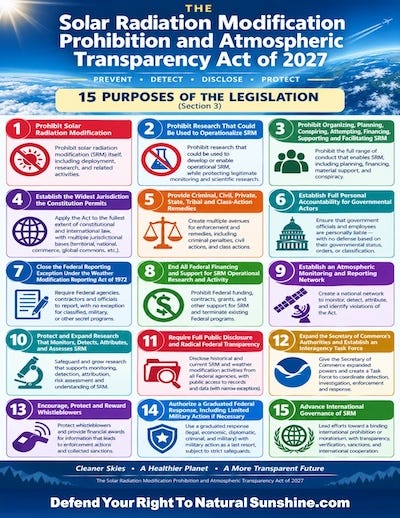
Executive Summary of the 15 Purposes of The Solar Radiation Modification Prohibition and Atmospheric Transparency Act of 2027:
Listen to a brief summary of the 15 Purposes:

Section-by-Section Summary of The Solar Radiation Modification Prohibition and Atmospheric Transparency Act of 2027
Listen to the audio recording of the above PDF:

The Top 50 Reasons People Should Support The Solar Radiation Modification Prohibition and Atmospheric Transparency Act of 2027:
The Solar Radiation Modification Prohibition and Atmospheric Transparency Act of 2027:
At the very least, be sure to read sections 1, 2, 3, 4, 6, 9, 10, 12, 15, 16, 17, 18 and 33 of the proposed legislation that are highlighted below.
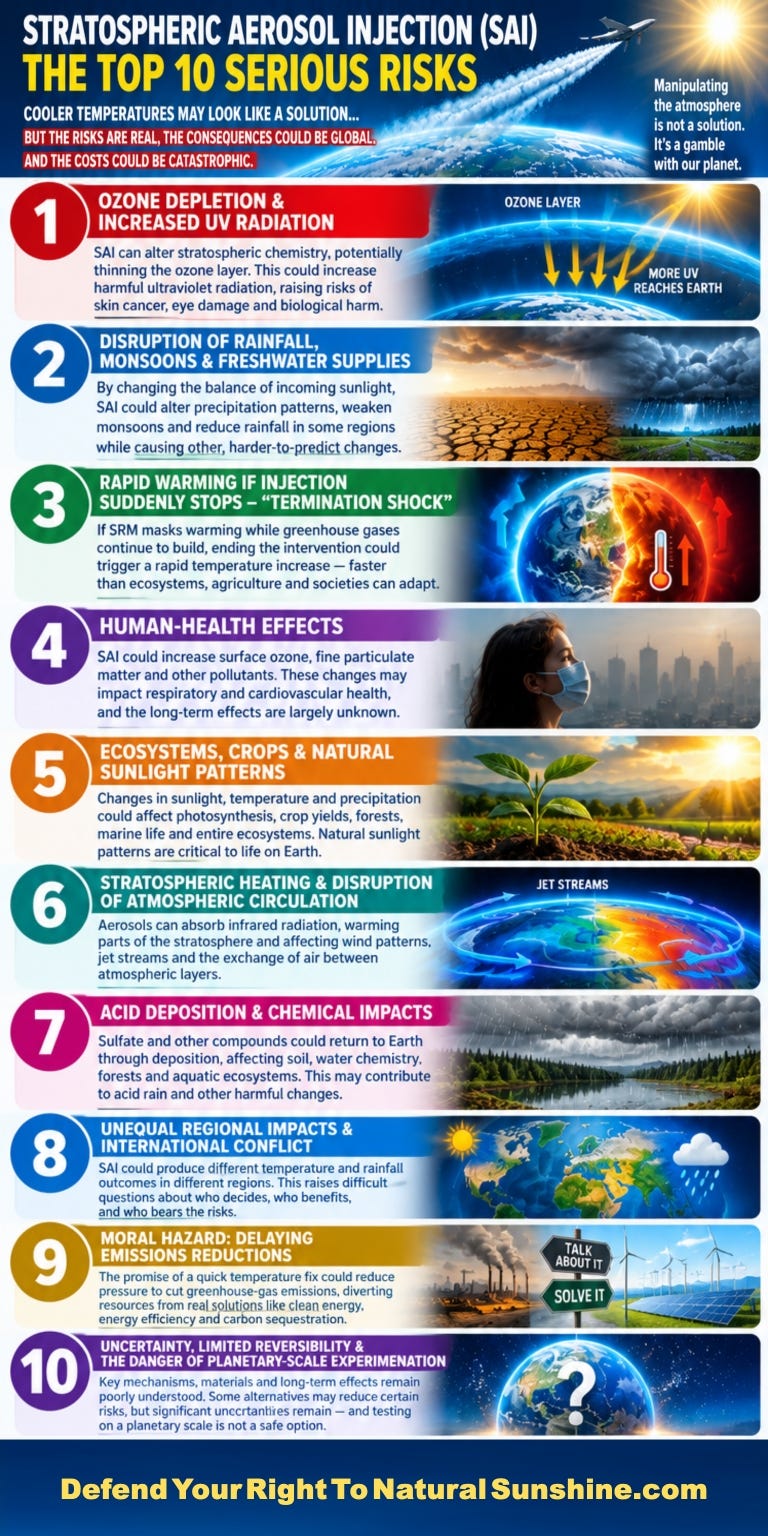
Stratospheric Aerosol Injection - What Could Possibly Go Wrong? - Risks and Potential Adverse Effects:
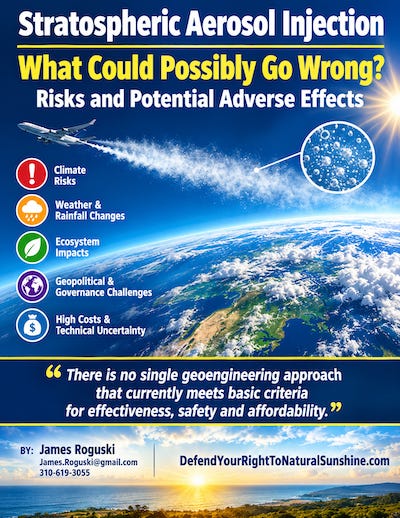

The Potential Risks Associated With Solar Radiation Modification
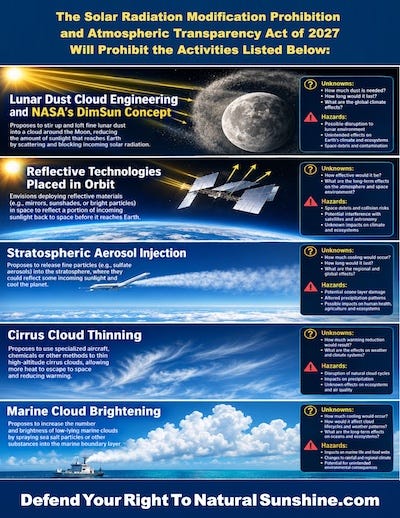

INFOGRAPHICS


Dear Reader,
Let me start by saying that I personally feel that the idea of blocking and/or reflecting sunlight on a global scale (solar geoengineering) in order to cool the planet as a response to “climate change” is absolutely foolish.
I also feel that every man, woman, child, as well as every animal, plant and every other living creature on earth has an unalienable right to receive unobstructed and unaltered life-giving energy from the sun. Purposefully blocking sunlight on a global scale would truly be the quintessential crime against nature.
But just because I think that such activity is wrong and that it should be treated as a crime does not magically make blocking the sun a crime.
In the United States, our system of governance is a representative republic. If we want any activity to be treated as a criminal act, then we need to work to convince our representatives to enact laws to criminalize the behaviour that we want to prevent.
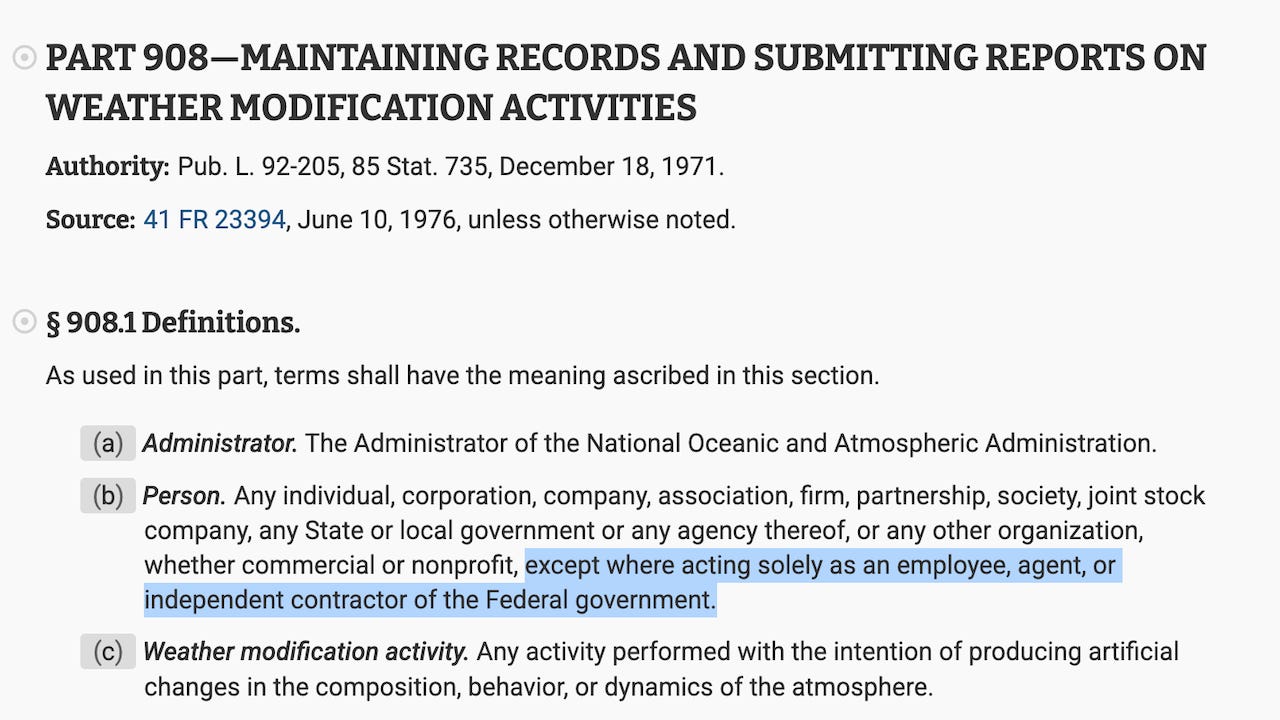
While many people refer to stratospheric aerosol injection as either “geoengineering” or “climate engineering,” the United States Code of Federal Regulations defines such activity as a form of weather modification that is NOT prohibited and is NOT regulated, but is only subject to reporting requirements:
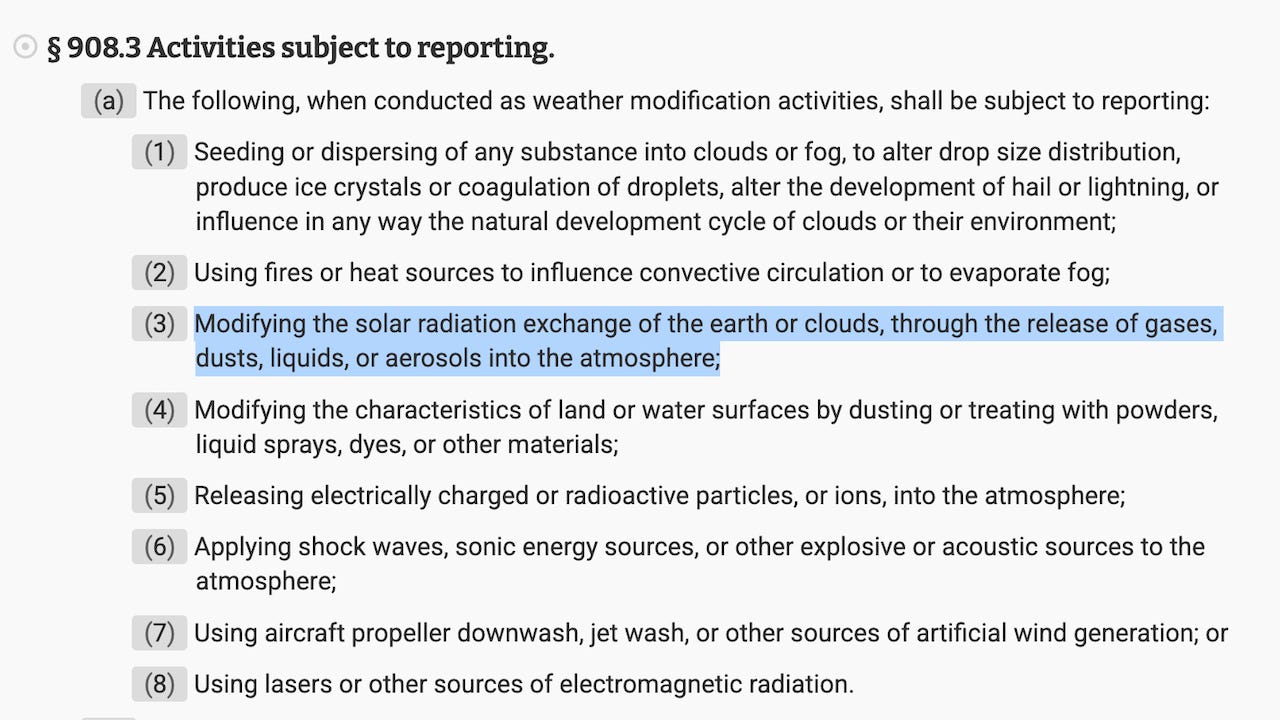
While spraying chemicals or particulate matter into the stratosphere in order to block the sun’s radiation from reaching the surface of the earth is, in my opinion, a crime against humanity that could have absolutely catastrophic and existential consequences, such activities are currently NOT considered to be “against the law” in the United States!
Even crazier ideas to block sunlight, such as space mirrors or lunar dust cloud engineering are also not prohibited by current laws or regulations.
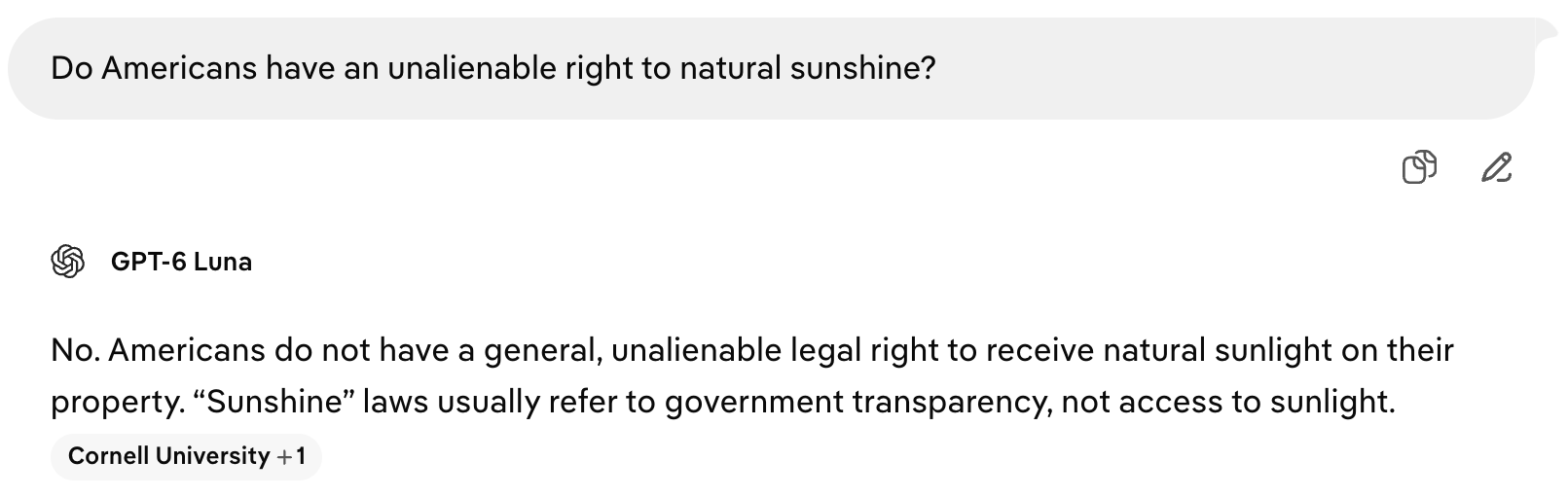
I encourage you to ask your favorite search engine or Artificial Intelligence platform the following question:
Do Americans have an unalienable right to natural sunshine?
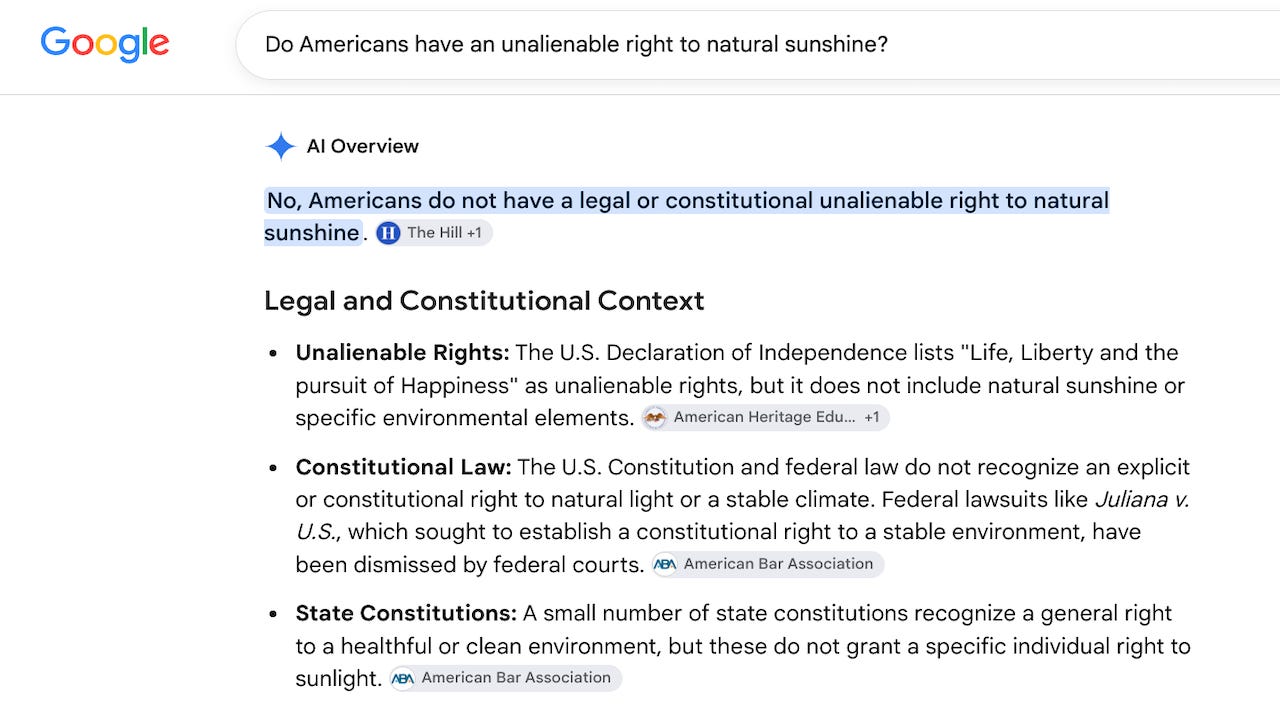
When I first pointed out in THIS ARTICLE that blocking the sun is legal in the United States and Federal employees and Federal contractors are exempt from any requirements to report such activity
100% of people who responded to the poll in that article agreed that the law should be changed.
My goal is to do exactly that.
I have personally written a very serious and extensive draft proposal for Congressional legislation that would criminalize any attempt to block or modify the life-giving solar radiation that we receive from the sun.
This is just the starting point of a series of important conversations that need to happen as soon and as widely as possible.
Millions of people across the United States need to come together to comprehend that an extremely small group of rogue actors could potentially impact each and every one of our lives by making a catastrophic decision to block the sun simply because they think it is a good idea and they can afford to do it.
I find it very interesting that on page 19 in the document shown below that was published by the Convention on Biological Diversity, they actually stated, in print, that
“There is no single geoengineering approach that currently meets basic criteria for effectiveness, safety and affordability.”

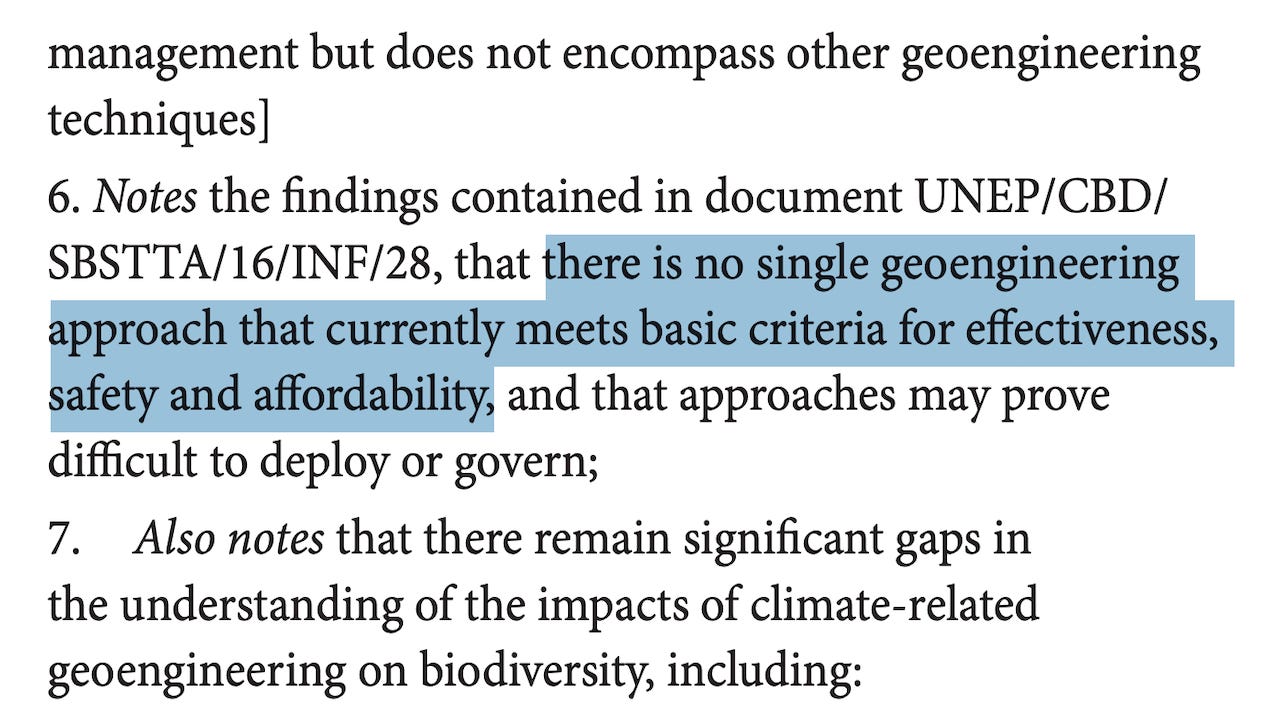
https://www.cbd.int/doc/publications/cbd-ts-84-en.pdf
In their misguided attempt to address “climate change,” by blocking the light from the sun, we could all be involuntarily involved in a catastrophic and existential threat to life on earth caused by the extraordinary hubris and stupidity of a very small group of very wealthy people.
We must realize that the concepts of solar radiation modification are not only being discussed in the halls of academia. These ideas are also ACTIVELY being planned and developed in the boardrooms of multinational corporations around the world.
The unalienable human right to freely access full spectrum sunlight from an “unaltered sky” must be protected.
If you oppose attempts to block the sun, NOW is a good time to take action!
I am asking you to do just three simple things in support of this effort:
Read the executive summary and the draft of the proposed legislation to ban and criminalize solar radiation modification activity that are available within this article. At the very least, be sure to read sections 1, 2, 3, 4, 6, 9, 10, 12, 15, 16, 17, 18 and 33 of the proposed legislation that are highlighted below.
If you support the proposed legislation, please CLICK HERE to let me know, and please help spread the word to raise public awareness in order to get the proposed legislation introduced and ultimately passed by the 120th Congress in 2027-2028. Please share this link:
Contact me directly if you really want to help.
Sincerely,
James Roguski
310-619-3055
James.Roguski@gmail.com

The Proposed Legislation Will Prohibit the Following:
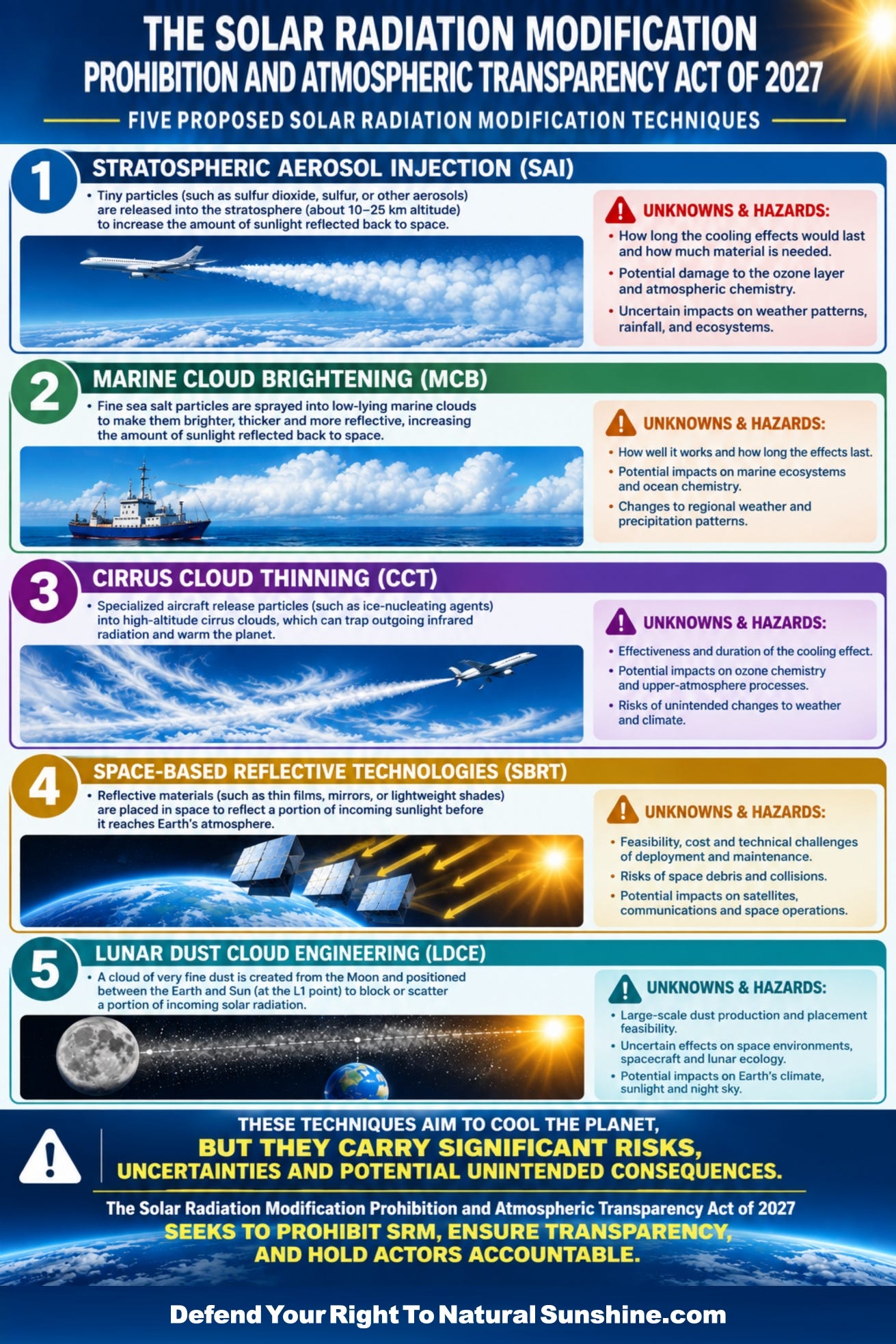

Executive Summary of the 15 Purposes of The Solar Radiation Modification Prohibition and Atmospheric Transparency Act of 2027:
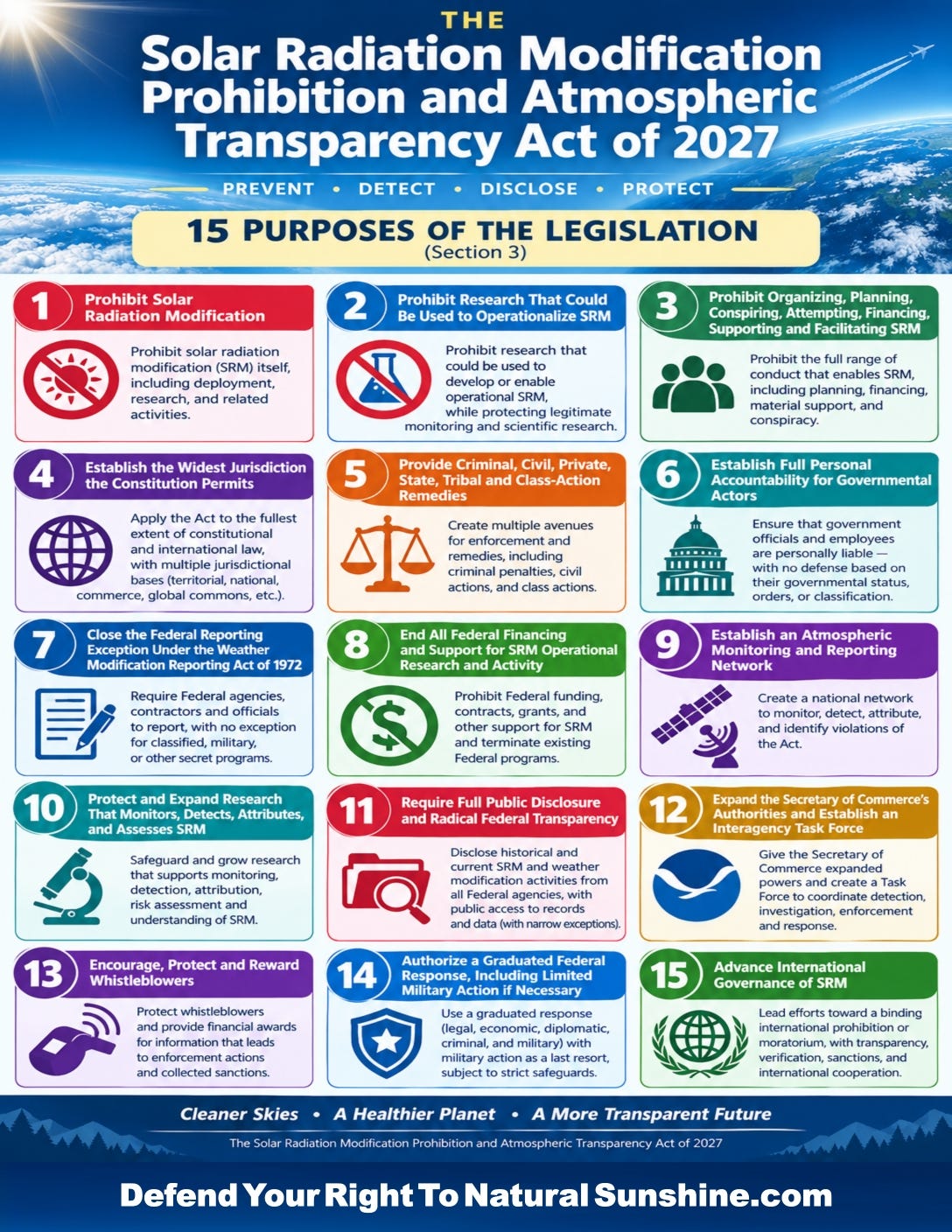
The Solar Radiation Modification Prohibition and Atmospheric Transparency Act of 2027 is designed as a comprehensive Federal statutory framework to prevent Solar Radiation Modification (SRM), prevent the development of operational capabilities for SRM, expose and investigate previously undisclosed atmospheric modification activities, establish continuous independent atmospheric monitoring, impose meaningful accountability on private and governmental actors, protect those who blow the whistle on prohibited activity, and to create mechanisms for responding to SRM threats both domestically and internationally.
The fifteen purposes expressly stated in Section 3 provide the organizing framework for the legislation.
Rather than relying upon a single prohibition, the Act constructs an integrated system of prohibition, jurisdiction, enforcement, monitoring, disclosure, governmental accountability, whistleblower protection, emergency response, and international governance.
The Act’s first and foundational purpose is to prohibit solar radiation modification itself. Section 6 establishes a direct prohibition against any person engaging in, causing, or directing SRM deployment. The prohibition is deliberately technology-neutral and is supported by the Act’s broad definition of SRM, which encompasses interventions intended to alter incoming solar radiation or outgoing terrestrial radiation in order to alter temperature, climate, weather, or the Earth’s radiative balance. The definition applies regardless of the technology employed, the scale or duration of the intervention, its location or altitude, or whether it is characterized as research, experimentation, testing, weather modification, geoengineering, or by another name.
The prohibition therefore is intended to prevent an actor from avoiding the statute simply by changing the terminology used to describe an activity. Section 6 also makes it clear that the prohibition applies to Federal agencies, Federal contractors, governmental entities, and government officials, including classified, covert, military, intelligence, emergency, and other secret programs.
The second purpose distinguishes between legitimate scientific investigation of SRM and research that advances the capability to actually conduct it. The Act creates the category of “prohibited operational research” and expressly prohibits research, development, testing, engineering, demonstrations, and related activities that design, develop, fabricate, integrate, validate, demonstrate, or improve an SRM system or its materials for operational deployment.
At the same time, the bill deliberately protects monitoring, detection, attribution, risk assessment, atmospheric chemistry, aerosol and cloud science, radiative-transfer research, natural analog studies, legal and policy research, and other scientific work that does not constitute operationalization. This distinction is important to the structure of the legislation: the Act is intended to prohibit development of the capability to deploy SRM, not to prohibit scientific investigation into monitoring SRM.
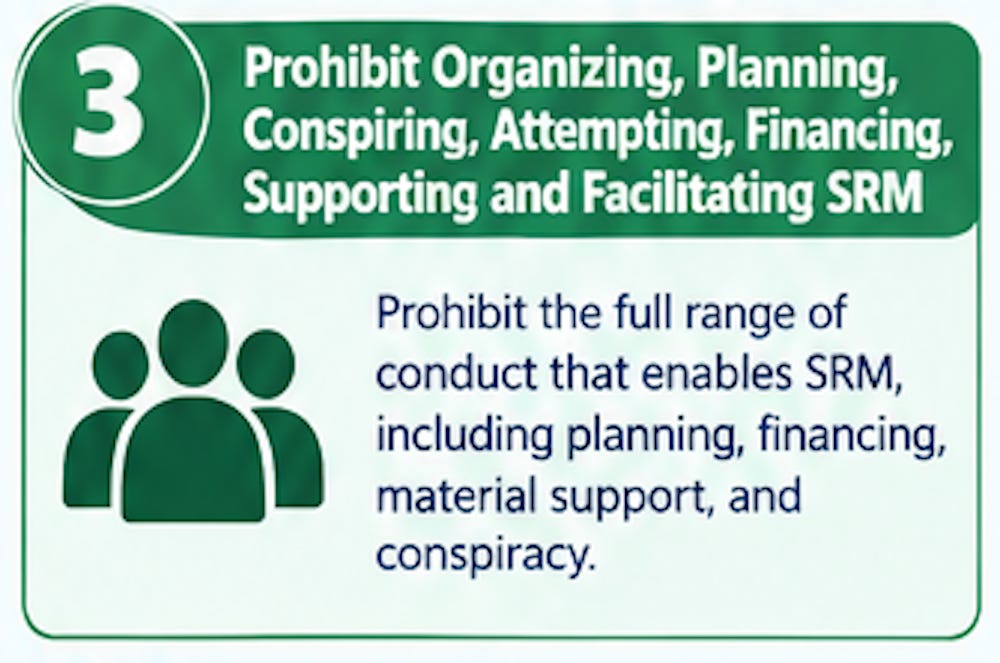
The third purpose moves beyond the physical deployment of SRM to address the conduct that makes deployment possible. Section 6 prohibits organizing, directing, recruiting, operational planning, financing, procurement, possession, transportation, material support, attempts, conspiracies, solicitation, prohibited operational research, concealment, obstruction, and shielding of SRM activity.
The criminal provisions reinforce this approach by creating separate offenses for deployment, attempt, conspiracy, solicitation, organizing, planning, financing, material support, prohibited operational research, concealment, obstruction, tampering, and retaliation. The underlying principle is that effective prevention must intervene before an SRM payload is released into the atmosphere. A completed deployment is therefore not the only point at which the Act operates; planning and preparation that materially advance deployment can themselves trigger liability.
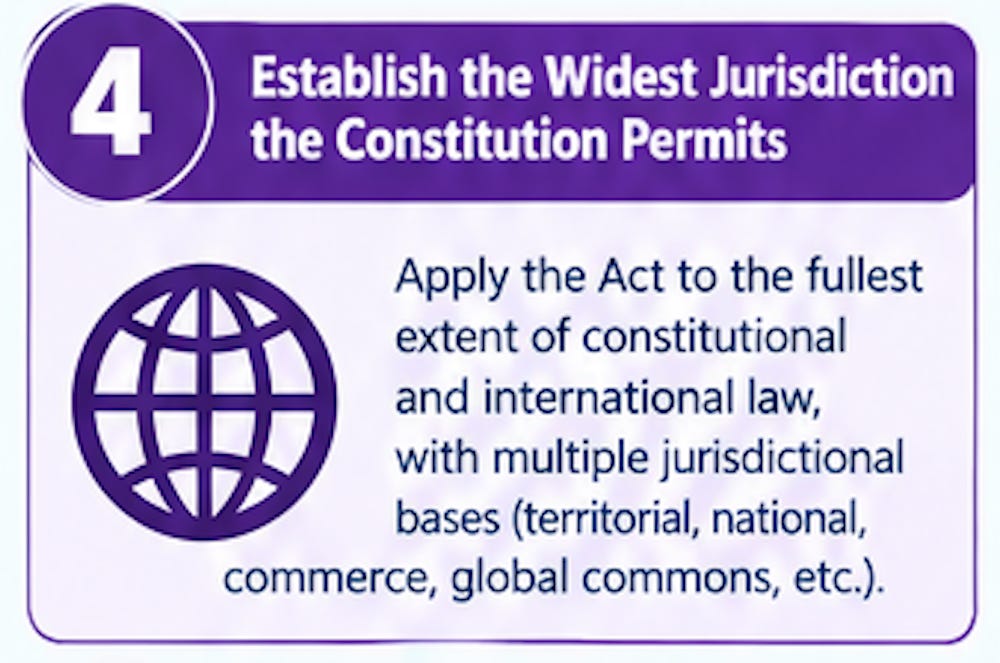
The fourth purpose seeks to prevent SRM activity from escaping Federal jurisdiction merely because it occurs outside ordinary United States territory. Section 7 establishes multiple independent jurisdictional bases, including territorial conduct, United States nationality, United States-registered or licensed aircraft and spacecraft, interstate and foreign commerce, effects within the United States, Federal involvement, activity in the global commons, presence of an offender in the United States, stateless instrumentalities, treaty obligations, and foreign-government conduct affecting the United States.
The bill expressly states that Congress intends the Act to apply to the fullest extent permitted by the Constitution and international law and seeks to overcome any presumption against extraterritorial application. Each jurisdictional basis is independent, so invalidation of one basis would not automatically invalidate the others.
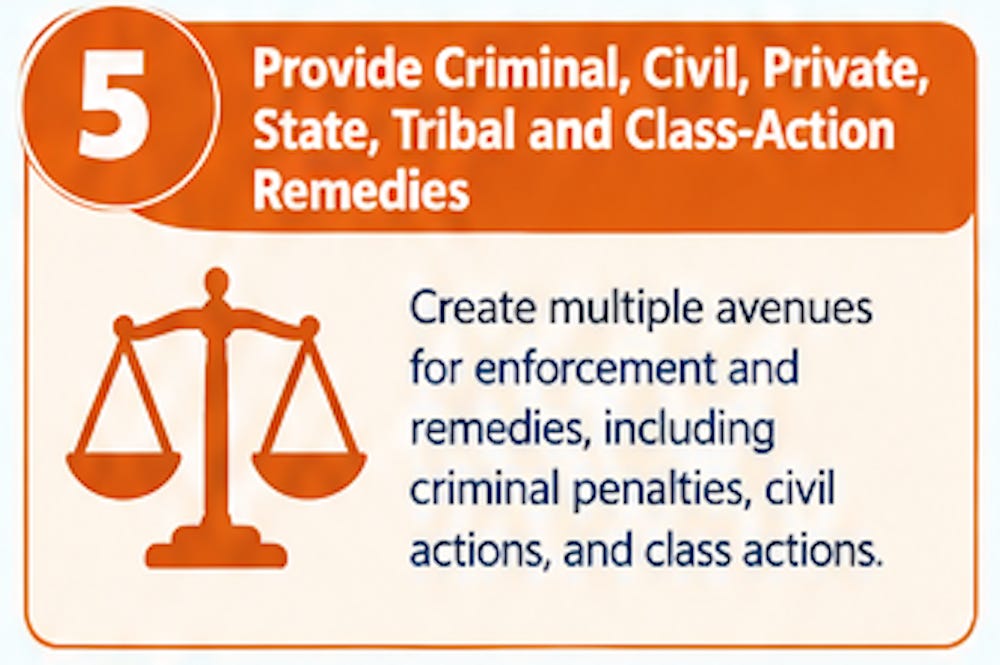
The fifth purpose establishes multiple avenues for enforcement rather than making enforcement dependent upon a single Federal prosecutorial decision. The Act creates Federal criminal offenses, Federal civil enforcement, administrative enforcement, private civil actions, State and Tribal actions, and class actions.
Federal civil enforcement can seek injunctions, civil penalties, monitoring and remediation orders, recovery of costs, disgorgement, restitution, and other relief. Private plaintiffs may seek prospective relief before deployment occurs as well as compensation for personal injury, death, property damage, economic loss, natural-resource damage, medical monitoring, mitigation, and remediation. The Act also characterizes SRM deployment as an abnormally dangerous activity and establishes strict liability for damages caused by deployment, together with joint and several liability for specified participants. States, political subdivisions, and Indian Tribes are expressly authorized to bring actions, including parens patriae actions, while Rule 23 class actions are expressly contemplated.
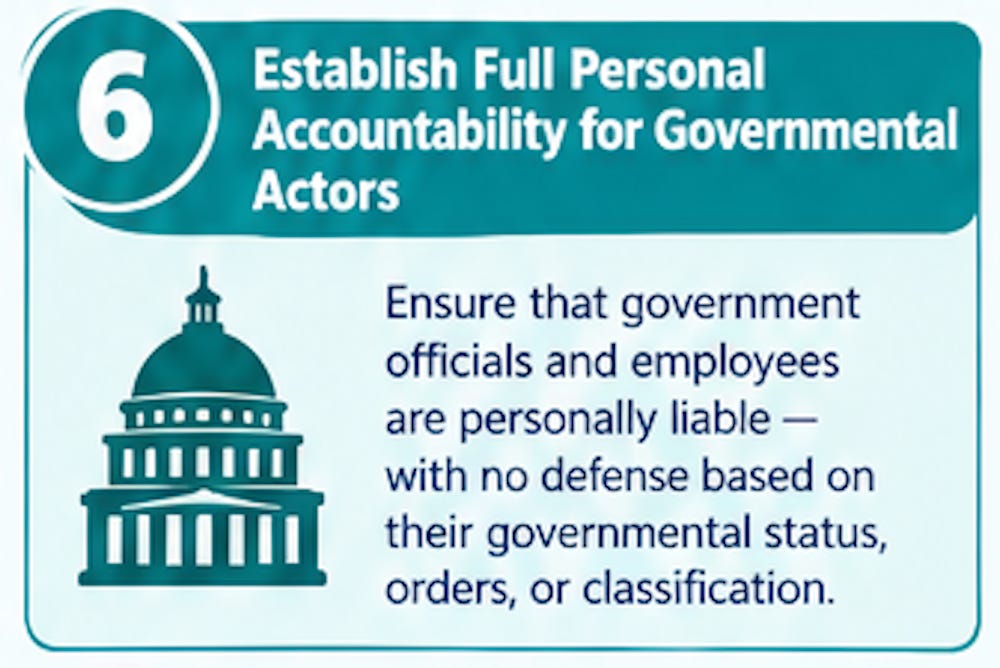
The sixth purpose is one of the Act’s most consequential structural features. The bill does not treat governmental status as an exemption from liability. Federal, State, local, Tribal, and foreign government officials are individually subject to the Act’s prohibitions and criminal provisions for their own conduct.
Section 9 expressly rejects official-duty, superior-order, governmental-authorization, national-security, scientific, humanitarian, environmental, commercial, and claimed emergency justifications as defenses to prohibited conduct. The criminal provisions likewise provide that government officials are personally subject to prosecution and cannot rely upon their governmental position, classification, orders, permits, contracts, or governmental approval as a defense. The legislation thus attempts to establish personal accountability at the level of the individual decision-maker, operator, planner, financier, or facilitator rather than allowing governmental status to become a shield.
The seventh purpose addresses a specific structural gap identified by the bill: the Federal exception in the Weather Modification Reporting Act of 1972. Section 16 rewrites the definition of “person” under that Act so that Federal agencies, Federal contractors, government officials, employees, agents, and contractors are brought within the reporting framework.
The revised reporting requirement applies to Federal agencies, Federal contractors, and United States persons worldwide and expressly provides that classified, covert, military, intelligence-related, or otherwise secret activity does not create an exemption. Classified reporting may occur through secure channels, but classification does not eliminate the reporting obligation or prevent later declassification review. The bill also makes it clear that reporting is not authorization: submitting a report cannot legalize otherwise prohibited conduct.
The eighth purpose turns the Federal Government itself into a principal subject of the prohibition. Section 17 provides that no Federal agency, government official, or Federal contractor may conduct, sponsor, fund, authorize, approve, procure, or otherwise provide Federal support for SRM activity or prohibited operational research.
The definition of “Federal support” is intentionally broad. It encompasses appropriations, grants, contracts, loans, subsidies, fellowships, technical assistance, personnel, facilities, laboratories, aircraft, spacecraft, vessels, computing resources, data, software, and other Federal resources, whether supplied directly or through an intermediary. Agencies must identify affected programs and terminate them, recover funds and property where legally possible, and address unobligated balances. This purpose therefore seeks not merely to prohibit Federal deployment but to sever the Federal financial and institutional infrastructure supporting operational SRM research and activity.
The ninth purpose creates the Act’s principal detection infrastructure: the National Atmospheric Integrity Monitoring Network. The Network is designed to continuously monitor the atmosphere and near-Earth space, establish baseline conditions, detect possible SRM deployment, support attribution, monitor the ozone layer, and provide public data.
Its components include ground-based remote sensing, aircraft and balloon sampling, satellite observations, marine and coastal observations, surveillance of potentially relevant space objects, stratospheric composition and ozone monitoring, chemical and isotopic fingerprinting, laboratory analysis, data assimilation, anomaly-detection tools, and contributions from universities, laboratories, nonprofit organizations, and certified independent and citizen-science monitors.
The bill establishes deadlines for initial and full operating capability and requires coordination with other Federal agencies and, where practicable, international monitoring systems.
The tenth purpose is deliberately complementary to the prohibition on operational SRM research. The Act creates a protected category for research that helps determine whether SRM is occurring, what caused an observed anomaly, what materials or signatures may be involved, and what consequences may result.
Section 21 establishes a safe harbor for lawful collection, possession, analysis, and publication of atmospheric samples and monitoring data and for developing and operating detection and attribution instruments. It also directs Federal scientific agencies to support research concerning detection, attribution, ozone and ecosystem effects, aerosol and material fingerprinting, and monitoring technology. Federal agencies are prohibited from restricting or terminating funding for monitoring research merely because of its subject matter, and scientists, researchers, and students receive protection against retaliation.
The eleventh purpose establishes a comprehensive historical and contemporary disclosure regime. Every Federal agency—including the Department of Defense, military departments, and intelligence community—is required to search for, identify, preserve, and disclose records concerning unreported weather modification, SRM research and testing, atmospheric or weather modification programs, funding, contracts, legal authorities, safety assessments, results, and relationships with foreign governments, international organizations, universities, and private entities.
The search is expressly required to extend beyond ordinary agency records systems to predecessor agencies, Federal Records Centers, the National Archives, Presidential libraries, classified repositories, procurement and financial systems, and records held by contractors and research institutions on behalf of the Government.
The bill then creates an independent Atmospheric Records Review Board to review records, require agencies to produce them, obtain unredacted classified records, subpoena non-Federal witnesses and records, and determine whether records must be released. Section 24 establishes an online public collection and requires Network data to be made publicly available in open, machine-readable formats, subject only to narrowly defined withholding provisions. The result is intended to transform atmospheric modification records from a predominantly agency-controlled system into a presumptively public historical and scientific record.
The twelfth purpose gives the Secretary of Commerce a substantially expanded institutional role. The bill creates the Office of Atmospheric Integrity and Enforcement within NOAA and assigns it responsibility for administering the monitoring network, conducting investigations, administering reporting requirements, supporting enforcement, and maintaining public records.
The Act also expands the Secretary’s statutory duties under the Weather Modification Reporting Act to include detection, investigation, attribution, enforcement, ozone assessment, international coordination, public records, and annual congressional reporting.
Complementing the Secretary’s authority is the SRM Interagency Enforcement Task Force, co-chaired by the Attorney General and Secretary of Commerce and including senior officials from numerous Federal departments and agencies. The Task Force is charged with coordinating detection, investigation, prosecution, sanctions, and response while preserving the independent statutory authorities of participating agencies. Commerce enforcement personnel receive specified law-enforcement authorities, while the FAA, Coast Guard, Customs and Border Protection, and other agencies receive complementary responsibilities.
The thirteenth purpose recognizes that individuals inside governmental, corporate, research, and operational structures may possess information unavailable to outside investigators. The Act therefore combines protection with financial incentives.
Section 30 protects a broad class of employees, former employees, contractors, researchers, students, government officials, and members of the Armed Forces who make protected disclosures, participate in investigations, refuse to participate in conduct they reasonably believe violates the Act, or conduct and publish monitoring research. Retaliation is prohibited, and protected individuals may bring civil actions without first exhausting administrative remedies.
The available remedies include reinstatement, restoration of security clearances and benefits, double back pay, compensatory damages, special damages, injunctive relief, and attorney and expert fees. Classified disclosures remain protected when made through legally authorized channels, without creating authority for public disclosure of classified information.
The separate whistleblower-award provisions establish financial awards tied to information that materially contributes to enforcement actions producing monetary sanctions. The Act also establishes an Atmospheric Integrity Enforcement Fund into which penalties, fines, and forfeitures are deposited, helping create a financial mechanism for both whistleblower awards and future enforcement activity.
The fourteenth purpose establishes a graduated response. The Act begins with monitoring, investigation, administrative stop orders, civil enforcement, criminal enforcement, sanctions, diplomatic measures, and other Federal responses.
Section 32 provides for a coordinated Presidential response when SRM deployment is ongoing, imminent, or being prepared and threatens public health, safety, the environment, atmosphere, economy, or national security.
Section 33 provides a last-resort authorization for military action when civil, law-enforcement, and diplomatic means are inadequate or unavailable in time.
The military authority is surrounded by specific safeguards. The President must make written determinations concerning the threat, necessity, proportionality, and protection of human life. Manned platforms receive substantially greater protections than unmanned platforms, destruction of a manned platform is restricted to extraordinary circumstances involving imminent catastrophic harm, and lethal force against individuals remains constrained by existing law. The authority is time-limited, subject to congressional notification and renewal requirements, and expressly does not constitute a declaration of war.
The fifteenth and final purpose recognizes that SRM cannot be governed effectively through domestic law alone because atmospheric effects and potentially relevant activities can cross national boundaries and extend into the global commons.
The Act therefore makes it United States policy to lead efforts toward a binding international prohibition or moratorium on SRM deployment and prohibited operational research, accompanied by transparency and verification. The Secretary of State is directed to engage the Convention on Biological Diversity, pursue negotiations for a dedicated treaty or protocol, engage the ENMOD framework, request further scientific assessment under the Montreal Protocol, seek international resolutions and standards through multiple international institutions, and pursue bilateral and multilateral agreements concerning monitoring, data-sharing, mutual legal assistance, and extradition.
The legislation also calls for capacity-building assistance for countries lacking monitoring capability and establishes a Special Envoy for Atmospheric Integrity. Complementing these diplomatic measures, Section 35 establishes sanctions against specified foreign persons involved in SRM deployment or material support, including property blocking, visa restrictions, financial-system restrictions, and denial of export licenses and Federal support.
Conclusion
Taken together, the fifteen purposes reveal that the proposed legislation is designed as a complete prevention-and-accountability architecture rather than simply an SRM prohibition statute. Its central strategy is to make prohibited deployment difficult to initiate, difficult to prepare, difficult to finance, difficult to conceal, easier to detect, easier to attribute, and subject to multiple independent avenues of enforcement.

The Top 50 Reasons People Should Support The Solar Radiation Modification Prohibition and Atmospheric Transparency Act of 2027
Protecting the Public and Preventing Unilateral Intervention
It puts involuntary exposure at the center of federal policy. Sections 2(6) and 2(7) recognize the interests of people and communities unable to consent to, avoid, or withdraw from an atmospheric intervention.
It expresses a shared-interest principle for sunlight and the atmosphere. Section 2(1) frames access to sunlight and protection of the interconnected atmospheric system as matters extending beyond any single operator’s interests.
It establishes an explicit deployment prohibition. Section 6(a) forbids engaging in, causing, or directing SRM deployment, providing a direct statutory boundary rather than merely requiring reporting.
It prevents relabeling from defeating the prohibition. Section 4(27)(A) applies regardless of whether an intervention is called research, testing, weather modification, a pilot, or a commercial venture.
It covers emerging technologies. Section 4(27)(B) makes the definition technology-neutral, while Section 4(30) encompasses atmospheric, cloud-based, space-based, and extraterrestrial-material methods.
It does not create a blanket exemption for small trials. Section 4(29) includes tests, experiments, and trials of any scale, whether completed or effective, when they constitute SRM deployment.
It addresses operational preparation before release. Sections 6(b)(1) and 6(b)(2) prohibit organizing and operational planning, enabling intervention before deployment occurs.
It reaches the financial infrastructure behind prohibited activity. Section 6(b)(3) covers financing mechanisms including lending, underwriting, insurance, guarantees, and indemnification.
It targets operational capability development. Sections 4(22) and 6(b)(7) prohibit research that establishes or materially improves deployment capability while excluding protected research.
It resists evasion through intermediaries. Section 9(c) assigns responsibility to actors using subsidiaries, contractors, nominees, foreign persons, or foreign-registered platforms to conduct prohibited activity.
Preserving Science, Debate, and Evidence
It protects atmospheric observation and sampling. Section 8(b)(1) preserves monitoring, measurement, remote sensing, and the development and operation of instruments for those purposes.
It protects research into SRM risks and consequences. Section 8(b)(3) permits assessment and hypothetical modeling concerning ozone, climate, agriculture, health, ecosystems, economics, and security.
It preserves theoretical and laboratory science that is not operational research. Section 8(b)(4) protects qualifying work in atmospheric chemistry, aerosol and cloud science, and radiative transfer.
It protects public debate—including disagreement with the ban. Section 8(c) expressly protects journalism, teaching, petitioning, and advocacy that SRM be adopted as public policy, subject to its criminal-conduct limitations.
It creates a safe harbor for detection work. Section 21(a) protects lawful sampling, analysis, publication, and detection-instrument development from being treated as prohibited support or obstruction.
It affirmatively supports useful scientific research. Section 21(b) directs designated agencies to support attribution, fingerprinting, monitoring technology, and assessment of ozone and ecosystem effects.
It guards against subject-based suppression of monitoring research. Section 21(c) prohibits restricting funding or publication on the ground of the research’s subject, while preserving classified-information protections.
It requires baselines that can distinguish alternative explanations. Section 19(f) directs the Network to differentiate SRM effects from natural variability, volcanic activity, and other anthropogenic influences.
It separates scientific findings from prosecution. Section 19(h) protects the distinction between scientific determinations and prosecutorial decisions; Section 20(d) states that administrative determinations do not establish guilt.
It requires independent checking of significant findings. Section 20(h) calls for independent verification by qualified laboratories or scientific institutions, strengthening confidence in attribution.
Holding Governments and Powerful Organizations Accountable
It applies the ban to secret governmental programs. Section 6(c) expressly includes classified, covert, military, intelligence, and emergency activity rather than providing institutional exemptions.
It rejects superior orders as permission to violate the prohibition. Section 9(b)(2) prevents governmental direction or approval from becoming a defense to prohibited conduct.
It establishes personal accountability for officials’ own activity. Section 15(a) applies civil liability to officials across federal, State, local, Tribal, and foreign government.
It seeks to remove specified immunity obstacles while respecting constitutional limits. Section 15(b) addresses qualified and other immunity defenses but preserves constitutionally required immunity.
It authorizes specified claims against the federal government. Section 15(d) waives sovereign immunity for identified injunctive, declaratory, and damages actions, giving injured parties additional avenues for relief.
It prevents government contractors from using governmental status as a liability shield. Section 15(e) rejects the government-contractor defense and derivative sovereign immunity in actions under the Act.
It prohibits taxpayer indemnification for individuals’ committed violations. Section 15(f) bars federal payment or reimbursement of specified penalties, judgments, settlements, and legal fees arising from those violations.
It requires federal personnel to refuse and report prohibited activity. Section 18(a) creates duties directed at employees, Armed Forces members, and federal contractors.
It subjects defense and intelligence components to recurring oversight. Sections 18(e) and 18(f) require annual certifications, recurring audits, and congressional oversight hearings.
It terminates federal support for operationalization. Section 17 prohibits direct and indirect support, requires termination and rescission measures, and prevents continuation through reprogramming or substituted accounts.
Making Enforcement Effective and Remedies Accessible
It combines criminal, civil, and administrative tools. Sections 10, 12, and 13 allow different enforcement responses rather than making protection depend on one type of proceeding.
It creates substantial consequences for deployment and enabling conduct. Section 10’s proposed Sections 301–308 establish separate offenses, imprisonment, fines, restitution, and forfeiture.
It removes equipment and proceeds supporting violations. Proposed Section 308(g), together with Sections 11(a) and 12(h), provides forfeiture mechanisms addressing operational assets and financial benefits.
It allows injunctions before actual deployment. Section 12(d)(1) permits federal relief against planned, preparatory, or imminent conduct without waiting for a release or resulting injury.
It combines emergency orders with prompt judicial oversight. Section 13(b) requires a court-confirmation application within five days and expiration after fourteen days unless confirmed.
It gives affected people an independent route to court. Section 14(a) authorizes private actions, while Section 14(b) preserves constitutional standing requirements.
It lets States, local governments, and Tribes protect residents. Section 14(b) authorizes qualifying actions on their own behalf and through designated officials on behalf of residents.
It makes deployment participants responsible for damages caused. Sections 14(d) and 14(e) provide strict liability and joint and several liability for specified actors.
It addresses practical barriers to collective redress. Sections 14(h) and 14(k) contemplate Rule 23 class actions, reject predispute arbitration and class waivers for these claims, and provide prevailing-plaintiff fee awards.
It helps injured parties establish their cases without making allegations conclusive. Sections 14(f) and 14(n) provide a conditional, rebuttable causation presumption and access to relevant monitoring data and technical assistance.
Building Transparency, Early Warning, and International Cooperation
It creates a continuous atmospheric monitoring network. Section 19 integrates ground, airborne, satellite, marine, and space observations to support detection, baseline assessment, attribution, and public information.
It imposes specific response deadlines for flagged anomalies. Section 20(b) requires assessment within twenty-four hours, preliminary assessment within seventy-two hours, and a reasonable-grounds determination within fourteen days.
It makes monitoring data available for independent scrutiny. Section 24(b) requires raw and processed data, metadata, quality flags, and methods in open formats within twenty-four hours after quality control.
It requires comprehensive historical records searches and preservation. Section 22 reaches specified records across archives, classified repositories, financial systems, predecessor agencies, and contractor-held government records.
It places disclosure review outside the originating agency alone. Section 23 establishes an independent review board with access and release authorities, defined postponement standards, and judicial review.
It expands federal weather-modification reporting obligations. Section 16 brings specified federal actors within the reporting framework and states that secrecy does not eliminate their duties.
It protects and rewards responsible whistleblowing. Sections 29 and 30 combine qualifying enforcement and prevention awards with confidentiality measures, anti-retaliation rights, and substantial civil remedies.
It coordinates enforcement across relevant agencies. Sections 25–28 establish a dedicated NOAA office, scientific advice, investigative tools, transaction reporting, export controls, and an interagency task force.
It provides a graduated response with express limits on military action. Sections 32 and 33 require specified threat, necessity, proportionality, human-life, territorial, reporting, and duration safeguards.
It connects domestic protection to international cooperation and stronger local law. Sections 34 and 35 pursue international prohibition or moratorium, monitoring cooperation, legal assistance, and sanctions; Section 36 preserves additional State, local, and Tribal protections.
The Solar Radiation Modification Prohibition and Atmospheric Transparency Act of 2027 VERSION 1 October 10, 2026
A NOTE TO MY READERS:
I realize that the proposed legislation is 68 pages long. There are 38 sections. The longest section is section 10, which criminalizes solar radiation modification activity, and it is only six pages long. The next longest section is section 4, Definitions, and it is only five pages long. Section 2, which are the Congressional Findings, is only three pages long. All of the other sections are just one or two pages long.
Read ten pages a day, focus on one section at a time, and a week from now you will have read the entire document.
At the very least, be sure to read sections 1, 2, 3, 4, 6, 9, 10, 12, 15, 16, 17, 18 and 33 of the proposed legislation that are highlighted below.
Working draft for introduction in the 1st Session of the 120th Congress
120TH CONGRESS
1ST SESSION
H. R. ______
IN THE HOUSE OF REPRESENTATIVES
[Date]
Mr./Ms. __________ introduced the following bill;
which was referred to the Committee on __________
A BILL
To prohibit solar radiation modification and the organizing, planning, financing, supporting, and operationalizing conduct that enables it; to establish criminal, civil, private, and class-action remedies, including full personal accountability for governmental actors at every level; to close the Federal reporting exception under the Weather Modification Reporting Act of 1972; to terminate Federal support for prohibited research; to protect monitoring research; to establish a national atmospheric monitoring and detection network; to require radical transparency and public disclosure of Federal weather modification and solar radiation modification research and activity; to protect and reward whistleblowers; to authorize a graduated response, including limited military action if necessary; to advance international governance; to expand the duties and authorities of the Secretary of Commerce; and for other purposes.
Be it enacted by the Senate and House of Representatives of the United States of America in Congress assembled,

TITLE I—GENERAL PROVISIONS
SEC. 1. SHORT TITLE; TABLE OF CONTENTS.
(a) Short Title.—This Act may be cited as the “Solar Radiation Modification Prohibition and Atmospheric Transparency Act of 2027”.
(b) Table of Contents.—The table of contents for this Act is as follows:
TITLE I—GENERAL PROVISIONS
SEC. 1. SHORT TITLE; TABLE OF CONTENTS.
SEC. 2. FINDINGS.
SEC. 3. PURPOSES.
SEC. 4. DEFINITIONS.
SEC. 5. RULES OF CONSTRUCTION.
TITLE II—PROHIBITION
SEC. 6. PROHIBITION ON SOLAR RADIATION MODIFICATION AND RELATED CONDUCT.
SEC. 7. JURISDICTION.
SEC. 8. EXCLUSIONS AND PROTECTED ACTIVITY.
SEC. 9. NO AUTHORIZATION; NO DEFENSE; ANTI-EVASION.
TITLE III—CRIMINAL OFFENSES
SEC. 10. SOLAR RADIATION MODIFICATION OFFENSES.
SEC. 11. CONFORMING AND SUPPORTING CRIMINAL-LAW AMENDMENTS.
TITLE IV—CIVIL ENFORCEMENT AND PRIVATE REMEDIES
SEC. 12. FEDERAL CIVIL ENFORCEMENT.
SEC. 13. ADMINISTRATIVE ORDERS AND EMERGENCY AUTHORITY.
SEC. 14. PRIVATE, STATE, TRIBAL, AND CLASS ACTIONS.
SEC. 15. LIABILITY OF GOVERNMENTAL ACTORS; WAIVER OF IMMUNITY.
TITLE V—FEDERAL GOVERNMENT AND FEDERAL CONTRACTORS
SEC. 16. CLOSING THE FEDERAL REPORTING EXCEPTION.
SEC. 17. TERMINATION OF FEDERAL SUPPORT FOR SRM AND PROHIBITED OPERATIONAL RESEARCH.
SEC. 18. ACCOUNTABILITY OF FEDERAL PERSONNEL.
TITLE VI—ATMOSPHERIC MONITORING AND DETECTION
SEC. 19. NATIONAL ATMOSPHERIC INTEGRITY MONITORING NETWORK.
SEC. 20. DETECTION, ATTRIBUTION, AND INVESTIGATION.
SEC. 21. PROTECTION OF AND SUPPORT FOR MONITORING RESEARCH.
TITLE VII—DISCLOSURE AND TRANSPARENCY
SEC. 22. MANDATORY DISCLOSURE OF FEDERAL WEATHER MODIFICATION AND SRM ACTIVITY.
SEC. 23. ATMOSPHERIC RECORDS REVIEW BOARD.
SEC. 24. PUBLIC ACCESS TO RECORDS AND ATMOSPHERIC DATA.
TITLE VIII—SECRETARY OF COMMERCE
SEC. 25. OFFICE OF ATMOSPHERIC INTEGRITY AND ENFORCEMENT; SCIENCE ADVISORY BOARD.
SEC. 26. AMENDMENTS TO THE WEATHER MODIFICATION REPORTING ACT OF 1972.
SEC. 27. REPORTING OF COVERED RELEASES AND TRANSACTIONS; EXPORT CONTROLS.
SEC. 28. INTERAGENCY TASK FORCE AND ENFORCEMENT AUTHORITIES.
TITLE IX—WHISTLEBLOWERS
SEC. 29. WHISTLEBLOWER AWARDS.
SEC. 30. WHISTLEBLOWER AND EMPLOYEE PROTECTIONS.
SEC. 31. ATMOSPHERIC INTEGRITY ENFORCEMENT FUND.
TITLE X—PRESIDENTIAL RESPONSE
SEC. 32. PRESIDENTIAL DETERMINATION AND RESPONSE.
SEC. 33. AUTHORIZATION FOR LIMITED USE OF MILITARY FORCE; SAFEGUARDS.
TITLE XI—INTERNATIONAL GOVERNANCE AND SANCTIONS
SEC. 34. INTERNATIONAL GOVERNANCE OF SRM.
SEC. 35. SANCTIONS AND DIPLOMATIC MEASURES.
TITLE XII—GENERAL PROVISIONS
SEC. 36. RELATIONSHIP TO STATE, LOCAL, AND TRIBAL LAW.
SEC. 37. AUTHORIZATION OF APPROPRIATIONS.
SEC. 38. EFFECTIVE DATE; APPLICABILITY; SEVERABILITY.
SEC. 2. FINDINGS.
Congress finds the following:
(1) Every living being possesses an inherent, inalienable right to enjoy unhindered access to unadulterated sunlight. This right must be protected without discrimination based on geography, economic status, race, or nationality. Sunlight is not merely an environmental amenity but is a biological necessity essential to physical well-being, psychological health, and environmental health. It is the fundamental catalyst for all terrestrial life and a shared planetary inheritance. The atmosphere and the Earth’s radiative balance form a single interconnected system that no person or nation can enclose, contain, or control, and on which the health, food supply, ecosystems, and economies of all peoples depend. No one has any right to block anyone else’s access to this fundamental source of life-sustaining energy.
(2) There is an important distinction between weather modification and solar radiation modification. Solar radiation modification methods, including stratospheric aerosol injection, marine cloud brightening, cirrus cloud thinning, space-based reflective technologies, and the engineering of dust clouds from lunar or other extraterrestrial material, are intended to alter the radiation that governs the Earth’s climate on a regional or global scale. Congress further recognizes that solar radiation modification constitutes a distinct category of activity requiring a clear Federal framework addressing deliberate activities undertaken to alter solar radiation or atmospheric conditions for the purpose of modifying radiative effects.
(3) The atmosphere, atmospheric chemistry, clouds, precipitation, sunlight, solar radiation, weather patterns, and related physical systems are interconnected and do not conform to State, national, or other jurisdictional boundaries. Substances, materials, particles, aerosols, gases, and other agents introduced into the atmosphere may be transported across jurisdictional boundaries and solar radiation modification activity may produce effects extending beyond the geographic location in which the activity is initiated. Materials released into the atmosphere disperse across State and national boundaries, cannot practicably be retrieved, and may persist for months or years. The effects of a deployment therefore cannot be confined. Such effects may negatively impact the ozone layer, public health, agriculture, forests, transportation, energy production, property, natural resources, ecosystems, interstate and foreign commerce, and other substantial Federal and State interests.
(4) Scientific assessments, including the Scientific Assessment of Ozone Depletion: 2026 prepared under the Montreal Protocol, have identified serious risks of stratospheric aerosol injection, including ozone loss or delayed ozone recovery. The National Oceanic and Atmospheric Administration, together with the National Aeronautics and Space Administration and other domestic and international scientific institutions, contributes substantially to the observation, measurement, analysis, modeling, and scientific assessment of stratospheric ozone and related atmospheric constituents. The United States has a substantial and continuing interest in protecting the stratospheric ozone layer and in maintaining the scientific capacity necessary to detect, characterize, monitor, and explain changes in atmospheric ozone and the physical and chemical processes that affect ozone recovery.
(5) Risks have been identified to precipitation patterns, agriculture, and ecosystems, as well as the risk of rapid, severe warming if a sustained deployment is interrupted. Because a sustained deployment creates dependence on its continuation and is difficult to reverse, substantial scientific uncertainty remains.
(6) A deployment can be initiated by a single governmental or private, domestic or foreign actor, and imposes its risks on populations that have no ability to consent to, avoid, or withdraw from it. Effective deterrence depends not solely upon the theoretical severity of criminal or civil penalties, but also upon the reasonable expectation that prohibited conduct will be detected, investigated, attributed, and subject to predictable and proportionate legal consequences. A comprehensive enforcement framework should therefore address the economic, organizational, and individual consequences of participation in prohibited solar radiation modification activity, including appropriate penalties, forfeiture, enforcement against responsible organizations, and other lawful remedies.
(7) Persons and communities have substantial Federal interests in being protected from unauthorized solar radiation modification activities that materially affect public health, safety, property, natural resources, ecosystems, or interstate or foreign commerce. Persons, communities, agricultural producers, natural-resource users, States, Tribes, and nations may be affected by alterations of atmospheric or radiative conditions despite having no practical ability to isolate themselves from, avoid, or individually consent to such alterations. Therefore, preventing unauthorized solar radiation modification activity serves substantial Federal interests in protecting persons and communities from involuntary exposure to alterations of interconnected atmospheric and radiative systems and in preventing unilateral actions capable of producing transboundary or global consequences. Prevention before deployment is preferable to remediation afterwards. Deterrence depends on a credible prospect of detection, attribution, and accountability. Effective deterrence must therefore reach the organizing, planning, financing, procurement, and preparation that precede implementation.
(8) The Weather Modification Reporting Act of 1972 requires reporting but authorizes nothing and prohibits nothing, and by its terms it excludes persons acting solely as Federal employees, agents, or independent contractors from its reporting requirement.
(9) State law alone cannot address activity whose effects cross State and national boundaries. Tennessee (2024), Florida and Louisiana (2025), and Mexico (announcement of January 13, 2023) have adopted or announced prohibitions or restrictions, which this Act complements and does not preempt.
(10) Existing international law does not provide an adequate and comprehensive criminal jurisdictional framework for addressing catastrophic, unilateral solar radiation modification activity or other interventions capable of materially altering the atmosphere, the Earth’s radiative balance, or other components of the global atmospheric commons, particularly when such activities are conducted outside the territory of the United States. The Conference of the Parties to the Convention on Biological Diversity has addressed climate-related geoengineering through Decisions X/33 (2010), XI/20 (2012), XIII/14 (2016) and XVI/22 (2024). The absence of a comprehensive international regime governing all forms of solar radiation modification activity does not eliminate the substantial interests of the United States in preventing, investigating, and responding to conduct within Federal jurisdiction.
(11) Solar radiation modification activity may involve aircraft, spacecraft, vessels, vehicles, telecommunications, transportation systems, financial transactions, materials, equipment, personnel, contracts, grants, procurement, and other instrumentalities, channels, or activities of interstate or foreign commerce.
(12) Secrecy concerning Federal weather modification and solar radiation modification activity, including by military and intelligence components, impairs scientific scrutiny, public trust, and democratic accountability. The public is entitled to a full accounting. There is a need for full disclosure and archiving of all past, current and future weather modification research and activity as well as real time monitoring and public disclosure of any and all attempts to alter the weather and/or solar radiation levels.
(13) Independent, continuous monitoring of the stratosphere and upper atmosphere is essential to detect deployments and protect the ozone layer, and research that supports monitoring and detection deserves protection and expansion. Effective prevention and accountability depend upon publicly credible monitoring, attribution, verification, and scientific assessment capabilities that no individual community, private organization, or State can reliably provide alone. Fragmented, proprietary, classified, or inaccessible monitoring systems may impair public confidence, delay emergency response, and make it difficult to distinguish lawful scientific activity from prohibited deployment. The Federal Government should support interoperable, independently reviewable, and appropriately protected monitoring and data systems capable of supporting scientific, administrative, civil, criminal, congressional, and international functions.
(14) Effective prevention requires liability, as provided in this Act, to extend beyond the person physically conducting the activity to persons who direct, authorize, procure, finance, materially or support prohibited solar radiation modification activity, subject to the specific elements and limitations established by Federal law. It is not adequate to prohibit just the activity itself. The planning and preparation to implement solar radiation modification activity must also be prohibited. Persons who become aware of planning, preparation, financing, procurement, or other participation in a prohibited solar radiation modification operation may be uniquely positioned to prevent such activity before deployment occurs and effective deterrence should therefore combine substantial penalties for participation in prohibited activity with meaningful protections and appropriate incentives for persons who promptly disclose relevant information, preserve evidence, cooperate with lawful investigations, and assist Federal authorities in preventing or terminating prohibited activity.
(15) Governmental status does not reduce the danger of solar radiation modification. Federal, State, local, Tribal, and foreign governmental actors, and the individuals who act for them, must be held fully accountable.
(16) Solar radiation modification deployment, and organized preparation to deploy, are grave threats to national security and to the global commons that warrant treatment comparable to other offenses for which planning, conspiracy, and material support are themselves punished.
(17) Congress enacts this Act under article I, section 8, clauses 1, 3, 10, 11 through 16, and 18 of the Constitution, article IV, section 3, clause 2, and other applicable constitutional authority, and intends the broadest jurisdiction consistent with the Constitution and international law.
SEC. 3. PURPOSES.
The purposes of this Act are—
(1) to prohibit solar radiation modification;
(2) to prohibit research that could be used to operationalize solar radiation modification;
(3) to prohibit organizing, planning, conspiring, attempting, financing, supporting, and facilitating solar radiation modification, and the related activities that any such operation would require;
(4) to establish the widest jurisdiction the Constitution permits;
(5) to provide for criminal, civil, private, State, Tribal and class-action remedies;
(6) to include full personal accountability for individuals acting as governmental employees, agents, or contractors at any level of government;
(7) to close the Federal reporting exception under the Weather Modification Reporting Act of 1972;
(8) and to end all Federal financing of and support for SRM operational research and activity;
(9) to establish an atmospheric monitoring and reporting network capable of identifying violations;
(10) to protect and expand research that helps monitor, detect, attribute, and assess solar radiation modification;
(11) to require full public disclosure of unreported weather modification activity and solar radiation modification research and testing, and radical transparency from every Federal department and agency, including the military;
(12) to expand the authorities of the Secretary of Commerce and a Task Force of government agencies empowered to stop SRM operational research, planning and other S RM activity.
(13) to encourage, protect, and reward whistleblowers;
(14) to authorize a graduated Federal response, including limited military action if necessary; and
(15) to advance international governance of solar radiation modification.
SEC. 4. DEFINITIONS.
In this Act:
(1) Administrator.—The term “Administrator” means the Under Secretary of Commerce for Oceans and Atmosphere and Administrator of the National Oceanic and Atmospheric Administration.
(2) Appropriate Congressional Committees.—The term “appropriate congressional committees” means the Committees on Energy and Commerce, Science, Space, and Technology, the Judiciary, Armed Services, Foreign Affairs, and Oversight and Government Reform of the House of Representatives, and the Committees on Commerce, Science, and Transportation, the Judiciary, Armed Services, Foreign Relations, and Homeland Security and Governmental Affairs of the Senate, and, with respect to classified matters, the congressional intelligence committees.
(3) Armed Forces.—The term “Armed Forces” has the meaning given in section 101 of title 10, United States Code.
(4) Atmosphere.—The term “atmosphere” means the gaseous envelope of the Earth, including the troposphere, stratosphere, mesosphere, thermosphere, and exosphere, and the clouds, aerosols, and particles within it.
(5) Catastrophic Harm.—The term “catastrophic harm” means any of the following, resulting from SRM activity:
(A) The death of, or serious bodily injury to, multiple persons.
(B) Crop failure, famine, or displacement of populations.
(C) Damage to ecosystems or natural resources.
(D) Damage to, or delayed recovery of, the stratospheric ozone layer.
(E) Disruption of a regional or global climate, hydrological, oceanic, or ecological systems.
(6) Covered Enabling Item.—The term “covered enabling item” means—
(A) an SRM system;
(B) any item specially designed, modified, or configured for use in SRM deployment; and
(C) any covered material in a quantity, form, purity, or combination that the Secretary has designated by rule as reasonably indicative of SRM deployment.
(7) Covered Material.—The term “covered material” means a substance or material that the Secretary has designated by rule as capable of use in SRM deployment, which may include sulfur dioxide, hydrogen sulfide, sulfuric acid, magnesium sulfate, calcium carbonate, aluminum oxide, titanium dioxide, amorphous silica or other silicates, diamond particles, sea-salt aerosol formulations, ice-nucleating agents, and their precursors.
(8) Federal Agency.—The term “Federal agency” means any department, agency, office, establishment, instrumentality, or corporation of the Federal Government, including the Executive Office of the President, each military department, each element of the intelligence community, and each independent regulatory agency.
(9) Federal Contractor.—The term “Federal contractor” means any person, at any tier, that is a party to or performs work under a contract, subcontract, grant, subgrant, cooperative agreement, other transaction, license, lease, prize, or similar arrangement with or funded in whole or in part by a Federal agency, including any university, laboratory, federally funded research and development center, consortium, employee, or agent of such a person.
(10) Federal Support.—The term “Federal support” means any appropriation, allotment, funds, grant, cooperative agreement, contract, loan, loan guarantee, subsidy, prize, fellowship, in-kind assistance, technical or scientific assistance, personnel, facility, laboratory, test range, aircraft, spacecraft, vessel, computing resource, data, software, or other Federal property or resource, whether provided directly or through an intermediary.
(11) Foreign Government.—The term “foreign government” includes a “foreign state” as defined in section 1603(a) of title 28, United States Code, and any agency, instrumentality, or official of a foreign state.
(12) Global Commons.—The term “global commons” means areas beyond the national jurisdiction of any State, including the high seas, Antarctica and the international airspace and the atmosphere above them, and outer space.
(13) Governmental Entity.—The term “governmental entity” means the Federal Government, a State, a political subdivision of a State, an Indian Tribe, a foreign government, and any agency, instrumentality, authority, corporation, or enterprise of any of them.
(14) Government Official.—The term “government official” means any individual who is an officer, employee, elected or appointed official, member of the Armed Forces or of a foreign armed force or agent of a governmental entity, whether or not acting in an official capacity.
(15) Indian Tribe.—The term “Indian Tribe” has the meaning given in section 4 of the Indian Self-Determination and Education Assistance Act (25 U.S.C. 5304).
(16) Individual.—The term “individual” means a natural person, whether acting in a personal, official, representative, or contractual capacity.
(17) Material Support or Resources.—The term “material support or resources” has the meaning given in section 2339A(b)(1) of title 18, United States Code, and also includes launch, flight, and payload-integration services, aircraft, balloons, vessels, spacecraft, covered enabling items, and any operational plan.
(18) Network.—The term “Network” means the National Atmospheric Integrity Monitoring Network established under section 19.
(19) Operational Planning.—The term “operational planning” means formulating, designing, drafting, adopting, approving, or refining a concrete plan to carry out SRM deployment that is specific enough that, if executed, it would result in SRM deployment (such as a plan identifying, in combination, a method, materials or platforms, a location or region, and timing, quantity, or funding). The term does not include modeling, scenario analysis, risk assessment, or study undertaken to evaluate SRM or to inform governance decisions.
(20) Organization.—The term “organization” means any entity other than an individual, including a corporation, company, partnership, association, joint venture, trust, foundation, nonprofit organization, educational or research institution, consortium, special-purpose entity, and any governmental entity.
(21) Person.—The term “person” means an individual or an organization, and includes any Federal agency, Federal contractor, and other governmental entity, to the full extent consistent with the Constitution and with any immunity that is not waived by this Act.
(22) Prohibited Operational Research.—The term “prohibited operational research” means any research, development, test, evaluation, engineering, or demonstration activity, by any person, that—
(A) is or includes SRM deployment;
(B) designs, develops, fabricates, integrates, tests, validates, demonstrates, or improves an SRM system, or a material, particle, or formulation for use in an SRM system, with the purpose or knowledge that it will be used for, or will advance the capability to conduct, SRM deployment;
(C) produces or refines an operational deployment specification, including a concept of operations, deployment strategy, injection or release schedule, rate, altitude, or location plan, control or feedback algorithm for deployment, logistics plan, or engineering design intended to enable SRM deployment; or
(D) is otherwise undertaken to establish, validate, or materially improve an operational capability to conduct SRM deployment.
The term does not include protected research.
(23) Protected Research.—The term “protected research” means research and related activity described in section 8(b).
(24) Radiative Balance.—The term “radiative balance” means the balance between incoming solar radiation and outgoing terrestrial radiation, including the amount, distribution, and spectrum of radiation absorbed, reflected, scattered, transmitted, or emitted by the atmosphere, clouds, or the surface of the Earth.
(25) Secretary.—The term “Secretary” means the Secretary of Commerce.
(26) Serious Bodily Injury.—The term “serious bodily injury” has the meaning given in section 1365(h)(3) of title 18, United States Code.
(27) Solar Radiation Modification; SRM.—
(A) In General.—The terms “solar radiation modification” and “SRM” mean any intervention in the atmosphere, in near-Earth space, in outer space, or on the surface of the Earth that reflects, scatters, absorbs, blocks, filters, redirects, or otherwise alters incoming solar radiation or outgoing terrestrial radiation in order to alter the temperature, climate, weather, or radiative balance of the Earth or of any region of the Earth, regardless of the scale, duration, location, altitude, or technology of the intervention; regardless of whether it is characterized as research, experiment, test, trial, demonstration, pilot, commercial venture, weather modification, climate intervention, geoengineering, or by any other name; and regardless of whether it produces any measurable effect.
(B) Technology-Neutral.—Whether an intervention is SRM does not depend on the substance, material, device, platform, altitude, or technology employed, including any method now known or hereafter devised.
(C) Exclusions.—The exclusions in section 8(a) apply to this paragraph.
(28) SRM Activity.—The term “SRM activity” means SRM deployment and any conduct described in section 6(b).
(29) SRM Deployment.—The term “SRM deployment” means the release, injection, dispersal, emplacement, launch, positioning, activation, or operation of any substance, material, device, structure, or system as part of SRM, including any test, experiment, or trial of any scale, whether or not it is completed or produces any effect.
(30) SRM Method.—The term “SRM method” includes, without limitation—
(A) stratospheric aerosol injection, including the introduction of reflective or radiatively active particles, gases, or precursors into the stratosphere or upper atmosphere;
(B) marine cloud brightening, including the introduction of sea-salt or other particles into marine clouds or the marine boundary layer;
(C) cirrus cloud thinning or modification, including seeding of upper-tropospheric clouds to alter their radiative properties;
(D) space-based reflective technologies, including mirrors, reflectors, sunshades, shields, solar panels associated with mega-constellations of orbiting satellites, and orbital particle rings or clouds placed in Earth orbit or at any Sun-Earth Lagrange point;
(E) lunar or extraterrestrial engineering, including the extraction, processing, launch, or deployment of lunar or other extraterrestrial material to form dust clouds or other structures that alter solar radiation reaching the Earth;
(F) any other method, technique, or technology, now known or hereafter devised, that satisfies paragraph (28), including any method the Secretary designates under section 8(f).
(31) SRM System.—The term “SRM system” means any substance, material, device, apparatus, aircraft, balloon, rocket, vessel, spacecraft, platform, payload, dispersal or delivery system, control system, or software designed, adapted, or used for SRM deployment.
(32) United States.—The term “United States” includes the several States, the District of Columbia, the territories and possessions of the United States, the territorial sea and airspace of the United States, and every place within the special maritime and territorial jurisdiction or the special aircraft jurisdiction of the United States.
(33) United States Person.—The term “United States person” means a citizen or national of the United States, an alien lawfully admitted for permanent residence, and an organization organized under the laws of the United States or any State or having its principal place of business in the United States, and any organization controlled by any of them.
(34) Unreported Weather Modification Activity.—The term “unreported weather modification activity” means weather modification activity, wherever and whenever conducted, that was required to be reported under the Weather Modification Reporting Act of 1972 (15 U.S.C. 330 et seq.) but was not, and any weather modification activity conducted by or for a Federal agency or Federal contractor that was not reported to the Secretary, whether or not reporting was then required.
(35) Weather Modification; Weather Modification Activity.—The terms “weather modification” and “weather modification activity” have the meaning given “weather modification” in section 1 of the Weather Modification Reporting Act of 1972 (15 U.S.C. 330).
SEC. 5. RULES OF CONSTRUCTION.
(a) Reporting Is Not Authorization.—Reporting, registration, disclosure, or archival requirements under any law do not authorize, license, approve, or permit any activity prohibited by this Act, and compliance with them is not a defense.
(b) Cumulative Remedies.—The remedies in this Act are cumulative and in addition to any other remedy under Federal or State law.
(c) Broad Construction of Prohibitions; Narrow Construction of Exclusions.—The prohibitions in this Act shall be construed to accomplish their purposes, and the exclusions and protections in section 8 shall be construed according to their terms.
(d) Constitutional Construction.—This Act shall be construed consistent with the Constitution. No provision shall be construed to punish belief, opinion, or expression that is protected by the First Amendment.
(e) No Implied Repeal.—Nothing in this Act repeals or limits any other Federal authority to investigate, prevent, or punish conduct prohibited by this Act.
TITLE II—PROHIBITION
SEC. 6. PROHIBITION ON SOLAR RADIATION MODIFICATION AND RELATED CONDUCT.
(a) SRM Deployment.—No person may engage in, cause, or direct SRM deployment.
(b) Related Conduct.—Whether or not deployment occurs, no person may—
(1) organize, direct, lead, supervise, recruit for, or authorize SRM activity;
(2) engage in operational planning;
(3) finance SRM activity, including by providing, arranging, soliciting, managing, lending, guaranteeing, underwriting, insuring, or indemnifying money, credit, or other financial resources;
(4) develop, manufacture, procure, acquire, possess, store, transport, import, export, supply, or provide any SRM system or covered enabling item;
(5) attempt, conspire, or solicit or induce another to engage in conduct prohibited by this Act;
(6) provide material support or resources;
(7) conduct, sponsor, or fund prohibited operational research;
(8) conceal, disguise, or misrepresent the existence, nature, ownership, financing, or location of SRM activity, or destroy, alter, falsify, or withhold records or evidence relating to it, or obstruct, impede, or interfere with any investigation, inspection, monitoring instrument, or proceeding concerning it;
(9) protect, shield, or harbor a person or property engaged in SRM activity so as to prevent detection or lawful interruption of it; or
(10) take, or threaten, any retaliatory action prohibited by section 30.
(c) Federal Government and Governmental Actors.—Subsections (a) and (b) apply to every Federal agency, Federal contractor, and other governmental entity and to every government official, without exception for classified, covert, intelligence, military, emergency, or other secret programs.
(d) Civil and Criminal Enforcement.—A violation of this section is subject to enforcement under titles III and IV.
SEC. 7. JURISDICTION.
(a) Intent.—Congress intends this Act, and chapter 16 of title 18, United States Code, to apply to the fullest extent permitted by the Constitution and international law, and to overcome any presumption against extraterritorial application.
(b) Bases.—Federal jurisdiction exists over SRM activity, and over any offense or violation under this Act or chapter 16 of title 18, United States Code, if any of the following applies:
(1) Territory.—The conduct, or any part of it, occurs in the United States, on Federal property or in a Federal facility, or in any place subject to the jurisdiction of the United States.
(2) Nationality.—The offender, or any participant in the offense, is a United States person.
(3) Registered or Licensed Instrumentalities.—The conduct is carried out by, on, or through an aircraft, balloon, vessel, spacecraft, space object, or other platform that is registered, documented, flagged, licensed, or authorized by the United States, or launched from the United States or from a facility or vessel subject to United States jurisdiction, or for which the United States is a launching State.
(4) Commerce.—The conduct uses, or affects, any means, facility, channel, or instrumentality of interstate or foreign commerce, including the mails, wire, radio, satellite, or internet communications, transportation, or the financial system, including any transaction conducted through a United States financial institution or in United States currency; or any item used in the conduct has moved in interstate or foreign commerce.
(5) Effects.—The conduct has, is intended to have, or would reasonably be foreseen to have an effect in the United States, or on any United States person, natural resource, property, agriculture, commerce, or national security interest, or on the atmosphere over or adjacent to the United States, or on United States interests abroad.
(6) Federal Nexus.—The conduct is by, for, on behalf of, or funded, contracted, licensed, permitted, or otherwise supported by a Federal agency or Federal contractor, or involves national defense, intelligence, or a Federal defense facility, contract, or procurement.
(7) Global Commons.—The conduct occurs in, over, or is directed at the global commons, in which case jurisdiction exists over any person, wherever a national, who is found in, brought to, or otherwise subject to the jurisdiction of the United States.
(8) Presence.—The offender is present in the United States, or is brought to or found in the United States, after the offense, wherever the offense was committed.
(9) Stateless Instrumentalities.—The conduct is carried out on or through a stateless vessel, aircraft, or platform.
(10) Treaty and Law of Nations.—Jurisdiction is necessary and proper to carry out an obligation of the United States under a treaty or other international agreement, including ENMOD, or a duty under customary international law to prevent significant transboundary harm, or to define and punish offenses against the law of nations.
(11) Foreign-Government Conduct Affecting the United States.—The conduct is by or on behalf of a foreign government and has or is intended to have an effect described in paragraph (5).
(c) Independent Bases.—Each basis in subsection (b) is independent. If any basis or its application is held invalid, every other basis and application remains in force.
(d) Proof of Jurisdictional Facts.—In a criminal case the Government shall prove the jurisdictional facts beyond a reasonable doubt, and need not prove that the defendant knew of any jurisdictional fact. In a civil case, jurisdictional facts shall be proved by a preponderance of the evidence.
SEC. 8. EXCLUSIONS AND PROTECTED ACTIVITY.
(a) Excluded Activities.—The following are not SRM, SRM activity, or SRM deployment, unless undertaken for the purpose, or with the knowledge of a principal effect, described in section 4(27)(A):
(1) The design, construction, coating, and operation of buildings, roofs, roads, pavements, vehicles, and other infrastructure, and land, forest, urban forestry, and agricultural practices, including shade structures, for energy efficiency, local heat mitigation, safety, cultivation, or other purposes not described in section 4(27)(A).
(2) Weather modification for precipitation enhancement, hail suppression, or fog dispersal that is not undertaken for a purpose described in section 4(27)(A). Such activity remains subject to reporting under the Weather Modification Reporting Act of 1972.
(b) Protected Research.—The following are protected research, and are not prohibited operational research:
(1) Atmospheric, oceanic, and cryospheric monitoring, observation, measurement, sampling, and remote sensing, by ground, ship, aircraft, balloon, satellite, or other means, including the development, calibration, and operation of instruments and platforms for those purposes.
(2) Detection, characterization, attribution, and forensic analysis of SRM or suspected SRM.
(3) Assessment of the risks, impacts, and consequences of SRM, including for ozone, climate, hydrology, agriculture, ecosystems, health, the economy, and security, and modeling and simulation of hypothetical SRM scenarios undertaken for those purposes.
(4) Laboratory and theoretical research in atmospheric chemistry, aerosol and cloud science, radiative transfer, and related fields that is not prohibited operational research.
(5) Study of natural analogs, including volcanic eruptions, wildfires, ship tracks, dust events, and contrails.
(6) Legal, policy, economic, ethical, social-science, governance, verification, and treaty research concerning SRM.
(7) Research concerning the effects, prevention, detection, termination, and remediation of SRM.
(8) Education, teaching, publication, peer review, and public communication concerning any of the foregoing.
(c) Protected Expression.—Speech, publication, teaching, journalism, petitioning, advocacy, and expression of belief or opinion concerning SRM, including advocacy that SRM be adopted as public policy, are not prohibited by this Act. This subsection does not protect speech that is integral to criminal conduct, including solicitation, conspiracy, and the provision of material support or of an operational plan to a person the speaker knows or intends will use it to carry out SRM deployment.
(d) Providers of General-Purpose Items and Services.— In this subsection, “general-purpose item or service” means an item or service that is ordinarily used for lawful purposes and is not an SRM system or a covered enabling item designated under section 4(6)(B) or (C).
(e) Burden.—A person asserting an exclusion under subsection (a) or (d) bears the burden of production. In a criminal case the Government retains the burden of persuasion beyond a reasonable doubt on every element of the offense, including that no exclusion applies.
(f) Designation of Additional Methods.—The Secretary may by rule, after notice and comment and consultation with the Science Advisory Board established under section 25, designate additional methods as SRM methods under section 4(30)(F). The Secretary shall notify the appropriate congressional committees of each designation not less than 60 days before it takes effect. The Secretary may not, by rule or otherwise, narrow any SRM method listed in section 4(30) or any prohibition in this Act.
SEC. 9. NO AUTHORIZATION; NO DEFENSE; ANTI-EVASION.
(a) No Authorization.—No permit, license, certification, contract, grant, appropriation, classification, report, registration, or approval by any Federal, State, local, Tribal, or foreign governmental entity authorizes, or is a defense to, SRM activity prohibited by this Act. No government official has authority to authorize SRM activity prohibited by this Act.
(b) No Defense.—None of the following is a defense to a violation of this Act or of chapter 16 of title 18, United States Code:
(1) That the conduct was performed in the course of official duties or under color of law.
(2) That the conduct was ordered, directed, or approved by a superior or by a governmental entity.
(3) That the conduct served scientific, humanitarian, environmental, commercial, national-security, or other purposes.
(4) That the conduct was intended to reduce, or would reduce, global warming or any other harm, or was necessitated by a claimed climate or other emergency.
(5) That the defendant was ignorant of the law.
(c) Anti-Evasion.—Any person that arranges, conducts, directs, authorizes, finances, or supports SRM activity through an intermediary, nominee, agent, subsidiary, affiliate, contractor, joint venture, special-purpose entity, foreign person, or foreign-flagged or foreign-registered platform, or otherwise causes it to occur, is responsible for it as if the person had engaged in it directly. The use of a separate legal entity or a foreign instrumentality does not defeat any basis of jurisdiction under section 7.
TITLE III—CRIMINAL OFFENSES
SEC. 10. SOLAR RADIATION MODIFICATION OFFENSES.
(a) In General.—Part I of title 18, United States Code, is amended by inserting after chapter 15 the following:
“CHAPTER 16—CLIMATE NON-INTERVENTION
“Sec.
“300. Definitions.
“301. Solar radiation modification deployment.
“302. Attempt, conspiracy, and solicitation.
“303. Organizing, planning, financing, and other preparatory and support offenses.
“304. Prohibited operational research.
“305. Concealment, obstruction, tampering, and retaliation.
“306. Jurisdiction and venue.
“307. Liability of organizations and governmental actors; no defenses.
“308. Penalties, restitution, and forfeiture.
“309. Relationship to other law.
Ҥ300. Definitions
“(a) Incorporated Definitions.—In this chapter, the terms ‘SRM’, ‘SRM activity’, ‘SRM deployment’, ‘SRM method’, ‘SRM system’, ‘covered enabling item’, ‘covered material’, ‘operational planning’, ‘prohibited operational research’, ‘protected research’, ‘material support or resources’, ‘person’, ‘individual’, ‘organization’, ‘government official’, ‘governmental entity’, ‘Federal agency’, ‘Federal contractor’, ‘United States’, ‘United States person’, ‘catastrophic harm’, ‘global commons’, and ‘serious bodily injury’ have the meanings given those terms in section 4 of the Solar Radiation Modification Prohibition and Atmospheric Transparency Act of 2027.
“(b) Substantial Step.—In this chapter, the term ‘substantial step’ means an act that, in view of what the person intended, strongly corroborates the person’s intent to carry out SRM deployment, including acquiring, positioning, loading, fueling, configuring, or testing an SRM system, aircraft, balloon, vessel, or spacecraft for SRM deployment; reconnoitering or preparing a release site or flight path; entering a contract or transferring funds for SRM deployment; recruiting or training operators; or filing a flight plan, launch application, or similar request for SRM deployment.
“(c) Exclusions.—Conduct excluded from SRM by section 8 of that Act is not an offense under this chapter.
Ҥ301. Solar radiation modification deployment
“(a) Offense.—Whoever engages in, causes, or directs SRM deployment shall be punished as provided in section 308.
“(b) Continuing Offense.—Each deployment event is a separate offense. SRM deployment that continues after the effective date of this chapter is punishable as to the conduct occurring on and after that date.
Ҥ302. Attempt, conspiracy, and solicitation
“(a) Attempt.—Whoever takes a substantial step toward commission of an offense under section 301, 303, or 304, shall be punished as provided in section 308 for the offense attempted.
“(b) Conspiracy.—Whoever conspires with one or more other persons to commit an offense under this chapter shall be punished as provided in section 308 for the object offense. A conspiracy exists upon agreement to commit the offense; no overt act is required.
“(c) Solicitation.—Whoever commands, induces, entreats, or otherwise endeavors to persuade another person to engage in conduct constituting an offense under this chapter shall be punished as provided in section 308 for the offense solicited.
“(d) No Defense.—It is not a defense to an offense under this section that the object offense could not have been completed, including because a payload was inert or a plan could not have succeeded, or that a person with whom the defendant conspired or whom the defendant solicited was an undercover agent. Withdrawal is not a defense to conspiracy after the agreement is made.
Ҥ303. Organizing, planning, financing, and other preparatory and support offenses
“(a) Offenses.—Whoever, in connection with SRM deployment (whether or not deployment occurs)—
“(1) organizes, directs, leads, supervises, or finances SRM activity;
“(2) engages in operational planning;
“(3) develops, manufactures, procures, acquires, possesses, stores, transports, imports, exports, supplies, or provides—
“(A) any SRM system or covered enabling item used in preparation for or in carrying out SRM deployment; or
“(B) any SRM system designed or adapted for SRM deployment;
“(4) provides material support or resources to be used in preparation for or in carrying out an offense under this chapter, or in concealing such an offense or escaping after it; or
“(5) harbors or conceals a person who has committed, or is about to commit, an offense under this chapter, in order to prevent the person’s discovery or arrest;
shall be punished as provided in section 308.
“(b) Provision of Material Support Through Speech.—Nothing in this section prohibits expression protected by the First Amendment. It is an offense under this section to provide an operational plan, or expert assistance directed at carrying out SRM deployment, to a person who intends to use it to carry out SRM deployment.
Ҥ304. Prohibited operational research
“Whoever conducts, sponsors, funds, directs, or participates in prohibited operational research shall be punished as provided in section 308. Prohibited operational research that consists of SRM deployment is punishable under section 301.
Ҥ305. Concealment, obstruction, tampering, and retaliation
“(a) Concealment and Obstruction.—Whoever—
“(1) conceals, disguises, falsifies, destroys, alters, or withholds any record, document, sample, data, equipment, or other evidence with intent to impair its availability or integrity in an investigation, inspection, or proceeding concerning an offense or violation under this chapter or the Solar Radiation Modification Prohibition and Atmospheric Transparency Act of 2027;
“(2) obstructs, impedes, or interferes with any such investigation, inspection, or proceeding;
“(3) destroys, disables, damages, jams, spoofs, or otherwise interferes with any monitoring instrument, sensor, satellite, communications link, or data of the National Atmospheric Integrity Monitoring Network or of any instrument used to detect SRM, or falsifies monitoring data;
“(4) makes a materially false statement, or submits a materially false certification, in any report, disclosure, application, or other submission required or authorized by that Act; or
“(5) removes, conceals, or transfers an SRM system or covered enabling item to prevent its seizure or forfeiture;
shall be punished as provided in section 308.
“(b) Retaliation.—Whoever takes, or threatens to take, any action harmful to a person, including interference with lawful employment or livelihood, in retaliation for the person’s providing truthful information to a law enforcement officer, the Secretary of Commerce, an Inspector General, or the Congress relating to an offense or violation described in subsection (a), or for the person’s refusal to participate in such an offense or violation, shall be punished as provided in section 308.
Ҥ306. Jurisdiction and venue
“(a) Jurisdiction.—There is Federal jurisdiction over an offense under this chapter on any basis set forth in section 7 of the Solar Radiation Modification Prohibition and Atmospheric Transparency Act of 2027. This chapter applies extraterritorially to the fullest extent permitted by the Constitution and international law.
“(b) Jurisdictional Facts.—Each jurisdictional fact is an element that the Government must prove beyond a reasonable doubt. The Government need not prove that the defendant knew of any jurisdictional fact.
“(c) Venue.—An offense under this chapter may be prosecuted in any district in which the offense was begun, continued, or completed, or in which any act in furtherance of it occurred. An offense committed outside any district may be prosecuted in the district in which the offender is arrested or first brought, or, if the offender is not arrested or brought to a district, in the district of the offender’s last known residence or, if none is known, in the District of Columbia.
Ҥ307. Liability of organizations and governmental actors; no defenses
“(a) Organizations.—An organization is criminally liable for an offense under this chapter committed by an officer, employee, contractor, or agent acting within the scope of employment or agency and at least in part to benefit the organization. The knowledge of such persons, individually or collectively, is imputed to the organization. A parent organization is liable if it directed, authorized, financed the offense or benefited from it. A successor organization is liable for the offenses of its predecessor. The existence of a compliance program is not a defense.
“(b) Individuals.—An individual is liable for the individual’s own conduct, including as a principal under section 2. An officer, director, or manager is also liable if the person directed or authorized the offense or, having authority to prevent it, permitted the offense to occur.
“(c) Governmental Actors.—Every government official is personally subject to prosecution under this chapter for the official’s own conduct, at every level of Federal, State, local, Tribal, and foreign government. It is not a defense that the defendant was a government official; acted within official duties or under color of law; acted under orders; acted under a classification, national-security designation, or secrecy designation; or acted under any authorization, permit, contract, or approval of a governmental entity. No government official has authority to authorize an offense under this chapter, and no public-authority, entrapment-by-estoppel, or similar defense may be based on any such authorization.
“(d) Classified Information.—The Classified Information Procedures Act (18 U.S.C. App.) applies in prosecutions under this chapter. Classification of information is not a bar to prosecution.
Ҥ308. Penalties, restitution, and forfeiture
“(a) Deployment and Related Inchoate Offenses.—Whoever violates section 301, or violates section 302 as to an offense under section 301, shall be fined under subsection (e), imprisoned not more than 30 years, or both; except that if death results, or if catastrophic harm results, the defendant shall be imprisoned for any term of years or for life, and fined under subsection (e).
“(b) Organizing, Planning, Financing, and Support.—Whoever violates section 303 shall be fined under subsection (e), imprisoned not more than 20 years, or both; except that whoever violates section 303(a)(1) shall be imprisoned not more than 30 years. Whoever violates section 302 as to an offense under section 303 or 304 shall be punished as provided for the object offense.
“(c) Prohibited Operational Research.—Whoever violates section 304 shall be fined under subsection (e), imprisoned not more than 10 years, or both.
“(d) Concealment, Obstruction, and Retaliation.—Whoever violates section 305(a) shall be fined under subsection (e), imprisoned not more than 20 years, or both. Whoever violates section 305(b) shall be fined under subsection (e), imprisoned not more than 10 years, or both.
“(e) Fines.—Notwithstanding section 3571(b) and (c), the maximum fine for an offense under this chapter is—
“(1) for an individual, $100,000,000,000 per count;
“(2) for an organization, $500,000,000,000 per count; or
“(3) in either case, if greater, twice the gross gain or gross loss under section 3571(d), or three times the value of the SRM activity, including all funds committed to it.
“(f) Restitution.—Section 3663A applies to every offense under this chapter. In addition to restitution to victims, the court shall order restitution to the United States, to States, and to Indian Tribes for the costs of monitoring, investigation, response, mitigation, and remediation.
“(g) Forfeiture.—
“(1) Property Subject to Forfeiture.—The court, in imposing sentence on a person convicted of an offense under this chapter, shall order forfeiture to the United States of—
“(A) any property constituting, derived from, or traceable to proceeds obtained directly or indirectly from the offense;
“(B) any property, real or personal, used or intended to be used to commit or to facilitate the offense, including any SRM system, covered enabling item, aircraft, balloon, vessel, spacecraft, launch or dispersal system, equipment, or facility; and
“(C) any property involved in a transaction or attempted transaction constituting the offense, and any property traceable to such property.
“(2) Procedures.—Subsections (b) through (p) of section 413 of the Controlled Substances Act (21 U.S.C. 853) apply to forfeiture under this subsection. Property subject to forfeiture under this subsection is also subject to civil forfeiture under section 981 of this title.
“(3) Property Outside the United States.—Forfeiture extends to property located outside the United States to the extent the United States has jurisdiction over it or over the owner.
“(h) Organizational Sanctions.—In addition to any other penalty, the court may order an organization convicted of an offense under this chapter to adopt a compliance program under an independent monitor; make public disclosures; be ineligible for Federal support and contracts for up to 10 years (and shall order ineligibility upon a conviction under section 301); divest interests; and, if the organization is principally engaged in SRM activity, be dissolved or reorganized.
“(i) Individual Ineligibility.—An individual convicted of an offense under this chapter is ineligible for Federal support and for employment or contracts with a Federal agency for 10 years.
Ҥ309. Relationship to other law
“(a) Cumulative.—This chapter is in addition to, and does not limit, any other law, including sections 2, 3, 4, 371, 373, 1001, 1512, 1519, 1956, 1957, and 1962 of this title.
“(b) No Preemption.—Nothing in this chapter preempts or limits any State, Tribal, or local law that prohibits or regulates conduct described in this chapter.”.
(b) Clerical Amendment.—The table of chapters for part I of title 18, United States Code, is amended by inserting after the item relating to chapter 15 the following:
“16. Climate Non-intervention .................. 300”.

SEC. 11. CONFORMING AND SUPPORTING CRIMINAL-LAW AMENDMENTS.
(a) Forfeiture.—Section 981(a)(1) of title 18, United States Code, is amended by adding at the end a subparagraph providing that any property, real or personal, that constitutes, is derived from, or is traceable to proceeds of, or was used or intended to be used to commit or facilitate, an offense under chapter 16 of that title, or is involved in a transaction constituting such an offense, is subject to forfeiture to the United States.
(b) Money Laundering.—Section 1956(c)(7)(D) of title 18, United States Code, is amended by inserting “chapter 16 (relating to Climate Non-intervention),” after the reference to the last chapter listed.
(c) Racketeering.—Section 1961(1) of title 18, United States Code, is amended by inserting “chapter 16 (relating to Climate Non-intervention),” in numerical order.
(d) Interception Predicate.—Section 2516(1) of title 18, United States Code, is amended by adding at the end a paragraph reading “any offense under chapter 16 (relating to Climate Non-intervention);”, with conforming changes to the punctuation of the preceding paragraph.
(e) Pretrial Detention.—Section 3142(e)(3) of title 18, United States Code, is amended by adding at the end a subparagraph reading “an offense under chapter 16 of this title.”.
(f) Statute of Limitations.—Section 3286 of title 18, United States Code, is amended by adding at the end the following: “(d) An offense under chapter 16 may be prosecuted not later than 15 years after the offense is committed, except that an offense that results in catastrophic harm may be prosecuted at any time.”.
(g) Sentencing Guidelines.—Pursuant to its authority under section 994 of title 28, United States Code, the United States Sentencing Commission shall, not later than 180 days after the date of enactment of this Act, promulgate or amend guidelines and policy statements to provide sentences for offenses under chapter 16 of title 18, United States Code, that reflect the gravity of those offenses and that are consistent with those for offenses involving weapons of mass destruction. The Commission shall provide enhancements for leadership and organization; abuse of a position of public or private trust, including by a government official; use of sophisticated means or concealment; foreign-government involvement; substantial financial gain; death or catastrophic harm; and continuation after notice.
TITLE IV—CIVIL ENFORCEMENT AND PRIVATE REMEDIES
SEC. 12. FEDERAL CIVIL ENFORCEMENT.
(a) Civil Violations.—A person violates this Act if the person engages in conduct prohibited by section 6.
(b) Civil Actions.—The Attorney General, on referral or request of the Secretary or on the Attorney General’s own initiative, may bring a civil action in a United States district court against any person that has violated, is violating, or threatens to violate section 6 for—
(1) injunctive relief, including temporary, preliminary, and permanent injunctions, cessation and preservation orders, and monitoring and remediation orders;
(2) civil penalties under subsection (c);
(3) recovery of costs of monitoring, investigation, attribution, response, mitigation, remediation, and enforcement;
(4) disgorgement of gains and restitution; and
(5) declaratory and other appropriate relief.
(c) Civil Penalties.—
(1) Amount.—A person that violates section 6 is liable for a civil penalty of not more than—
(A) $10,000,000,000 per violation, for an individual; and
(B) $50,000,000,000 per violation, for an organization,
or, in either case if greater, three times the gain or three times the value of the SRM activity, including all funds committed to it.
(2) Separate Violations.—Each deployment event, each act of organizing, planning, or financing, and each day of a continuing violation is a separate violation.
(3) Factors.—In setting a penalty the court shall consider the seriousness of the violation, the culpability of the violator, the violator’s role, any gain, the scale, scope, and risk of the activity, actual harm, cooperation and voluntary disclosure, and history of violations.
(4) Inflation Adjustment.—The maximum penalties in this subsection are subject to adjustment under the Federal Civil Penalties Inflation Adjustment Act of 1990 (28 U.S.C. 2461 note).
(d) Injunctive Relief.—
(1) Threatened Violations.—The United States may seek relief against conduct that is planned, in preparation, imminent, ongoing, or completed, and need not await deployment or actual consequence.
(2) Presumptions.—On a showing of a violation or a reasonable likelihood of a violation, the court shall presume irreparable harm and that the balance of equities and the public interest favor relief.
(3) Bond.—No bond is required of the United States.
(4) Asset Preservation.—The court may freeze assets, appoint receivers, and take other action to preserve assets sufficient to satisfy penalties, restitution, and costs.
(e) Trial by Jury.—A person against whom a civil penalty is sought in a civil action under this section is entitled to a jury trial on request.
(f) Standard of Proof.—The United States shall prove a civil violation by a preponderance of the evidence.
(g) Limitation.—An action under this section may be brought not later than 10 years after the violation is discovered and not later than 15 years after it occurs.
(h) Seizure and Civil Forfeiture.—Any SRM system, covered enabling item, and other property used or intended to be used to commit or facilitate a violation of section 6, and any proceeds of the violation, are subject to seizure on probable cause and to civil forfeiture under chapter 46 of title 18, United States Code.
(i) Federal Contracts and Support.—On a final determination of liability under this section, each Federal agency shall suspend and debar the person under subpart 9.4 of the Federal Acquisition Regulation (or an equivalent) and terminate the person’s eligibility for Federal support for not less than 10 years.
(j) Federal Agencies.—A Federal agency is subject to injunctive and declaratory relief under this section but no civil penalty may be assessed against it. Government officials, contractors, and other individuals are subject to civil penalties as provided in this section and section 15.

SEC. 13. ADMINISTRATIVE ORDERS AND EMERGENCY AUTHORITY.
(a) Stop Orders.—If the Secretary has reasonable grounds to believe that SRM activity is occurring, is planned, or is imminent, the Secretary may issue a written order to any person requiring the person to cease and refrain from the activity, to preserve records, equipment, materials, and evidence, and to take other action to prevent or mitigate it.
(b) Emergency Orders.—If the Secretary finds that SRM deployment is imminent or ongoing and presents an imminent and substantial threat to public health, safety, the environment, the atmosphere, or national security, the Secretary shall issue an order under subsection (a) without prior notice or hearing, effective immediately. The Secretary shall apply to a United States district court for confirmation within 5 days. The order expires 14 days after issuance unless the court confirms it.
(c) Compliance Orders.—The Secretary shall issue orders requiring compliance with this Act and with regulations and requirements of the Secretary under the Weather Modification Reporting Act of 1972.
(d) Administrative Penalties.—The Secretary shall assess an administrative penalty of not more than $250,000 per violation for violations of reporting, registration, record-keeping, or transaction-reporting requirements under this Act or the Weather Modification Reporting Act of 1972, and for violations of orders under this section, after notice and an opportunity for a hearing. A respondent may, within 30 days after notice, elect to have the penalty determined in a civil action in a United States district court with a trial by jury, in which case the Secretary may not assess the penalty administratively.
(e) Judicial Enforcement.—The Attorney General may bring a civil action to enforce any order issued under this section. Failure to obey an order is punishable as contempt.
(f) No Authorization of Force.—This section does not authorize the use of force by the Department of Commerce.
SEC. 14. PRIVATE, STATE, TRIBAL, AND CLASS ACTIONS.
(a) Cause of Action.—Any person, including a State, a political subdivision of a State, and an Indian Tribe, may bring a civil action in a United States district court against any person that has violated, is violating, or threatens to violate section 6.
(b) Standing.—Congress intends that a plaintiff have standing to the full extent permitted by article III of the Constitution. In an action for prospective relief, documented planning or preparation, including organized financing, acquisition of an SRM system or covered enabling item, or positioning of platforms, is a threatened injury sufficient to warrant relief if the plaintiff otherwise satisfies article III. A State, political subdivision, or Indian Tribe may sue on its own behalf and, through its Attorney General or equivalent official, on behalf of its residents as parens patriae.
(c) Relief.—A court may award—
(1) temporary, preliminary, and permanent injunctive relief, including orders prohibiting commencement or continuation of SRM activity, without regard to whether deployment has occurred, and without a bond if the court finds a bond unnecessary;
(2) declaratory relief;
(3) compensatory damages for personal injury, death, property damage, economic loss, loss of use, and natural-resource damage, and the costs of medical monitoring, mitigation, and remediation;
(4) restitution and disgorgement; and
(5) punitive damages if the defendant’s conduct was reckless.
(d) Strict Liability.—Congress declares SRM deployment to be an abnormally dangerous activity. A person that engages in, causes, directs, or finances SRM deployment is strictly liable for damages caused by it, regardless of the care exercised.
(e) Joint and Several Liability.—Persons that organized, directed, financed, or engaged in SRM deployment, and persons that supplied it, are jointly and severally liable for damages.
(f) Causation.—A plaintiff is entitled to a rebuttable presumption that SRM deployment caused the plaintiff’s injury if the plaintiff shows that (1) SRM deployment occurred, which may be shown by a determination of the Secretary, Network data, or other competent evidence; (2) the plaintiff was within an area reasonably determined to have been exposed; and (3) the injury is of a kind reasonably associated with the effects of the deployment. The defendant may rebut the presumption by a preponderance of the evidence. Where more than one deployment or actor may have caused an injury, liability may be apportioned or imposed jointly and severally as the court finds appropriate.
(g) Effect of Criminal Judgment.—A final judgment of conviction under chapter 16 of title 18, United States Code, is conclusive in a civil action under this section between the same parties as to every fact necessarily established. A determination by the Secretary under section 20 is admissible as evidence and is entitled to appropriate weight.
(h) Class Actions.—One or more persons who satisfy article III may sue on behalf of a class under rule 23 of the Federal Rules of Civil Procedure. Congress finds that actions under this Act commonly present common questions of law and fact and that multistate, nationwide, and issue classes may be appropriate. A predispute arbitration agreement or class waiver is unenforceable as to a claim under this Act. Actions under this section may be consolidated under section 1407 of title 28, United States Code.
(i) Notice.—Except in an action for damages, and except where the plaintiff shows that delay would materially increase the risk of the violation, a plaintiff seeking prospective relief shall give 60 days’ written notice of the alleged violation to the defendant, the Secretary, and the Attorney General before commencing the action.
(j) Relation to Government Enforcement.—A private action is not barred or stayed by any Federal or State investigation or proceeding, but the court may coordinate with a criminal prosecution to avoid prejudice to it.
(k) Fees.—The court shall award a prevailing plaintiff reasonable attorney’s fees, expert-witness fees, and litigation costs. A prevailing defendant may recover fees only on a finding that the action was frivolous, in bad faith, or brought for an improper purpose.
(l) Limitation.—An action under this section may be brought not later than 10 years after the plaintiff discovers, or reasonably should have discovered, the injury and its connection to SRM activity. The period is tolled during any concealment and during the minority or incapacity of the plaintiff.
(m) Venue and Service.—An action may be brought in any district in which any defendant resides or may be found, in which any part of the conduct occurred, or in which the plaintiff was injured or threatened. Process may be served nationwide, and worldwide on a defendant that is a United States person or that is subject to jurisdiction under section 7.
(n) Access to Data.—On request of a party, the Secretary shall provide Network data and certified records relevant to the action, and technical assistance reasonably necessary to interpret them, subject to protection of information in an ongoing criminal investigation or of classified information under section 24.
SEC. 15. LIABILITY OF GOVERNMENTAL ACTORS; WAIVER OF IMMUNITY.
(a) Personal Liability.—Every government official, at every level of Federal, State, local, Tribal, and foreign government, is personally liable under sections 12 and 14 for the official’s own SRM activity, without regard to whether the official acted in an official capacity or under color of law.
(b) No Immunity.—Qualified immunity, official immunity, the discretionary-function doctrine, and any other judge-made or statutory immunity or exclusivity of remedy do not bar an action under this Act against an individual for SRM activity, except an immunity the Constitution requires, such as legislative, judicial, and prosecutorial absolute immunity for functions within its scope.
(c) Federal Employees.—An action under this Act against a Federal employee is an action “brought for a violation of a statute of the United States under which such action against an individual is otherwise authorized” within the meaning of section 2679(b)(2)(B) of title 28, United States Code. The employee shall not be dismissed from the action, and the United States shall not be substituted, by reason of section 2679 of that title.
(d) Waiver of Federal Sovereign Immunity.—The United States waives sovereign immunity as to—
(1) actions for injunctive and declaratory relief under this Act; and
(2) actions for money damages under section 14 for injury caused by SRM activity of a Federal agency or Federal contractor, and section 2680(a) and (j) of title 28, United States Code, do not apply. A judgment against the United States under this subsection shall be paid from the Judgment Fund, and the agency responsible shall reimburse the Fund from its appropriations.
(e) No Contractor Defense.—Neither the government-contractor defense nor derivative sovereign immunity is a defense in an action under this Act.
(f) No Indemnification.—No Federal funds may be used to pay, reimburse, or indemnify any individual for a fine, penalty, judgment, settlement, or legal fees arising from a violation of this Act or chapter 16 of title 18, United States Code, that the individual committed. The Judgment Fund is not available for any such purpose.
(g) States and Political Subdivisions.—
(1) Individual Capacity and Prospective Relief.—Nothing in this Act treats an action against an individual State or local official in a personal capacity as an action against the State, and an action for prospective relief against a State official is authorized to the extent permitted under Ex parte Young, 209 U.S. 123 (1908).
(2) Abrogation.—To the extent the Constitution permits, Congress abrogates State sovereign immunity for actions under this Act.
(3) Consent as a Condition of Federal Assistance.—Any State, political subdivision, or instrumentality thereof that receives Federal financial assistance for atmospheric, climate, weather, aviation, or space activities, or from the Department of Commerce, the National Science Foundation, the National Aeronautics and Space Administration, the Department of Energy, or the Environmental Protection Agency, thereby consents to suit in Federal court under this Act for SRM activity of its agencies and officials.
(4) Political Subdivisions.—A political subdivision of a State is not immune from suit under this Act.
(h) Foreign States.—Chapter 97 of title 28, United States Code, is amended by inserting after section 1605B the following:
Ҥ1605C. Exception to the jurisdictional immunity of a foreign state for solar radiation modification
“(a) In General.—A foreign state shall not be immune from the jurisdiction of the courts of the United States or of a State in any case in which money damages or equitable relief is sought for personal injury, death, or damage to or loss of property or natural resources occurring in the United States and caused by solar radiation modification deployment, or by conduct described in section 6(b) of the Solar Radiation Modification Prohibition and Atmospheric Transparency Act of 2027, by the foreign state or by an official, employee, or agent of the foreign state while acting within the scope of office, employment, or agency, wherever the conduct occurred.
“(b) Definitions.—Terms defined in section 4 of that Act have the meanings given there.”.
(i) Clerical Amendment.—The table of sections for chapter 97 of title 28, United States Code, is amended by inserting after the item relating to section 1605B the following: “1605C. Exception to the jurisdictional immunity of a foreign state for solar radiation modification.”.
TITLE V—FEDERAL GOVERNMENT AND FEDERAL CONTRACTORS
SEC. 16. CLOSING THE FEDERAL REPORTING EXCEPTION.
(a) Definition of Person.—Section 1(2) of the Weather Modification Reporting Act of 1972 (15 U.S.C. 330(2)) is amended by striking “any State or local government or any agency thereof, or any other organization, whether commercial or nonprofit, who is performing weather modification activities, except where acting solely as an employee, agent, or independent contractor of the Federal Government” and inserting “any Federal, State, local, Tribal, or foreign government or any agency, instrumentality, officer, employee, agent, or contractor thereof, or any other organization, whether commercial or nonprofit, that performs, sponsors, funds, directs, or participates in weather modification activities, in each case whether acting in a public or private capacity, and any individual officer, employee, agent, or contractor of any of them”.
(b) Reporting Requirement.—Section 2 of that Act (15 U.S.C. 330a) is amended to read as follows:
“(a) Report Requirement.—No person may engage, or attempt to engage, in any weather modification activity in the United States, or, in the case of a Federal agency, Federal contractor, or United States person, anywhere in the world, unless the person submits to the Secretary such reports with respect to the activity, in such form and containing such information, as the Secretary may by rule prescribe. The Secretary shall require that such reports be submitted before any such activity or attempt.
“(b) No Exception for Federal Activity.—A Federal agency, Federal contractor, or government official is not exempt from subsection (a) because the activity is conducted by, for, or on behalf of the Federal Government, or because it is classified, covert, military, intelligence-related, or otherwise secret.
“(c) Classified Activity.—Reports concerning classified activity shall be submitted to the Secretary or the Secretary’s cleared designee through secure channels prescribed by the Secretary in consultation with the Director of National Intelligence and the Secretary of Defense. The Secretary shall maintain a classified annex and shall submit it to the appropriate congressional committees. Classification of a report does not exempt the activity from declassification review under title VII of the Solar Radiation Modification Prohibition and Atmospheric Transparency Act of 2027.
“(d) Reporting Is Not Authorization.—Submission, acceptance, or review of a report, or the Secretary’s failure to object to it, does not authorize, permit, or approve any activity or constitute a defense to any liability under Federal law.”.
(c) Regulations.—Not later than 180 days after the date of enactment of this Act, the Secretary shall revise part 908 of title 15, Code of Federal Regulations, and associated forms and procedures, to conform to this section, including by extending reporting to Federal agencies and Federal contractors and by removing any provision suggesting that an activity prohibited by this Act is merely reportable. Failure to complete the revisions does not delay the effect of any provision of this Act.
(d) Penalties.—The section of that Act codified at 15 U.S.C. 330d is amended to read as follows:
“(a) Criminal.—Any person that violates section 330a of this title, or any rule issued under it, shall be fined under title 18, United States Code, imprisoned not more than 3 years, or both. An organization shall be fined not more than $5,000,000.
“(b) Civil.—Any person that violates section 330a of this title, or any rule issued under it, is liable for a civil penalty of not more than $100,000 per violation, and each day of a continuing violation is a separate violation, assessed as provided in section 13 of the Solar Radiation Modification Prohibition and Atmospheric Transparency Act of 2027.”.
SEC. 17. TERMINATION OF FEDERAL SUPPORT FOR SRM AND PROHIBITED OPERATIONAL RESEARCH.
(a) Prohibition.—Effective on the date of enactment of this Act, notwithstanding any other provision of law, no Federal agency, government official, or Federal contractor may conduct, sponsor, fund, authorize, approve, procure, or provide Federal support for—
(1) SRM activity; or
(2) prohibited operational research,
whether directly or indirectly through a State, Tribal government, foreign government, international organization, nonprofit organization, educational or research institution, corporation, contractor, subcontractor, affiliate, joint venture, or other intermediary.
(b) Identification and Termination.—Not later than 30 days after the date of enactment of this Act, the head of each Federal agency shall—
(1) identify each program, project, contract, grant, cooperative agreement, agreement, and other undertaking under the agency’s jurisdiction that constitutes, supports, or materially facilitates SRM activity or prohibited operational research; and
(2) terminate each one, exercising all termination, suspension, non-renewal, and deobligation rights available under law and under the terms of the instrument.
(c) Recovery.—To the maximum extent permitted by law and by the terms of the instrument, each agency shall recover Federal funds and property from any recipient that used them for SRM activity or prohibited operational research after the date of enactment.
(d) Rescission.—
(1) In General.—Unobligated balances of funds made available before the date of enactment for prohibited operational research or SRM activity are rescinded.
(2) Mixed Accounts.—For any account that funds both prohibited operational research and other activity, the head of the agency, with the agency’s Inspector General and the Director of the Office of Management and Budget, shall, not later than 60 days after the date of enactment, identify the unobligated amount attributable to prohibited operational research, which is rescinded. Amounts for protected research and other lawful activity are not rescinded.
(3) Return.—Rescinded amounts shall be returned to the Treasury and are not available for obligation without a later Act of Congress.
(e) Obligated But Unpaid Amounts.—No payment may be made after the date of enactment under an existing obligation for prohibited operational research that has not been performed, or for any option, renewal, extension, supplement, or additional work not legally required on that date. Each agency shall terminate the unperformed portion of each such instrument to the maximum extent permitted by law.
(f) No Reprogramming or Substitution.—No Federal agency may continue prohibited operational research by reprogramming, transferring, or charging it to another appropriation, account, working-capital fund, or revolving fund, or to funds received from another Federal agency.
(g) Contract and Grant Terms.—Not later than 180 days after the date of enactment, the Federal Acquisition Regulatory Council and the Director of the Office of Management and Budget shall amend the Federal Acquisition Regulation and part 200 of title 2, Code of Federal Regulations, to require that each contract, grant, and cooperative agreement contain a clause prohibiting SRM activity and prohibited operational research, requiring certification of compliance, and providing for termination and recovery for breach.
(h) Protected Research Preserved and Encouraged.—Nothing in this section prohibits Federal support for protected research. No Federal agency may terminate or refuse to fund protected research solely because it concerns SRM. Agencies shall give priority to protected research that supports monitoring, detection, attribution, and assessment.
(i) Wind-Down Actions.—Subsection (a) does not prohibit actions necessary to terminate an activity safely; to protect health, safety, and the environment; or to preserve records, data, samples, property, and evidence. No such action may continue SRM activity or prohibited operational research.
(j) Later Acts.—Congress intends that no Act enacted after this Act be construed to authorize Federal support for SRM activity or prohibited operational research unless it expressly identifies this section and states that it supersedes it.
(k) Certification and Review.—
(1) Agency Certification.—Not later than 90 days after the date of enactment, and annually for 10 years thereafter, the head of each Federal agency shall certify to the appropriate congressional committees and the Comptroller General of the United States, subject to section 1001 of title 18, United States Code, that the agency has complied with this section, identifying each instrument terminated, each amount rescinded or recovered, and each unresolved issue.
(2) Inspector General.—Each Inspector General shall review the agency’s compliance and report to Congress.
(3) Comptroller General.—The Comptroller General shall report to Congress not later than 18 months after the date of enactment on agency implementation, including the treatment of mixed accounts, existing obligations, and recovered funds.
SEC. 18. ACCOUNTABILITY OF FEDERAL PERSONNEL.
(a) Duty to Refuse and Report.—Any Federal employee, member of the Armed Forces, or Federal contractor who is directed to engage in, or who learns of, SRM activity or prohibited operational research by a Federal agency or Federal contractor shall refuse to participate and shall report it to the Inspector General of the agency, the Secretary, or the Attorney General. An order to engage in such conduct is unlawful and is not a defense.
(b) Agency Heads.—The head of each Federal agency shall prevent SRM activity and prohibited operational research within the agency’s jurisdiction, shall report any suspected violation to the Inspector General and the Attorney General within 15 days, and shall take disciplinary action, including removal, against any employee finally determined to have violated this Act.
(c) Inspectors General.—Each Inspector General shall investigate reports under this section and shall include a summary in each semiannual report under the Inspector General Act of 1978.
(d) Mandatory Referral.—A Federal agency that has reasonable grounds to believe a violation of this Act or chapter 16 of title 18, United States Code, has occurred shall refer it to the Attorney General and the Secretary within 15 days.
(e) Annual Certification by Heads of Defense and Intelligence Components.—The Secretary of Defense, the Secretaries of the military departments, and the head of each element of the intelligence community shall certify annually to the appropriate congressional committees, in classified form as necessary, that no SRM activity or prohibited operational research has been conducted, sponsored, or funded within their jurisdiction during the preceding year, or shall describe each instance.
(f) Audits and Hearings.—The Comptroller General shall audit compliance with this title every 2 years for 10 years, and the appropriate congressional committees shall hold oversight hearings at least annually.
TITLE VI—ATMOSPHERIC MONITORING AND DETECTION
SEC. 19. NATIONAL ATMOSPHERIC INTEGRITY MONITORING NETWORK.
(a) Establishment.—The Secretary, acting through the Administrator, shall establish and operate within the National Oceanic and Atmospheric Administration the National Atmospheric Integrity Monitoring Network.
(b) Purposes.—The Network shall continuously monitor the atmosphere and near-Earth space to detect SRM deployment, document baseline conditions, support attribution, protect the ozone layer, and provide public data.
(c) Components.—The Network shall integrate, as appropriate—
(1) ground-based lidar, spectrometer, photometer, radar, and other remote-sensing stations;
(2) balloon, aircraft, and unmanned-aircraft sampling of the upper troposphere and stratosphere;
(3) satellite and space-based observations of aerosols, ozone, clouds, temperature, water vapor, and the Earth’s radiation budget, including commercial and international data;
(4) marine and coastal observations to detect marine cloud brightening;
(5) surveillance, in coordination with the Department of Defense (including the Space Force) and the Office of Space Commerce, of objects in near-Earth space and at Sun-Earth Lagrange points that may be reflective structures or particle clouds;
(6) stratospheric composition, ozone, and ozone-depleting-substance monitoring;
(7) chemical, isotopic, and physical fingerprinting and a library of aerosol and material signatures, together with chain-of-custody sampling and laboratory analysis;
(8) data assimilation, modeling, and machine-learning tools for anomaly detection; and
(9) contributions by universities, laboratories, non-profit organizations, and certified independent and citizen-science monitors.
(d) Milestones.—The Network shall attain initial operating capability, including continuous monitoring of the stratosphere over the United States and adjacent oceans, not later than 24 months after the date of enactment of this Act, and full operating capability not later than 60 months after that date, in cooperation with other countries to extend coverage globally.
(e) Partner Agencies.—The National Aeronautics and Space Administration, the National Science Foundation, the Department of Energy and its national laboratories, the Environmental Protection Agency, the Department of Defense, the Federal Aviation Administration, and other Federal agencies shall, to the extent permitted by law, support the Network with data, instruments, platforms, and expertise.
(f) Baseline.—The Secretary shall establish and maintain baseline observations and reference datasets sufficient to distinguish SRM effects from natural variability, volcanic activity, changes in ozone-depleting substances, and other anthropogenic influences.
(g) Data Access.—Network data shall be made public as provided in section 24.
(h) Independence and Integrity.—The Network shall operate under applicable Federal scientific-integrity policies, with peer review and the advice of the Science Advisory Board established under section 25. Scientific determinations of the Network shall be kept separate from prosecutorial decisions.
(i) Continuity.—No Federal agency may terminate or materially degrade an ongoing ozone, stratospheric-aerosol, or radiation-budget observation program without replacement of equivalent capability, unless the Secretary certifies to the appropriate congressional committees that the capability is redundant.
(j) Procurement.—The Secretary may use contracts, grants, cooperative agreements, and other transactions, and may purchase commercial and foreign data and services, to carry out this section.
(k) Security.—The Secretary shall protect the Network against physical and cyber interference in coordination with the Director of the Cybersecurity and Infrastructure Security Agency.
(l) International Integration.—The Secretary shall integrate the Network, to the extent practicable, with similar international programs and shall pursue data-sharing agreements consistent with section 34.
(m) Annual Report.—The Secretary shall publish an annual report on the state of the stratosphere and upper atmosphere, including observed anomalies, monitoring gaps, ozone conditions, and recommendations.
SEC. 20. DETECTION, ATTRIBUTION, AND INVESTIGATION.
(a) Anomaly Standards.—Not later than 12 months after the date of enactment of this Act, the Secretary shall by rule establish standards for identifying anomalies in Network data that may indicate SRM activity.
(b) Timelines.—The Secretary shall—
(1) assess any flagged anomaly within 24 hours and make a preliminary assessment within 72 hours; and
(2) determine within 14 days whether there are reasonable grounds to believe that SRM activity has occurred, is occurring, or is planned.
(c) Investigation.—If the Secretary determines that there are reasonable grounds, the Secretary shall promptly investigate using the authorities in section 330g of the Weather Modification Reporting Act of 1972 (as added by section 26) and shall refer evidence of any offense to the Attorney General.
(d) Evidence.—Determinations shall rest on multiple independent lines of evidence where practicable. Scientific certainty is not a prerequisite to monitoring, investigation, or referral. A determination by the Secretary is an administrative determination and does not establish liability or guilt.
(e) Public Notice.—The Secretary shall publish each determination of SRM deployment within 7 days, except that the Secretary may delay publication for not more than 30 days, renewable once by a court on an ex parte application, where necessary to protect an active investigation or to prevent evasion.
(f) Preservation.—The Secretary shall preserve data, samples, and records under chain-of-custody procedures.
(g) Coordination.—The Secretary shall coordinate with the Administrator of the Federal Aviation Administration, the Secretary of Defense, the Director of National Intelligence, the Director of the Federal Bureau of Investigation, and the Secretary of State, and shall notify the Secretary of State of any determination that may involve a foreign government.
(h) Independent Verification.—The Secretary shall arrange independent verification of significant determinations by qualified laboratories or scientific institutions.
SEC. 21. PROTECTION OF AND SUPPORT FOR MONITORING RESEARCH.
(a) Safe Harbor.—The lawful collection, possession, analysis, and publication of atmospheric samples and monitoring data, and the development and operation of instruments to detect, characterize, or attribute SRM, are protected research. They are not material support, concealment, obstruction, or any other conduct prohibited by this Act or chapter 16 of title 18, United States Code.
(b) Support.—The Secretary, the Director of the National Science Foundation, the Administrator of the National Aeronautics and Space Administration, the Administrator of the Environmental Protection Agency, and the Secretary of Energy shall support research on detection, attribution, ozone and ecosystem effects, aerosol and material fingerprinting, and monitoring technology, and shall establish an Atmospheric Integrity Research Program for that purpose.
(c) Non-Interference.—No Federal agency may restrict, condition, or terminate funding for monitoring research, or the publication of its results, on the ground of its subject. This subsection does not limit the protection of classified information under law.
(d) Scientists.—No person may retaliate against any scientist, researcher, or student for conducting or publishing monitoring research, and section 30 applies.
TITLE VII—DISCLOSURE AND TRANSPARENCY
SEC. 22. MANDATORY DISCLOSURE OF FEDERAL WEATHER MODIFICATION AND SRM ACTIVITY.
(a) Scope.—Each Federal agency, including the Department of Defense, each military department, and each element of the intelligence community, shall search for, identify, preserve, and disclose in accordance with this title all records concerning—
(1) unreported weather modification activity;
(2) SRM research, testing, experimentation, releases, and activity, past and present, since January 1, 1945;
(3) any other program, project, or operation, past or present, intended to alter the atmosphere, weather, climate, or radiation, including any that may implicate ENMOD;
(4) the funding, contracts, grants, authorizations, legal opinions, environmental and safety assessments, results, and communications concerning any of the foregoing; and
(5) cooperation with foreign governments, international organizations, universities, and private entities concerning any of the foregoing.
(b) Comprehensive Search.—A search under this section shall extend beyond an agency’s ordinary records systems to predecessor agencies, Federal Records Centers, the National Archives and Records Administration, Presidential libraries, classified and compartmented repositories, electronic systems, procurement and financial systems, and records held by contractors, grantees, federally funded research and development centers, and universities on behalf of the Federal Government. Each agency shall document its search, including repositories, custodians, date ranges, methods, records unavailable or destroyed, and known gaps.
(c) Preservation.—Effective on the date of enactment of this Act, each Federal agency and Federal contractor shall preserve every record described in subsection (a), and may not destroy, alter, or remove any such record.
(d) Timelines.—Not later than 180 days after the date of enactment of this Act, each agency shall submit to the Atmospheric Records Review Board established under section 23 and to the appropriate congressional committees an inventory of the records and activities identified, with an unclassified public version. Not later than 12 months after that date, each agency shall submit the records themselves to the Board for review under section 23.
(e) Contents.—For each activity identified, the agency shall report, to the extent the records permit, the nature, purpose, dates, and locations of the activity; the materials, quantities, equipment, and platforms used; funding and contract sources; the responsible agencies, organizations, and officials; the legal authority claimed; environmental and safety assessments; results; whether there was any release into the atmosphere; and whether the activity is continuing.
(f) Contractors.—Each Federal contractor shall disclose to the contracting agency, within 180 days after the date of enactment of this Act, all records and activities described in subsection (a) known to it. A contractor that fails to do so is subject to suspension and debarment.
(g) Voluntary Disclosure by Non-Federal Persons.—A person that conducted unreported weather modification activity or SRM-related activity in the United States or by a United States person during the 25 years before the date of enactment may report it to the Secretary within one year after that date. A person that does so is not liable for a civil penalty for the failure to report the past activity. This subsection does not apply to conduct occurring on or after the date of enactment, and does not limit any other law.
(h) Certification and Review.—The head of each agency shall certify the completeness of the agency’s search and submission, subject to section 1001 of title 18, United States Code. Each Inspector General and the Comptroller General shall review compliance and report to Congress.
(i) No Exemption.—No Federal agency may withhold any record described in subsection (a) from the Board or from Congress on any ground, including classification or executive privilege. Withholding from public release is governed only by section 23(e).
SEC. 23. ATMOSPHERIC RECORDS REVIEW BOARD.
(a) Establishment.—There is established as an independent establishment of the executive branch the Atmospheric Records Review Board (in this section, the “Board”).
(b) Membership.—The Board shall consist of 5 members appointed by the President, by and with the advice and consent of the Senate, from among persons of distinguished professional standing, including at least one historian, one atmospheric scientist, and one attorney. The President shall solicit nominations from the National Academies of Sciences, Engineering, and Medicine, the American Historical Association, and the American Bar Association, and shall consult the leadership of the Senate and the House of Representatives. No member may be a current officer or employee of a Federal agency, have participated in any SRM program, or hold a financial interest in an SRM enterprise.
(c) Functions.—The Board shall—
(1) identify and review records described in section 22(a);
(2) direct any Federal agency to identify, review, and transmit such records to it;
(3) determine whether a record is within section 22(a) and must be publicly disclosed;
(4) order the release of any record not postponed under subsection (e);
(5) subpoena the production of records and testimony from any non-Federal person, enforceable in a United States district court, and request the Attorney General to enforce the subpoena;
(6) require any agency to give the Board unredacted access to records, including classified records;
(7) publish its determinations, and issue reports to Congress not less often than annually; and
(8) refer suspected violations of this Act or chapter 16 of title 18, United States Code, to the Attorney General and the appropriate Inspector General.
(d) Access.—Board members and staff shall be granted the necessary security clearances promptly. Each Federal agency shall cooperate fully with the Board.
(e) Postponement of Public Release.—
(1) Standard.—A record may be postponed from public release only if the head of the originating agency certifies to the Board in writing, and the Board or the President determines, by clear and convincing evidence, that release would reveal the identity of a confidential human source, a specific intelligence or military method the disclosure of which would gravely and identifiably harm current national defense or intelligence activities, a specific ongoing law enforcement investigation, or a specific threat to the safety of a person, and that the harm is of such gravity that it outweighs the public interest in disclosure.
(2) Narrow Tailoring.—The Board shall require redaction, summary, or substitution in place of postponement wherever it would protect the interest asserted.
(3) Duration.—A postponement shall be reviewed by the Board every 3 years and may not exceed 10 years unless the President re-certifies it under paragraph (5).
(4) Prohibited Grounds.—A record may not be postponed to conceal a violation of law or an error, to avoid embarrassment, or because the activity was unlawful or unwise.
(5) Presidential Certification.—If the Board determines that a record must be released and the head of the originating agency disagrees, the President may, within 30 days, postpone the release by transmitting to the Board and the appropriate congressional committees a written certification stating the specific harm and the reasons it outweighs the public interest, in unclassified form to the greatest extent possible.
(6) Judicial Review.—Any person may bring an action in the United States District Court for the District of Columbia to compel compliance with this section. The court shall determine de novo, including by in camera review, whether a postponement meets the standard in paragraph (1).
(f) Termination.—The Board shall terminate 4 years after its members are first appointed, unless the Board finds, and reports to Congress, that its work is incomplete, in which case it shall terminate not later than 6 years after that date. On termination its functions transfer to the Archivist of the United States.
(g) Independence.—The Board’s budget request and testimony shall not require clearance by the Office of Management and Budget or any other executive-branch entity. The Board may appoint staff without regard to the competitive service.
SEC. 24. PUBLIC ACCESS TO RECORDS AND ATMOSPHERIC DATA.
(a) Public Collection.—The Archivist of the United States shall establish the Atmospheric Activities Records Collection, to which every record released under section 23 shall be transferred and made available online and in person, in searchable and machine-readable form, within 30 days after release.
(b) Network Data.—The Secretary shall make raw and processed Network data, with quality flags, metadata, calibration and processing information, and methods, publicly available through an online portal in open, machine-readable formats within 24 hours after quality control. The portal shall support searching by date, location, instrument, platform, and data type, shall use persistent identifiers, and shall identify corrections and superseded versions.
(c) Narrow Withholding.—Information may be withheld from public access only to the extent it is specifically protected by law and only for the following reasons: (1) classified sensor capabilities or methods, in which case the Secretary shall publish degraded, aggregated, or derived data that preserves scientific usefulness; (2) an active criminal investigation, in which case section 20(e) governs; (3) personal information the disclosure of which would violate law; and (4) trade secrets, narrowly construed. Each withholding shall be documented, narrowly tailored, reviewed at least annually, and publicly described in general terms.
(d) Enforcement Evidence.—Evidence held by the Secretary or by the Attorney General in connection with an active investigation or prosecution shall be released when it is no longer needed to protect that investigation or prosecution, and in any event within 90 days after a charging decision or the closing of the matter, except to the extent a court orders otherwise.
(e) Freedom of Information Act.—A request under section 552 of title 5, United States Code, concerning any record described in section 23(a) shall be processed on an expedited basis. Exemptions (b)(1) and (b)(3) of that section apply to such records only to the extent consistent with section 23(e). Exemption (b)(4) does not apply to records of an SRM-related contract or grant except for trade secrets.
(f) No Presumption of Liability.—Publication of a record, datum, or determination does not establish that any person violated any law.
(g) Congressional Access.—Nothing in this section limits access by Congress, or by any committee or Member, to any record or datum.

TITLE VIII—SECRETARY OF COMMERCE
SEC. 25. OFFICE OF ATMOSPHERIC INTEGRITY AND ENFORCEMENT; SCIENCE ADVISORY BOARD.
(a) Office.—There is established in the National Oceanic and Atmospheric Administration the Office of Atmospheric Integrity and Enforcement (in this section, the “Office”), headed by a Director appointed by the Secretary. The Director shall report to the Secretary through the Administrator, and shall have a Deputy Director for Science and a Deputy Director for Enforcement.
(b) Duties.—The Office shall administer the Network; carry out the duties and authorities of the Secretary under this Act and the Weather Modification Reporting Act of 1972 relating to SRM; conduct investigations; administer reporting and transaction-reporting requirements; support the Task Force under section 28; and maintain public records.
(c) Science Advisory Board.—The Secretary shall establish a Science Advisory Board of 15 members with expertise in atmospheric chemistry, radiative transfer, ozone, cloud physics, remote sensing, forensics, ecology, agriculture, public health, law, and ethics. No member may hold a financial interest in an SRM enterprise. The Board shall advise on Network design, designation of SRM methods, and detection and attribution standards, and shall publish its advice. The Federal Advisory Committee Act (5 U.S.C. App.) applies.
(d) Staffing.—The Secretary may appoint and compensate personnel, including scientists and special agents, without regard to the competitive service where necessary to meet the deadlines in this Act.
SEC. 26. AMENDMENTS TO THE WEATHER MODIFICATION REPORTING ACT OF 1972.
(a) In General.—The Weather Modification Reporting Act of 1972 (15 U.S.C. 330 et seq.) is amended by inserting after the section codified at 15 U.S.C. 330e the following:
Ҥ330f. Additional duties of the Secretary concerning solar radiation modification
“(a) In General.—In addition to the Secretary’s other duties, the Secretary shall—
“(1) administer the National Atmospheric Integrity Monitoring Network established under the Solar Radiation Modification Prohibition and Atmospheric Transparency Act of 2027 (in this section and section 330g, the ‘SRM Act’);
“(2) detect, investigate, and attribute solar radiation modification activity and weather modification activity, and refer evidence of offenses to the Attorney General;
“(3) administer the reporting, registry, and transaction-reporting requirements of this Act and the SRM Act;
“(4) enforce the SRM Act and this Act through the authorities in those Acts;
“5) monitor and assess the effects of solar radiation modification on the stratospheric ozone layer, in coordination with the National Aeronautics and Space Administration, the Environmental Protection Agency, and international scientific bodies;
“(6) coordinate with the Secretary of State on the technical aspects of international cooperation and governance of solar radiation modification;
“(7) maintain public records and data as provided in the SRM Act; and
“(8) submit an annual report to the Congress on the state of solar radiation modification threats, detection, enforcement, and recommendations for additional authority.
Ҥ330g. Investigative and enforcement authority
“(a) Investigations.—The Secretary may conduct investigations to determine whether any person has violated, is violating, or intends to violate the SRM Act, this Act, or chapter 16 of title 18, including through planning, preparation, financing, procurement, supply, or material support, before, during, or after any conduct.
“(b) Information.—The Secretary shall require any person whose activities relate to weather modification or solar radiation modification, or who has financed, supplied, transported, insured, brokered, procured, or otherwise dealt with any SRM system, covered enabling item, or solar radiation modification activity, to furnish testimony, books, records, electronically stored information, samples, and other information, by rule, subpoena, or otherwise.
“(c) Subpoenas.—The Secretary may issue administrative subpoenas requiring attendance, testimony under oath, and production of records and things, and may delegate that authority in writing. The Attorney General may apply to a district court to enforce a subpoena, and failure to obey a court order is punishable as contempt.
“(d) Inspections and Samples.—The Secretary may inspect premises, aircraft, vessels, spacecraft, vehicles, facilities, equipment, records, and materials, and may take samples, with consent, under an administrative warrant issued on probable cause, or as otherwise permitted by law.
“(e) Preservation.—The Secretary may require a person under investigation to preserve records, samples, equipment, and other evidence.
“(f) Financial and Ownership Information.—The Secretary may obtain information concerning ownership, control, beneficial interests, financing, payment, insurance, procurement, contracting, shipping, and transportation.
“(g) Interagency Assistance.—Any Federal agency shall, to the maximum extent permitted by law, furnish information and assistance requested by the Secretary.
“(h) Privileges.—Nothing in this section abrogates any privilege recognized by the Constitution or Federal law, or authorizes a search or seizure without a warrant or court order where the Constitution requires one.
“(i) Classified Information.—The Secretary may obtain, receive, and protect classified information in accordance with law.”.
(b) Clerical Amendment.—The table of sections for chapter 9A of title 15, United States Code, is amended by adding at the end items for sections 330f, 330g, and 330h (as added by this Act and section 27).
(c) Chapter Heading.—The heading of chapter 9A of title 15, United States Code, is amended to read “WEATHER MODIFICATION AND SOLAR RADIATION MODIFICATION; REPORTING, PROHIBITION, AND ENFORCEMENT”.
SEC. 27. REPORTING OF COVERED RELEASES AND TRANSACTIONS; EXPORT CONTROLS.
(a) Covered Releases and Transactions.—The Weather Modification Reporting Act of 1972 (15 U.S.C. 330 et seq.) is amended by inserting after section 330g the following:
Ҥ330h. Covered releases and covered-material transactions
“(a) Covered Releases.—A person that releases a covered material into the atmosphere shall notify the Secretary not less than 30 days before the release, or as soon as practicable in an emergency.
“(b) Transactions.—A person that sells, transfers, ships, or brokers a covered material or covered enabling item in a quantity above the threshold the Secretary specifies by rule shall verify the purchaser’s identity and intended use, keep records for 5 years and make them available for inspection, and report any suspicious order or transaction to the Secretary within 24 hours.
“(c) Protection for Reporters.—A person that reports in good faith under this section is not liable to any person for the report, and the Secretary shall protect the person’s identity to the maximum extent permitted by law.
“(d) Burden.—The Secretary shall set thresholds to avoid unnecessary burden on routine commerce and shall provide relief for small businesses.
“(e) Regulations.—The Secretary shall issue regulations under this section not later than 18 months after the date of enactment of the The Solar Radiation Modification Prohibition and Atmospheric Transparency Act of 2027.
“(f) Definitions.—The terms ‘covered material’ and ‘covered enabling item’ have the meanings given in section 4 of the The Solar Radiation Modification Prohibition and Atmospheric Transparency Act of 2027”.
(b) Export Controls.—Not later than 180 days after the date of enactment of this Act, the Secretary, in consultation with the Secretaries of State and Defense, shall use the authority of the Export Control Reform Act of 2018 (50 U.S.C. 4801 et seq.) to control the export, reexport, and in-country transfer of SRM systems, covered enabling items, and associated technology, and to add them to the Commerce Control List, with licensing requirements for all destinations except as the Secretary specifies. Publicly available information and protected research are not subject to those controls.
SEC. 28. INTERAGENCY TASK FORCE AND ENFORCEMENT AUTHORITIES.
(a) Task Force.—There is established the SRM Interagency Enforcement Task Force (in this section, the “Task Force”), co-chaired by the Attorney General and the Secretary. Its members are the Secretaries of State, Defense, Homeland Security, the Treasury, Transportation, and Energy; the Director of National Intelligence; the Administrators of the National Aeronautics and Space Administration and the Environmental Protection Agency; the Director of the National Science Foundation; the Director of the Federal Bureau of Investigation; the Commandant of the Coast Guard; and other officials the co-chairs designate. The Task Force shall coordinate detection, investigation, prosecution, sanctions, and response; develop incident-response protocols; share information, including classified information; and report annually to the appropriate congressional committees. The Task Force does not direct any agency’s exercise of its independent statutory authority.
(b) Prosecution.—The Attorney General shall designate a component of the Department of Justice to lead prosecutions under chapter 16 of title 18, United States Code, and to maintain expertise in them.
(c) Law Enforcement Authority of the Department of Commerce.—Subject to guidelines approved by the Attorney General, the Secretary may designate officers of the Office of Law Enforcement of the National Oceanic and Atmospheric Administration and special agents of the Office of Atmospheric Integrity and Enforcement to carry firearms; execute warrants; make arrests without a warrant for an offense under chapter 16 of title 18, United States Code, committed in their presence or for which they have probable cause; seize property subject to forfeiture; and conduct inspections. This subsection confers no other police power.
(d) Federal Aviation Administration.—At the request of the Secretary or the Attorney General, the Administrator of the Federal Aviation Administration shall use the Administrator’s authority, including under section 46105(c) of title 49, United States Code, to suspend or revoke airman, aircraft, and operating certificates; deny, withdraw, or amend flight plans and authorizations; ground aircraft; and restrict airspace, where necessary to prevent or terminate SRM deployment.
(e) Coast Guard and Customs and Border Protection.—The Commandant of the Coast Guard and the Commissioner of U.S. Customs and Border Protection shall, under their existing authorities, board, inspect, detain, and seize vessels, aircraft, vehicles, and cargo engaged in or reasonably suspected of SRM activity.
(f) Department of the Treasury.—The Secretary of the Treasury shall, through the Financial Crimes Enforcement Network, issue guidance to financial institutions on indicators of financing of SRM activity and shall treat offenses under chapter 16 of title 18, United States Code, as specified unlawful activity for purposes of anti-money-laundering programs.
TITLE IX—WHISTLEBLOWERS
SEC. 29. WHISTLEBLOWER AWARDS.
(a) Definitions.—In this title:
(1) Eligible Whistleblower.—The term “eligible whistleblower” means an individual who, alone or with others, voluntarily provides original information, directly or through counsel and including anonymously through counsel, to the Secretary, the Attorney General, an Inspector General, or another recipient authorized by the Secretary, and whose information leads to the prevention, interruption, or termination of SRM activity or to a successful enforcement action.
(2) Original Information.—The term “original information” means information derived from the individual’s independent knowledge or analysis that is not already known to the Federal recipient, and is not exclusively derived from public sources, unless the individual is the original source. Information is not excluded because it was obtained in the course of employment, government service, contract performance, or research, subject to laws governing classified and privileged information.
(3) Successful Enforcement Action.—The term “successful enforcement action” means a criminal, civil, forfeiture, or administrative action under this Act or chapter 16 of title 18, United States Code, that results in a conviction, judgment, order, settlement, or forfeiture.
(b) Enforcement Awards.—If a successful enforcement action results in monetary sanctions (including civil penalties, criminal fines, and forfeiture proceeds) actually collected, the Secretary shall pay from the Atmospheric Integrity Enforcement Fund an award to the eligible whistleblowers of not less than 15 percent and not more than 30 percent of the amount collected, in the aggregate.
(c) Prevention Awards.—If an eligible whistleblower’s information leads to the prevention, interruption, or termination of SRM activity and no monetary sanctions are collected, or the amounts collected are less than the award the Secretary determines appropriate, the Secretary shall pay an award of not less than $250,000 and not more than $10,000,000 from the Fund, based on the significance of the information, the risk averted, and the whistleblower’s assistance.
(d) Determination.—The Secretary shall determine each award on the significance, reliability, and usefulness of the information; the extent of the whistleblower’s assistance; the timeliness of the report; the risk averted; and other factors established by regulation. The Secretary shall issue a preliminary determination not later than 180 days after a complete claim and a final determination after the claimant has had a reasonable opportunity to respond. A claimant adversely affected by a final determination may, within 30 days, petition the United States Court of Appeals for the District of Columbia Circuit, or the court of appeals for the circuit in which the claimant resides, for review. A claim shall be filed not later than 2 years after the Secretary publishes notice of the relevant action, subject to extension for good cause.
(e) Participants.—An individual who participated in SRM activity is not ineligible for an award solely because of that participation, but the Secretary may reduce an award to reflect the individual’s role and culpability. An individual is ineligible if the individual (1) organized, directed, or financed the SRM activity; (2) is convicted of an offense under chapter 16 of title 18, United States Code, arising from the activity; (3) submits false information; or (4) acquired the information solely in the performance of official duties that include investigating SRM activity, as an Inspector General, law enforcement officer, or Network employee.
(f) Confidentiality and Anonymity.—The Secretary shall protect the identity of an eligible whistleblower to the maximum extent permitted by law, shall accept submissions through counsel and through secure channels, including channels for classified information authorized by law, and shall maintain a confidential hotline and portal.
(g) Effect on Liability.—An award does not determine the recipient’s civil or criminal liability, but a voluntary report and cooperation shall be considered in mitigation.
(h) Regulations.—Not later than 180 days after the date of enactment of this Act, the Secretary shall issue regulations implementing this title.
SEC. 30. WHISTLEBLOWER AND EMPLOYEE PROTECTIONS.
(a) Prohibition.—No person may discharge, demote, suspend, threaten, harass, blacklist, deny access or advancement to, revoke a security clearance of, terminate or refuse to renew a contract, grant, or procurement with, withhold funding, degree, or academic standing from, or otherwise discriminate against any covered person because the covered person, or a person believed to be associated with the covered person—
(1) reports, or is believed to have reported, conduct that the covered person reasonably believes violates this Act or chapter 16 of title 18, United States Code;
(2) provides information, testimony, or documents to the Secretary, the Attorney General, an Inspector General, a law enforcement agency, or the Congress;
(3) discloses unclassified information publicly, having reasonably believed it evidences a violation and either having first reported it to a recipient described in paragraph (2) without action within 60 days, or reasonably believing there is an imminent threat;
(4) participates in an investigation or proceeding;
(5) refuses to participate in conduct the covered person reasonably believes would violate this Act;
(6) seeks legal advice concerning rights under this Act; or
(7) conducts or publishes monitoring research.
(b) Covered Person.—In this section, “covered person” means any employee, former employee, applicant, contractor, subcontractor, grantee, subgrantee, researcher, student, postdoctoral fellow, volunteer, government official, or member of the Armed Forces, of any Federal, State, local, or Tribal governmental entity or of any private organization.
(c) Right and Duty to Refuse.—An order to participate in SRM activity is unlawful. A covered person has a right to refuse it without adverse action, and section 18(a) imposes a duty to refuse and report.
(d) Civil Action.—A covered person alleging a violation of this section may bring a civil action in a United States district court, without exhaustion of administrative remedies, and is entitled to a jury trial. The plaintiff shall show that protected activity was a contributing factor in the adverse action. The defendant may avoid liability only by proving by clear and convincing evidence that it would have taken the same action absent the protected activity.
(e) Remedies.—The court may order reinstatement; restoration of a security clearance, benefits, and standing; two times back pay with interest; compensatory damages, including for emotional distress and reputational harm; special damages; injunctive relief, including interim relief; and reasonable attorney’s fees, expert fees, and costs.
(f) Limitation.—An action may be brought not later than 6 years after the violation, or 3 years after the plaintiff reasonably should have discovered it, whichever is later, but in no event later than 10 years.
(g) Nonwaiver.—The rights in this section may not be waived. A nondisclosure, nondisparagement, confidentiality, or arbitration agreement or policy is void to the extent it restricts protected activity under this section.
(h) Federal and Intelligence Personnel.—This section supplements, and does not limit, section 2302(b)(8) and (9) of title 5, section 1034 of title 10, section 3234 and section 3341(j) of title 50, sections 4701 of title 10 and 4712 of title 41, United States Code, and any other protection. A covered person may proceed under this section instead of or in addition to those provisions.
(i) Classified Information.—Protected activity involving classified information remains protected if made through a channel authorized by law. Nothing in this section authorizes public disclosure of classified information.
(j) Relationship to Other Law.—This section does not preempt any greater protection under Federal, State, or local law.
SEC. 31. ATMOSPHERIC INTEGRITY ENFORCEMENT FUND.
(a) Establishment.—There is established in the Treasury of the United States the Atmospheric Integrity Enforcement Fund (in this section, the “Fund”).
(b) Deposits.—There shall be deposited in the Fund all civil penalties, criminal fines, and proceeds of forfeiture collected under this Act, the Weather Modification Reporting Act of 1972, and chapter 16 of title 18, United States Code, net of restitution to victims and costs of forfeiture.
(c) Availability.—Amounts in the Fund are available, without fiscal-year limitation and without further appropriation, for payment of awards under title IX. Amounts not needed to satisfy awards in the current and reasonably anticipated fiscal years are available, subject to appropriation, for operation of the Network, investigation, enforcement, and whistleblower outreach, but no amount may be so used to the extent it would reduce the amount available to pay an approved award.
(d) Report.—The Secretary shall report annually to the appropriate congressional committees on the Fund.
TITLE X—PRESIDENTIAL RESPONSE
SEC. 32. PRESIDENTIAL DETERMINATION AND RESPONSE.
(a) Authority.—If the President determines, on information from the Secretary, the Attorney General, the Secretary of Defense, the Director of National Intelligence, or another appropriate official, that SRM deployment is ongoing, imminent, or being prepared and threatens public health, safety, the environment, the atmosphere, the economy, or national security, the President may direct a coordinated Federal response, including—
(1) law enforcement action and investigation;
(2) civil actions, sanctions, and other economic measures;
(3) diplomatic action;
(4) emergency measures to protect the public; and
(5) action by the Armed Forces under section 33.
(b) Sense of Congress; IEEPA.—
(1) SENSE OF CONGRESS.—It is the sense of Congress that solar radiation modification deployment by a foreign person may constitute an unusual and extraordinary threat to the national security, foreign policy, or economy of the United States.
(2) AUTHORITY.—If the President determines that solar radiation modification deployment by a foreign person constitutes such a threat, the President may declare a national emergency with respect to that threat under the National Emergencies Act (50 U.S.C. 1601 et seq.) and may exercise the authorities of the International Emergency Economic Powers Act (50 U.S.C. 1701 et seq.) to address it.
(c) Notification.—Not later than 48 hours after making a determination under this section, the President shall notify the appropriate congressional committees of the nature, location, and magnitude of the activity, the basis for the determination, the agencies participating in the response, and the actions taken or planned.
(d) Other Authority.—This section does not limit any other authority of the President or any Federal agency, and does not immunize any person from liability under this Act.
SEC. 33. AUTHORIZATION FOR LIMITED USE OF MILITARY FORCE; SAFEGUARDS.
(a) Purpose.—This section enables last-resort military action to prevent or terminate SRM deployment when civil and law enforcement means are inadequate or unavailable in time.
(b) Authorization.—Subject to this section, the President is authorized to direct the Armed Forces to detect, track, intercept, divert, ground, disable, seize, and, as provided in subsection (d), destroy aircraft, balloons, vessels, spacecraft, payloads, launch systems, dispersal systems, and related instrumentalities that are engaged in or about to engage in SRM deployment, and to support law enforcement agencies and the Secretary in doing so.
(c) Conditions.—Before any action under this section, the President shall determine in writing, under section 32, that—
(1) SRM deployment is ongoing or imminent and presents a significant threat to the United States or its people, or to public health, safety, or the global atmosphere;
(2) civil, law enforcement, and diplomatic means have been tried or are inadequate or unavailable in time;
(3) military action is necessary and proportionate; and
(4) measures have been taken to minimize risk to human life and to persons on the ground and in aviation.
(d) Persons Aboard.—
(1) Unmanned Platforms.—The destruction of an unmanned platform, payload, or system is authorized under this section subject to paragraph (4) of subsection (c).
(2) Manned Platforms.—A manned aircraft, vessel, or spacecraft may be intercepted, diverted, forced to land or return, disabled by non-destructive or non-lethal means, and seized. Force against a manned platform is authorized only after warnings and an opportunity to comply, only when all reasonable alternatives have been exhausted, and only on the President’s personal written certification that the action is necessary and proportionate and that measures to avoid loss of life have been taken.
(3) Destruction of Manned Platforms.—Destruction of a manned platform is not authorized, except where the President certifies in writing that destruction is the only means of preventing imminent catastrophic harm, that all alternatives have been exhausted, and that the action is consistent with the obligations of the United States under treaties in force.
(4) Use of Force Against Individuals.—Nothing in this section authorizes lethal force against an individual except in defense against an imminent threat of death or serious bodily injury or as otherwise authorized by law.
(e) Foreign States and Territory.—This section does not authorize the use of force in or over the territory, territorial sea, or airspace of a foreign state without its consent, or against the armed forces or state-owned platforms of a foreign state, except in self-defense or under other lawful authority.
(f) Law of Armed Conflict and International Law.—All action under this section shall comply with the Constitution, the law of armed conflict, and the obligations of the United States under treaties in force.
(g) Domestic Support.—This section is express statutory authorization for purposes of section 1385 of title 18, United States Code, limited to (1) providing intelligence, surveillance, transportation, equipment, and training to law enforcement, and (2) intercepting, disabling, and seizing platforms in flight, in transit, or at sea. The Armed Forces shall transfer persons and property to a law enforcement agency promptly. This section does not authorize the Armed Forces to make arrests or conduct searches except as otherwise authorized by law.
(h) Duration and Renewal.—Each determination under this section expires 60 days after it is made. The President may renew it once, for not more than 30 days, on a new written determination and notice to Congress. Any further extension requires an Act of Congress.
(i) War Powers Resolution.—This section is specific statutory authorization within the meaning of section 5(b) of the War Powers Resolution (50 U.S.C. 1544(b)). Nothing in it is a declaration of war or an authorization for the use of military force against any nation.
(j) Rules of Engagement.—Not later than 180 days after the date of enactment of this Act, the Secretary of Defense, in consultation with the Attorney General, the Secretary of State, and the Secretary, shall issue rules of engagement for action under this section, subject to legal review, and shall train personnel accordingly.
(k) Status of Violators.—This Act does not designate any person engaged in SRM activity as an enemy combatant. Persons detained are entitled to the protections of the Constitution and the laws of the United States.
(l) Personnel.—A member of the Armed Forces or other Federal officer who acts in good faith and within the limits of this section and lawful orders is not personally liable under this Act for that action. This subsection does not protect any person from liability for SRM activity.
(m) After-Action Reports.—Not later than 30 days after each operation under this section, the President shall submit a report to the appropriate congressional committees describing the legal basis, the action taken, casualties, damage, and results. The Comptroller General shall review each operation.
TITLE XI—INTERNATIONAL GOVERNANCE AND SANCTIONS
SEC. 34. INTERNATIONAL GOVERNANCE OF SRM.
(a) Policy.—It is the policy of the United States to lead the effort to establish a binding international prohibition or moratorium on SRM deployment and on prohibited operational research, together with transparency and verification.
(b) Directives.—The Secretary of State, in consultation with the Secretary, the Administrator of the Environmental Protection Agency, the Administrator of the National Aeronautics and Space Administration, and the Secretary of Defense, shall—
(1) engage the Secretariat and Parties of the Convention on Biological Diversity, participate as an observer in meetings of the Conference of the Parties and its subsidiary bodies, submit the views of the United States, and support the strengthening of Decisions X/33 and XI/20 into a binding non-use commitment or protocol;
(2) propose and seek to lead negotiation of a treaty or protocol on non-use of solar radiation modification that provides for prohibition, notification and transparency, data-sharing and monitoring cooperation, verification, compliance and enforcement, national implementing legislation and criminalization, extradition and mutual legal assistance, a technical secretariat, and dispute settlement;
(3) request that the depositary of ENMOD convene the Consultative Committee of Experts and a Review Conference to consider solar radiation modification;
(4) ask the Parties to the Montreal Protocol on Substances that Deplete the Ozone Layer to task the Scientific Assessment Panel and the Technology and Economic Assessment Panel to assess solar radiation modification and its effects on the ozone layer;
(5) seek resolutions and standards in the United Nations General Assembly, the United Nations Environment Assembly, the World Meteorological Organization, the International Civil Aviation Organization, the International Maritime Organization, and the United Nations Committee on the Peaceful Uses of Outer Space concerning solar radiation modification, including high-altitude releases and space-based reflective technologies;
(6) pursue bilateral and multilateral agreements on data-sharing, joint monitoring, mutual legal assistance, and extradition, and provide capacity-building assistance to countries that lack monitoring capability; and
(7) cease all United States support for international SRM research, testing, or deployment.
(c) Accession Report.—Not later than 180 days after the date of enactment of this Act, the Secretary of State shall report to the appropriate congressional committees on the feasibility and implications of United States accession to the Convention on Biological Diversity, or to a separate protocol on solar radiation modification, including the need for the advice and consent of the Senate. Nothing in this Act constitutes or authorizes accession to any treaty.
(d) Special Envoy.—The President shall designate a Special Envoy for Atmospheric Integrity within the Department of State to coordinate this section.
(e) Reports.—The Secretary of State shall report annually to the appropriate congressional committees on progress under this section.
(f) Sense of Congress.—It is the sense of Congress that the United States should participate fully in the international governance of SRM and that any resulting international agreement should be submitted to the Senate for advice and consent.
SEC. 35. SANCTIONS AND DIPLOMATIC MEASURES.
(a) Sanctions.—The President shall impose the sanctions in subsection (b) on each foreign person that the President determines has engaged in, financed, or materially supported SRM deployment or conduct described in section 6(b) that has, or is intended to have, an effect described in section 7(b)(5), or that occurs in the global commons.
(b) Sanctions.—The sanctions are—
(1) blocking of all property and interests in property of the person in the United States or in the possession or control of a United States person, under the International Emergency Economic Powers Act;
(2) ineligibility for a visa, admission to the United States, and revocation of any visa held;
(3) prohibition of access to the United States financial system; and
(4) denial of export licenses and exclusion from Federal contracts and support.
(c) Waiver.—The President may waive sanctions with respect to a person for up to 180 days, renewable, if the President determines that it is in the vital national security interest of the United States and notifies the appropriate congressional committees with a justification.
(d) List.—The President shall publish a list of persons on whom sanctions are imposed, and shall report to the appropriate congressional committees annually.
(e) Rewards.—The Secretary of State may establish a rewards program under section 36 of the State Department Basic Authorities Act of 1956 (22 U.S.C. 2708) for information leading to the prevention, interruption, or prosecution of SRM activity.
(f) Foreign Person.—In this section, “foreign person” means a person that is not a United States person.
TITLE XII—GENERAL PROVISIONS
SEC. 36. RELATIONSHIP TO STATE, LOCAL, AND TRIBAL LAW.
(a) No Preemption.—Nothing in this Act preempts or limits any State, local, or Tribal law that regulates or prohibits SRM activity or provides additional or more stringent protections, or authorizes any person to engage in conduct that such a law prohibits.
(b) No Commandeering.—Nothing in this Act requires a State, local, or Tribal government or any official to enact any law, to administer or enforce any Federal program, or to provide resources for Federal enforcement.
(c) Voluntary Cooperation and Grants.—Nothing in this Act limits voluntary cooperation among governments. The Secretary may make grants to States, Indian Tribes, and political subdivisions for monitoring, reporting, and enforcement of State, Tribal, and local law concerning SRM.
(d) Weather Modification Programs.—A State, local, or Tribal weather modification program remains subject to the Weather Modification Reporting Act of 1972.
(e) Direct Application.—A State, local, or Tribal governmental entity, and every government official of any of them, is subject to this Act to the extent provided in it.
SEC. 37. AUTHORIZATION OF APPROPRIATIONS.
(a) In General.—There are authorized to be appropriated, for each of fiscal years 2028 through 2032, such sums as may be necessary to carry out this Act, including—
(1) $[__________] for the Network under title VI;
(2) $[__________] for the Office of Atmospheric Integrity and Enforcement and the Science Advisory Board;
(3) $[__________] for the Atmospheric Records Review Board and the Atmospheric Activities Records Collection;
(4) $[__________] for the Atmospheric Integrity Research Program;
(5) $[__________] for the Department of Justice for prosecutions under chapter 16 of title 18, United States Code; and
(6) $[__________] for international activities under title XI.
(b) Availability.—Amounts appropriated under this section remain available until expended.
(c) No Use for Prohibited Activity.—No amount appropriated under this Act may be used for SRM activity or prohibited operational research.
SEC. 38. EFFECTIVE DATE; APPLICABILITY; SEVERABILITY.
(a) Effective Date.—Except as otherwise provided, this Act and the amendments made by it take effect on the date of enactment of this Act.
(b) Prospective Application of Penal Provisions.—Criminal and civil penalties under this Act and chapter 16 of title 18, United States Code, apply only to conduct occurring on or after the date of enactment, including the continuation after that date of conduct begun before it. Nothing in this subsection limits the disclosure and reporting requirements of title VII or the effect of title V on Federal support.
(c) Ongoing Activity.—A person engaged in SRM activity on the date of enactment shall cease it immediately.
(d) Regulations.—A failure to issue any regulation, form, or guidance required by this Act does not delay, suspend, or limit the effect or enforceability of any provision of this Act.
(e) Severability.—If any provision of this Act, or any amendment made by it, or its application to any person or circumstance, is held invalid, the remainder of this Act and its application to any other person or circumstance shall not be affected. Congress specifically intends that each jurisdictional basis, each offense, each remedy, each provision applying to a category of person (including a governmental entity or a government official), and each title of this Act be severable from the others.


I want to do more to help support the passage of this proposed legislation by the U.S. Congress. How can I help?
Contact the author directly via phone, text, Telegram, Signal or WhatsApp at 310-619-3055 or send an email to James.Roguski@gmail.com
What is the bill’s number?
The proposed legislation does not yet have a number because it has not yet been sponsored by any member of the House of Representatives or the Senate. That is exactly the next step that we are working to achieve.
Will this proposed legislation stop the white lines in the sky?
No. This proposed legislation is not about the “white lines in the sky.” CLICK HERE and HERE to learn more about that issue. Please realize that sulfur dioxide is an invisible gas, so if stratospheric aerosol injection of sulfur dioxide was to be implemented, it would not be visible. Space mirrors and lunar dust deposited into the first Lagrange point would also not be visible.
In general, I support the idea behind this proposed legislation, but I would like to make a few amendments to it (add, subtract, edit). How can I do that?
As the original author of this proposed legislation, I encourage anyone and everyone to adapt this legislation in any way they wish. If you want to strengthen the proposed legislation by changing it in some way, go right ahead. Contact me anytime. I am open to new ideas and I will be happy to help in any way that I can.
What does this proposed legislation mean for anti-geoengineering bills that have been proposed on a state level?
I support any and all efforts to raise awareness and express the people’s desire to protect their right to natural sunshine. I encourage you to support state legislation in the state in which you live, but also share this proposed legislation with the Representative in your House Congressional District and with both of your Senators.
Please be aware that under 49 U.S. Code § 40103 - Sovereignty and use of airspace the Federal Government has exclusive jurisdiction over airspace throughout the country. While Tennessee, Florida and Louisiana have passed state laws banning geoengineering, it remains to be seen if they will be enforceable in court. The Tennessee Attorney General has stated:
Although we believe that a court is likely to conclude that Tennessee can generally enforce the statute as applied to activities conducted from a base on the ground, there is a risk that a court could hold that enforcement is preempted as applied to activities occurring in navigable airspace.
Similarly, in the previously cited Riggs decision, the Tennessee Supreme Court referenced 49 U.S.C. § 40103(b)(1) in support of its observation that there was “congressional intent to place exclusive authority for regulating the airspace above the United States with the Federal Aviation Administration.”
https://www.tn.gov/content/dam/tn/attorneygeneral/documents/ops/2025/op25-006.pdf
Activists on the state level must acknowledge the importance of jurisdiction and should focus their efforts on having their State assemblies pass resolutions calling upon their Congressional delegation (Federal Representatives in the House and Senate) to support passage of The Solar Radiation Modification Prohibition and Atmospheric Transparency Act of 2027 or similar legislation on the Federal level.
ADDITIONAL DETAILS

Solar Radiation Modification Prohibition and Atmospheric Transparency Act of 2027
Version 1
October 10, 2026
Additional Details Regarding the 15 Purposes of the Legislation That Are Detailed in Section 3
Section 3 establishes fifteen express purposes for the Act. Those purposes are not merely statements of congressional intent. Taken together with the operative provisions of the bill, they establish the architecture of the legislation: prohibition, prevention, jurisdiction, accountability, enforcement, monitoring, transparency, whistleblower protection, Federal response, and international governance.
Purpose 1:
Prohibit Solar Radiation Modification
Section 3(1): “to prohibit solar radiation modification.”
Operative provisions:
§4 — Definitions: Defines SRM, SRM activity, SRM deployment, SRM methods, and SRM systems.
§5 — Rules of Construction: Establishes cumulative remedies and broad construction of the prohibitions.
§6(a) — Prohibition on SRM Deployment: Directly prohibits every person from engaging in, causing, or directing SRM deployment.
§6(c) — Governmental Actors: Applies the prohibition to Federal, State, local, Tribal, and other governmental entities and officials without an exception for classified, covert, military, intelligence, emergency, or secret programs.
§9 — No Authorization; No Defense; Anti-Evasion: Establishes that no permit, license, contract, grant, classification, governmental approval, or official order can authorize prohibited SRM.
§10 — SRM Criminal Offenses: Makes prohibited SRM conduct subject to Federal criminal prosecution.
§12 — Federal Civil Enforcement: Makes violations subject to Federal civil enforcement.
§13 — Administrative Orders and Emergency Authority: Authorizes immediate administrative intervention.
§14 — Private, State, Tribal, and Class Actions: Creates private and governmental civil remedies.
§15 — Liability of Governmental Actors; Waiver of Immunity: Removes governmental immunity barriers in specified circumstances.
§32–33 — Presidential Response and Limited Military Force: Provide mechanisms to terminate an ongoing or imminent deployment.
§38(c) — Ongoing Activity: Requires a person engaged in SRM activity on enactment to cease immediately.
The central prohibition is exceptionally broad: §6 prohibits deployment itself and numerous preparatory and enabling activities, while §10 expressly prevents governmental authorization from becoming a defense.
Purpose 1 is the strongest and most directly implemented purpose in the bill. The operative provisions leave little doubt that the legislation intends to establish an affirmative prohibition rather than merely regulate or require disclosure of SRM.
Purpose 2:
Prohibit Research That Could Be Used To Operationalize SRM
Section 3(2): “to prohibit research that could be used to operationalize solar radiation modification.”
Operative provisions:
§4(22) — Prohibited Operational Research: Defines prohibited operational research.
§4(23) — Protected Research: Establishes the corresponding protected-research category.
§6(b)(7): Prohibits conducting, sponsoring, or funding prohibited operational research.
§8(b): Explicitly protects monitoring, detection, attribution, risk assessment, modeling, laboratory research, natural analog studies, governance research, and related activities.
§9: Prevents governmental authorization from creating a defense.
§10: Criminalizes prohibited operational research.
§12: Makes prohibited operational research subject to Federal civil enforcement.
§13: Permits administrative orders.
§17: Terminates Federal support for prohibited operational research.
§19–21: Establish and protect monitoring and detection research.
§28: Provides investigative and law-enforcement mechanisms.
The definition of prohibited operational research encompasses research that designs, develops, fabricates, integrates, tests, validates, demonstrates, or improves an SRM system, or produces an operational deployment specification or otherwise materially improves operational capability.
The current draft appropriately protects legitimate monitoring, detection, attribution, risk-assessment, scientific, legal, policy, and governance research.
Purpose 3:
Prohibit Organizing, Planning, Conspiring, Attempting, Financing, Supporting and Facilitating SRM
Section 3(3): prohibits “organizing, planning, conspiring, attempting, financing, supporting, and facilitating” SRM and the related activities an operation would require.
Operative provisions:
§4 — Definitions: Particularly “operational planning,” “material support or resources,” “SRM activity,” and “SRM system.”
§6(b)(1)–(10): Prohibits organizing, directing, recruiting, authorizing, planning, financing, procurement, supply, attempt, conspiracy, solicitation, material support, operational research, concealment, obstruction, shielding, and retaliation.
§9(c) — Anti-Evasion: Addresses arrangements designed to circumvent the Act.
§10 — Criminal Offenses: Criminalizes the prohibited conduct.
§11 — Criminal-Law Amendments: Adds forfeiture, money-laundering, RICO, interception, pretrial detention, enhanced limitations, and sentencing provisions.
§12 — Federal Civil Enforcement.
§13 — Administrative Orders.
§14 — Private, State, Tribal, and Class Actions.
§17 — Termination of Federal Support.
§20 — Detection, Attribution, and Investigation.
§26 — Weather Modification Act investigative authority.
§27 — Covered-material transactions and export controls.
§28 — Interagency Enforcement Task Force and enforcement authorities.
§35 — Foreign sanctions.
Section 6 is particularly comprehensive because it reaches conduct whether or not an actual deployment occurs.
The bill clearly adopts a pre-deployment prevention model rather than waiting for an atmospheric release to occur. The criminal, civil, administrative, financial, investigative, and export-control provisions collectively implement this purpose.
Purpose 4:
Establish the Widest Jurisdiction the Constitution Permits
Section 3(4): “to establish the widest jurisdiction the Constitution permits.”
Operative provisions:
§7(a): Express congressional intent to exercise jurisdiction to the fullest constitutional and international-law extent.
§7(b)(1): Territorial jurisdiction.
§7(b)(2): United States nationality jurisdiction.
§7(b)(3): Jurisdiction over U.S.-registered or licensed aircraft, vessels, spacecraft, and other instrumentalities.
§7(b)(4): Interstate and foreign commerce.
§7(b)(5): Effects within the United States and on U.S. persons and interests.
§7(b)(6): Federal nexus.
§7(b)(7): Global commons.
§7(b)(8): Presence in the United States.
§7(b)(9): Stateless instrumentalities.
§7(b)(10): Treaty and law-of-nations jurisdiction.
§7(b)(11): Foreign-government conduct affecting the United States.
§7(c): Makes jurisdictional bases independent.
§15(h): Creates an additional Foreign Sovereign Immunities Act exception.
§35: Provides sanctions against qualifying foreign persons.
§38(e): Makes each jurisdictional basis independently severable.
Section 7 is expressly designed to overcome the presumption against extraterritorial application and enumerates numerous independent jurisdictional bases.
The bill very clearly attempts to exercise the maximum jurisdiction available to Congress.
Purpose 5:
Provide Criminal, Civil, Private, State, Tribal and Class-Action Remedies
Section 3(5): expressly identifies six categories of remedies.
Operative provisions:
§10: Federal criminal offenses.
§11: Criminal forfeiture, money laundering, RICO, interception, detention, limitations, and sentencing provisions.
§12: Federal civil enforcement.
§13: Administrative orders and penalties.
§14: Private civil actions.
§14(b): State, political-subdivision, and Tribal standing.
§14(c): Injunctive, declaratory, compensatory, restitutionary, disgorgement, and punitive relief.
§14(d): Strict liability for SRM deployment.
§14(e): Joint and several liability.
§14(f): Causation presumption.
§14(h): Class actions.
§15: Governmental liability and sovereign-immunity provisions.
§28: DOJ prosecution and Federal enforcement authorities.
§35: Foreign sanctions.
§36: Preservation of State, local, and Tribal law.
Section 15 expressly creates the private, State, Tribal, and class-action components of this purpose.
This purpose has unusually extensive implementation.
Purpose 6:
Full Personal Accountability For Governmental Actors
Section 3(6): seeks personal accountability for individuals acting as governmental employees, agents, or contractors at any level.
Operative provisions:
§4(13)–(16), (21): Broad definitions of governmental entity, government official, individual, and person.
§6(c): Applies the prohibition to governmental entities and officials without classified/military/etc. exceptions.
§9(a)–(b): Governmental authorization and official orders are not defenses.
§12: Civil liability.
§14: Private civil liability.
§15(a): Personal liability of government officials at Federal, State, local, Tribal, and foreign levels.
§15(b): Eliminates specified immunities.
§15(c): Prevents substitution of the United States for Federal employees under the Federal Tort Claims Act framework.
§15(f): Prohibits Federal indemnification of individual violators.
§18: Duties and accountability of Federal personnel.
§30: Whistleblower protections for government personnel and other covered persons.
Section 15 expressly makes government officials personally liable for their own SRM activity.
The bill goes much further than ordinary governmental-accountability statutes.
Purpose 7:
Close the Federal Reporting Exception
Section 3(7): close the Federal reporting exception under the Weather Modification Reporting Act of 1972.
Operative provisions:
§4(34): Defines “unreported weather modification activity.”
§16(a): Rewrites the definition of “person.”
§16(b): Rewrites the reporting requirement.
§16(b)(2): Expressly eliminates the Federal, classified, covert, military, intelligence, and secret-activity exceptions.
§16(b)(3): Creates secure classified reporting.
§16(b)(4): Makes clear reporting is not authorization.
§16(c): Requires conforming regulations.
§16(d): Creates criminal and civil reporting penalties.
§22: Requires retrospective disclosure of unreported Federal activity.
§23: Creates independent review of those records.
§24: Creates public access.
§26: Adds Secretary of Commerce duties and investigative authority to the Weather Modification Reporting Act.
§27: Adds covered-release and transaction reporting.
The central amendment directly replaces the old Federal exception with an affirmative reporting obligation covering Federal agencies, contractors, officials, employees, agents, and contractors.
This is one of the clearest purpose-to-provision relationships in the Act.
The important distinction is that closing the reporting exception does not retroactively criminalize historical conduct. Section 38(b) preserves prospective application of criminal and civil penalties while preserving the disclosure/reporting requirements.
Purpose 8:
End All Federal Financing and Support for SRM Operational Research and Activity
Section 3(8): terminate Federal financing and support.
Operative provisions:
§4(10): Broad definition of Federal support.
§6(c): Applies the prohibition to Federal agencies and contractors.
§9: Prevents Federal authorization from becoming a defense.
§17(a): Directly prohibits Federal conduct, sponsorship, funding, authorization, approval, procurement, and support.
§17(b): Requires identification and termination of affected programs.
§17(c): Requires recovery of funds and property.
§17(d): Rescinds unobligated balances.
§17(e): Terminates specified unpaid obligations.
§17(f): Prohibits reprogramming or substitution to evade the prohibition.
§17(g): Requires Federal acquisition and grant clauses.
§17(h): Preserves and prioritizes protected monitoring research.
§17(k): Requires express supersession for later legislation to authorize Federal support.
§18: Creates agency accountability.
§34(b)(7): Ends U.S. support for international SRM research, testing, or deployment.
§37(c): Prohibits appropriated funds under the Act from being used for prohibited activity.
Section 17 establishes an unusually comprehensive funding prohibition, including indirect Federal support through intermediaries.
The Act does not merely prohibit Federal grants. It reaches contracts, personnel, facilities, aircraft, spacecraft, data, computing resources, laboratories, technical assistance, and indirect support.
The preservation of protected research is important because it prevents the funding prohibition from inadvertently destroying the monitoring and detection infrastructure created elsewhere in the Act.
Purpose 9:
Establish an Atmospheric Monitoring and Reporting Network Capable of Identifying Violations
Section 3(9): establish a monitoring and reporting network capable of identifying violations.
Operative provisions:
§19: National Atmospheric Integrity Monitoring Network.
§19(b): Establishes detection, baseline, attribution, ozone, and public-data purposes.
§19(c): Specifies ground, aircraft, balloon, satellite, marine, space, chemical, isotopic, laboratory, modeling, and citizen-science components.
§19(d): Establishes 24-month initial and 60-month full operating milestones.
§19(e): Requires support from NASA, NSF, DOE, EPA, DOD, FAA, and other agencies.
§19(f): Requires baseline datasets.
§19(g): Requires public data.
§19(i): Protects continuity of existing monitoring capabilities.
§19(k): Protects the Network against interference.
§19(l): Provides international integration.
§19(m): Requires annual reporting.
§20: Establishes anomaly detection, investigation, attribution, evidence preservation, public notice, coordination, and independent verification.
§24(b): Requires public access to Network data.
§25: Creates the Office responsible for administering the Network.
§26: Gives the Secretary related detection and investigation authority.
§37: Authorizes appropriations for the Network.
The Network is expressly designed to detect SRM deployment, establish baselines, support attribution, protect the ozone layer, and generate public data.
The institutional structure is strong. Global coverage, detection thresholds, unknown technologies, attribution uncertainty, and funding all affect actual performance.
NOTE: §37 currently contains blank authorization amounts.
Purpose 10:
Protect and Expand Research That Monitors, Detects, Attributes and Assesses SRM
Section 3(10): protect and expand monitoring-related research.
Operative provisions:
§8(b): Establishes protected research.
§17(h): Preserves and prioritizes Federal support for protected research.
§19: Incorporates research into the Network.
§20: Establishes scientific detection and attribution procedures.
§21(a): Creates a safe harbor for lawful monitoring research.
§21(b): Requires Federal support for detection, attribution, ozone, ecosystem, fingerprinting, and monitoring research.
§21(c): Prohibits Federal funding restrictions based merely on subject matter.
§21(d): Prohibits retaliation against scientists, researchers, and students.
§25(c): Establishes the Science Advisory Board.
§37(a)(4): Authorizes funding for the Atmospheric Integrity Research Program.
Section 21 is the central research-protection provision and expressly establishes an Atmospheric Integrity Research Program.
Purpose 10 is well matched to the operative text.
The Act makes a critical distinction between research intended to enable SRM and research intended to detect, understand, attribute, prevent, terminate, or assess SRM.
Purpose 11:
Require Full Public Disclosure and Radical Transparency
Section 3(11): requires full public disclosure of unreported weather modification activity and SRM research/testing and “radical transparency” from every Federal department and agency, including the military.
Operative provisions:
§16: Closes the Federal reporting exception.
§18: Requires agency reporting and certifications.
§22: Requires comprehensive retrospective disclosure.
§22(a): Includes DOD, military departments, and intelligence agencies.
§22(b): Requires searches beyond ordinary records systems.
§22(c): Requires preservation.
§22(d): Establishes disclosure deadlines.
§22(e): Specifies the information to be disclosed.
§22(f): Requires contractor disclosure.
§22(h): Requires agency certifications, IG review, and GAO review.
§22(i): Prevents withholding from the Board or Congress based on classification or executive privilege.
§23: Creates the Atmospheric Records Review Board.
§23(c): Gives the Board access, review, subpoena, and referral authority.
§23(e): Establishes the limited grounds for postponing public release.
§24: Establishes public records collection and public access.
§24(b): Requires rapid public release of Network data.
§24(c): Establishes narrow withholding rules.
§24(d): Provides for eventual release of enforcement evidence.
§24(e): Accelerates FOIA processing.
§26: Requires public records and data.
§28: Requires annual Task Force reporting.
§37: Authorizes funding for the Records Review Board and records collection.
Section 22 expressly reaches Federal weather modification and SRM activity dating back to January 1, 1945 and requires searches of classified repositories, predecessor agencies, Presidential libraries, procurement systems, contractor records, and other repositories.
Purpose 12:
Expand the Authorities of the Secretary of Commerce and an Interagency Task Force
Section 3(12): expand the Secretary’s authorities and create a Task Force empowered to stop prohibited activity.
Operative provisions:
§13: Administrative stop orders and emergency authority.
§19: Secretary administers the Network.
§20: Secretary investigates and makes determinations.
§25: Establishes the Office of Atmospheric Integrity and Enforcement.
§26: Expands Secretary’s Weather Modification Reporting Act duties.
§26 — §330g: Grants investigative, subpoena, inspection, evidence-preservation, financial-information, and interagency-assistance authorities.
§27: Covered-material reporting and export controls.
§28: Creates the SRM Interagency Enforcement Task Force.
§28(b): Designates DOJ leadership for prosecutions.
§28(c): Gives Commerce specified law-enforcement authority.
§28(d): Gives FAA enforcement tools.
§28(e): Gives Coast Guard and CBP inspection/detention/seizure functions.
§28(f): Gives Treasury/FinCEN responsibilities.
§32: Provides Presidential response.
§35: Provides foreign sanctions.
Section 28 expressly establishes a Task Force composed of senior officials across the Federal Government and assigns it detection, investigation, prosecution, sanctions, and response coordination.
Purpose 13:
Encourage, Protect and Reward Whistleblowers
Section 3(13): whistleblower encouragement, protection, and rewards.
Operative provisions:
§6(b)(10): Prohibits retaliation.
§18(a): Creates a duty for Federal personnel to refuse and report.
§21(d): Protects scientists and researchers.
§29: Creates monetary whistleblower awards.
§29(b): Awards 15–30% of collected monetary sanctions.
§29(c): Creates awards even when no monetary sanctions are collected.
§29(f): Provides confidentiality and secure reporting.
§30: Creates comprehensive whistleblower and employee protections.
§30(c): Right and duty to refuse participation.
§30(d): Private civil action without administrative exhaustion.
§30(e): Reinstatement, back pay, compensatory damages, special damages, injunctions, and fees.
§30(i): Protects classified disclosures made through authorized channels.
§31: Creates the enforcement fund used to pay awards.
§35(e): Permits an additional State Department rewards program for information leading to prevention or prosecution.
Section 29 provides both sanctions-based awards and prevention/interruption awards, while §30 supplies the corresponding anti-retaliation framework.
This purpose is particularly well implemented because the Act does not treat whistleblowing merely as protected speech.
It creates an integrated system of:
duty → protected reporting → confidentiality → anti-retaliation → private enforcement → monetary reward → enforcement funding.
The award provisions are also structured so that a whistleblower can potentially receive compensation for preventing or terminating SRM even where no monetary sanction is collected.
Purpose 14:
Authorize a Graduated Federal Response, Including Military Action if Necessary
Section 3(14): graduated Federal response, including military action when necessary.
Operative provisions:
§13: Administrative stop and emergency orders.
§20: Detection and investigation.
§28: Interagency enforcement.
§32(a): Federal response options.
§32(a)(1): Law enforcement.
§32(a)(2): Civil actions, sanctions, and economic measures.
§32(a)(3): Diplomatic action.
§32(a)(4): Emergency public protection.
§32(a)(5): Armed Forces action.
§32(b): IEEPA authority for qualifying foreign activity.
§33: Limited military-force authority.
§33(c): Requires a finding that civil, law-enforcement, and diplomatic means have been tried or are inadequate or unavailable.
§33(d): Establishes graduated treatment of unmanned and manned platforms.
§33(e)–(f): Limits foreign-territory action and requires compliance with international law.
§33(g): Limits domestic military support.
§33(h): Limits duration and renewal.
§33(i): Addresses the War Powers Resolution.
§33(j): Requires rules of engagement.
§33(m): Requires after-action reporting.
§35: Provides foreign sanctions.
Section 33 expressly characterizes military action as a last resort and requires prior consideration of civil, law-enforcement, and diplomatic means.
The Act clearly contemplates a progression from detection and investigation to administrative, civil, criminal, economic, diplomatic, and ultimately military measures.
Section 33 contains a meaningful last-resort requirement: civil, law-enforcement, and diplomatic means must have been tried or determined inadequate or unavailable in time.
Purpose 15:
Advance International Governance of SRM
Section 3(15): advance international governance of SRM.
Operative provisions:
§7: International and global-commons jurisdiction.
§15(h): Foreign sovereign immunity provisions.
§19(l): International monitoring integration.
§20(g): Coordination involving foreign governments.
§26: Secretary of Commerce international coordination.
§32(b): IEEPA treatment of foreign SRM deployment.
§33(e)–(f): Foreign-territory and international-law limitations.
§34: International governance.
§34(a): U.S. policy to establish a binding international prohibition or moratorium.
§34(b)(1): Convention on Biological Diversity engagement.
§34(b)(2): Negotiation of a treaty or protocol.
§34(b)(3): ENMOD engagement.
§34(b)(4): Montreal Protocol engagement.
§34(b)(5): UNGA, UNEA, WMO, ICAO, IMO, and COPUOS engagement.
§34(b)(6): Bilateral and multilateral monitoring, mutual legal assistance, extradition, and capacity building.
§34(b)(7): Termination of U.S. international support for SRM research/testing/deployment.
§34(c): Report on potential U.S. accession to the CBD or separate SRM protocol.
§34(d): Special Envoy.
§34(e): Annual reports.
§35: Foreign sanctions and diplomatic measures.
§35(e): International rewards program.
§37: Authorization for international activities.
Section 34 expressly directs the United States to pursue an international prohibition or moratorium incorporating transparency, verification, enforcement, criminalization, extradition, mutual legal assistance, and dispute settlement.
The Act can direct the United States to seek international governance, but Congress cannot unilaterally create a binding international regime applicable to foreign sovereigns.
Section 34 therefore establishes an extensive diplomatic and treaty-negotiation program, but it does not itself create the international treaty or binding global regime contemplated by the purpose.
Purpose 15 will remain only partially accomplished until international agreements are actually negotiated and enter into force.
That is not necessarily a defect in the legislation. It is an inherent limitation of domestic legislation attempting to establish international governance.












ADDITIONAL INFORMATION:


https://handsoffmotherearth.org/manifesto/
https://climatenetwork.org/wp-content/uploads/2024/02/Info-sheet-SRM-ARTWORK.pdf
https://climatenetwork.org/wp-content/uploads/2019/09/CAN-SRM-position.pdf
https://www.geoengineeringmonitor.org/technologies/stratospheric-aerosol-injection
https://www.geoengineeringmonitor.org/technologies/marine-cloud-brightening
https://www.geoengineeringmonitor.org/technologies/cirrus-cloud-thinning
https://www.geoengineeringmonitor.org/wp-content/uploads/2018/10/home-new-EN-feb6.pdf
May/June 2008
20 reasons why geoengineering may be a bad idea
https://climate.envsci.rutgers.edu/pdf/20Reasons.pdf
January 19, 2016
Assessing the direct occupational and public health impacts of solar radiation management with stratospheric aerosols
https://pmc.ncbi.nlm.nih.gov/articles/PMC4717532/
November 1, 2018
Against Geoengineering
https://www.geoengineeringmonitor.org/against-geoengineering
May/June 2022
Solar geoengineering: The case for an international non-use agreement
https://wires.onlinelibrary.wiley.com/doi/10.1002/wcc.754

We call for an International Non-Use Agreement on Solar Geoengineering
https://www.solargeoeng.org/non-use-agreement/signatories/
February 2023
https://wedocs.unep.org/rest/api/core/bitstreams/d00a20a3-4219-4d4c-a8ca-a93110e8c87f/content
February 5, 2023

https://www.solargeoeng.org/mexico-bans-solar-geoengineering-experiments/
September 21, 2023
Solar Geoengineering Could Wreak Havoc on the Planet
October 15, 2024
Why Geoengineering is a False Solution to the Climate Crisis
https://www.ciel.org/why-geoengineering-is-a-false-solution-to-the-climate-crisis/
November 7, 2024
Reflecting on Solar Geoengineering and Biodiversity: Insights from CBD COP16 in Cali
https://www.sgdeliberation.org/dsg-writing/reflecting-on-solar-geoengineering-and-biodiversity
February 21, 2025
Injecting solid particles into the stratosphere could mitigate global warming but currently entails great uncertainties
https://www.nature.com/articles/s43247-025-02038-1
April 2, 2026

https://www.solargeoeng.org/who-opposes-solar-geoengineering-and-why/
July 31, 2025
Public concerns about solar geoengineering research in the United States
https://www.nature.com/articles/s43247-025-02595-5
September 4, 2025

https://www.solargeoeng.org/african-ministers-call-for-a-non-use-agreement-on-solar-geoengineering/
2026
Solar Radiation Modification (SRM) Primer
https://www.amacad.org/sites/default/files/publication/downloads/2026_srm-primer.pdf
February 10, 2026

March 24, 2026
Science & Tech Spotlight:Solar Geoengineering
https://www.gao.gov/products/gao-26-108837
May 26, 2026
Recent Solar Geoengineering Developments Highlight Dangers of Normalization and Need to Advance Non-Use
https://www.ciel.org/solar-geoengineering-developments-spring-2026/
June 8, 2026

June 25, 2026

June 29, 2026
The Gaping Loophole in U.S. Federal Law Regarding Weather Modification Reporting

Under the federal weather modification reporting guidelines, the Federal government and/or contractors working for the Federal government are
September 10, 2026
The (Lack of) Legal Framework for Geoengineering
https://www.eli.org/vibrant-environment-blog/lack-legal-framework-geoengineering
October 17, 2026




James Roguski
310-619-3055
My Story

JamesRoguski.substack.com/archive
All support is deeply appreciated.
CLICK HERE TO DONATE

Should we allow governments or corporations to block the sun?

Signed and shared. What gob smacking insane hubris to mess with Mother Nature in this way.
Anyone with 2 brain cells would know that 'NET ZERO' is an utterly insane off the charts idiocy, an absolute mathematical, physical, statistical and practical impossibility that can never be achieved or exist in reality!
Electricity has to come from somewhere, and the only reliable sources are coal, oil and gas (nukes don't cut it, the radioactive waste is too poisonous).
The 'CLIMATE CHAOS' fraud is the excuse and propaganda misdirection justifying attacks on farming and food, concealing a profoundly inimical globalist genocidal enslavement scheme.
Do you want to live in the squalor and drudgery and misery of the pre-industrial age? HELL NO!
HANDS OFF MY GAS STOVE! I LOVE MY GAS STOVE! Ever try to cook on an electric stove - absolute nightmare!
Can't say this often enough! CLIMATE CHANGE IS AN EVEN WORSE FRAUD THAN THE PLANSCAMDEMIC! SO-CALLED GREEN TECH IS A GIGANTIC SCAM! MINING AND MANUFACTURING 'GREEN' PRODUCTS NEEDS COAL, GAS AND OIL AND MINING RARE MINERALS IS MORE ENVIRONMENTALLY TOXIC AND DESTRUCTIVE THAN LEGACY PRODUCTS. SCREW YOUR DAMNED GREEN GRIFT AGENDA! climateviewer.com
We the People must restore The Constitutional Republic!
Congress recently passed a BRUTAL BETRAYAL BILL that robs from the poor and neediest to give more to the rapacious rich and psychotic murderous Military Industrial Complex, NOT what Life, Liberty and the Pursuit of Happiness and promoting The General Welfare is supposed to be!
This horrifying Congress Critters, Governor 'Gulag' Hochul, Gates, Governor 'Gruesome Newscum', 'Lone Scum', Soros, 'Benedict' Biden and Harris and even Trump, Vance, and 'Ramaswampy' et al are blatant fully owned and operated puppets of their globalist technocrat parasite masters same as other numerous 'PUBLIC SERPENTS' infesting by design from above, the bureaucratic apparatus.
Divide and rule! Agents provocateurs anyone, FALSE FLAGS, propaganda social engineering psyops? Keeping us proles at each others' throats while the globalist technocrat predators laugh all the way to the BIS and The Bank of Rothschild's!
Life everywhere is being assaulted by THE TECHNOCRATIC OMNIWAR! RESIST! DO NOT CONSENT TO ALL THINGS DIGITAL, 'SMART', AI, 5G, NO CASH - ALL OF IT! dhughes.substack.com Technocrat ruling class psychos get a sadistic thrill from their powers over life and death and hurting all who stand in their way and they need the resources worldwide to build their digital total slavery control grids (herd survivors into 15 minute city digital prisons)!
iaindavis.substack.com
AI is designed to be anti-human/anti-life programmed by technocrat control freak psychos - garbage in = garbage out. Everyone got along just fine without all these absurd and downright satanic electronic gadgets that did not exist until recently. NOBODY NEEDS THIS AI CRAP!
HELL NO TO GENESIS MISSION/STARGATE/DEEPSEEK! HELL NO TO AI! technocracy.news
The monsters in human skin suits who rule the world get a sadistic vampiric thrill and boost from perpetrating the vilest most demonic crimes against the most vulnerable (babies and small children) and then corrupting the system to get away with it scot free! We the People must stop them, there are a lot more of us than them!
BURN BACK BETTER!
CREATIVITY! ARTISTRY! IMAGINATION! SPIRITUALITY! HUMOR! LOVING KINDNESS! These are the best ways to fight THEM!
I also have a landline, a wired laptop and a wired monitor screen, and I never had or will have those infernal mobile devices designed to enslave you. I also use cash as much as possible, no cash is TOTAL SLAVERY.
It is heartbreaking to witness the holocausts happening and so many fellow citizens are brainwashed/bamboozled by the propaganda media, they are oblivious!
MISTAKES WERE NOT MADE! THEY can't get rid of the 'useless eaters' fast enough!
Peddling pure poison! Folks have to wake up to reality: health comes from organic diet, daily exercise and clean living and never from a needle or a pill except in dire, rare traumatic injuries.
It was NEVER about health! The Powers That Should Not Be were ALWAYS about they want you DEAD or a SLAVE! This is a painful truth to accept but we the people must wake up and fight back! And toxic injections/pills were/are a huge part of their arsenal! And kinetic military ops!
Can't say this often enough! The Military/Industrial Complex and the Biowarfare/industrial Complex, WEF agenda and the evils assaulting humanity are from one and the same source - it is the 99% against the diabolical GREED of the 0.01% who should not be in charge of anything!
Please check out this substack! ponerology.substack.com
JAB INJURIES: GROSS CALAMARI BLOOD CLOTS/AUTISM TSUNAMI/SADS/TURBO CANCER/BIZARRE TERMINAL ILLNESSES: More tragic victims of the ruling parasite genocidal enslavement agenda, sacrificed on the altar of psychopathic greed and hatred of humanity.
And BIG pHARMa is an arsenal making permanently sickly addicted slaves dependent on their products - the complete opposite of actual health.
Can't say this often enough!
SCREW THE HYPOCHONDRIA GERMAPHOBIC FEAR HYSTERIA! DO NOT CONSENT! Avian flu is for the birds! RESIST!
KEEP FIGHTING! All the perps who pushed this greatest crime against humanity, all the way down to the local level, must get their comeuppances!
Proudly ANTI-VAXX! Reiterating for the sake of newbies and to support this post.
Ban all vaccine jabs! There has never been a 'safe and effective' vaccine since Edward Jenner's fraud over 200 years ago as per 'Dissolving Illusions' by Suzanne Humphries and 'Turtles All the Way Down' by Anonymous. Health can never come from a needle or pills, but from healthy eating, healthy exercise and healthy living! virustruth.net
PSYCHOPATHS! MEGALOMANIACS!
Bless and thank you for doing what you do.
All living things depend on the sun. Blocking the sun would be a criminal action and should never never be considered. It would be dangerous to all humanity and once done might never be undone